Struggle accounting: Corruption opens the ruling party to criticism such as when Economic Freedom Fighters paraded a mock ANC coffin. (Photo: Marco Longari/AFP)
If the organisational culture of a liberation or independence movement — when in opposition — is soft on corruption in order to safeguard unity, condones using corrupt means to attain political ends and allows those managing organisational finances to do so without accountability, the government such a movement runs when it captures power will very quickly develop a culture of corruption.
This has been the case for the ANC when it operated as an exile opposition movement: tolerating corruption by certain powerful leaders, not strictly enforcing accountability in the management of funds, discouraging criticism of leaders’ behaviour by ordinary members and fostering a culture of corruption even before the party came to power in 1994.
Deeply ingrained
The organisational culture of political parties— the widely shared beliefs about how decisions are made and ways of doing things — determines how their members and leaders will conduct themselves.
The organisational culture of political parties also dominates the governments they run: determines the kind of people they nominate to become political representatives, the way they make decisions, and the way they manage public finances. In short, the organisational culture of parties that enter government become the administrative culture of the state, whether at national, provincial or municipal level.
An organisation’s history, the environment in which it operates and the leaders who dominate are critical factors in shaping the organisational culture. African liberation movements, those with armed wings, like the ANC, have very highly developed organisational footprints, with deeply embedded beliefs, values and modes of behaviours.
The organisational culture of African liberation movements are so highly institutionalised that they also replicate themselves in the governments they run, institutionalising the government’s with the party’s organisational culture. The ANC has since 1994 run the country as a party-state, where the party was seen by its leaders and members as synonymous with the state, with the party deploying its cadres to every level of the government, state-owned entities, democratic institutions and as beneficiaries of government tenders.
As an African liberation movement, the ANC developed an organisational culture of democratic centralism, where uncritical loyalty to the party leadership is prized, where those dissenting against official policies are likely to be marginalised and where secrecy is valued under the rubric that what happens inside the party remains inside. The argument is that criticisms of leaders, decisions or policies will cause disunity — and will be used by enemies to undermine the liberation movement.
In the ANC’s liberation struggle, leadership elections were often controlled to ensure approved candidates got elected and loyalty and struggle credentials were rewarded above competency, honesty and new ideas. This means that corrupt leaders were protected — if they were loyal to the party line or had strong struggle credentials. The discouragement of dissenting views, criticism of leaders and decisions meant that corruption, incompetency and bad policy could continue unabated.
Financial accountability and transparency
In the struggle for independence and liberation, these movements were often forced to operate clandestinely, appointing leaders without democratic elections. Alternatively, leaders stayed on for long periods, kept donations secret and rarely kept detailed records on how funds were spent or audited financial accounts of activities — to keep names of donors or the activities of the organisation secret.
The term “struggle accounting” came to describe the lack of transparency in accounting for donor funds, the wide discretionary powers of ANC leaders to give or withhold funds and resources to recipients based on loyalty and the use of donor funding often for personal use by some ANC leaders. This fostered an environment where official funds could be used for self-enrichment, to reward loyalty and punish dissent and where there was no need to account for how money was spent.
At the same time funders, supporters and sympathisers of these movements often looked the other way, excusing corrupt behaviour as isolated incidents, collateral damage or to be excused because exposing it could be used by the “enemy”.
During the struggle against apartheid, the ANC as an exile movement in opposition often tolerated leaders who were corrupt, incompetent and dishonest — especially if they had large support bases, ostensibly not to undermine the “unity” of the organisation. Donors during the ANC’s exile period would donate large amounts of money, often in cash, and not ask for receipts or for detailed reports on how the money was spent by the ANC.
The leaders who received the cash often had wide discretionary powers on how to use the money or whom to give it to — without having to formally account for this. Often the funds would be given along patronage bases, with leaders giving it to their allies, units they controlled and personal followers. Those seen to be critical of the leaders or policies would often be excluded from getting funding or resources.
An example of the kind of cash donations the ANC received while an opposition movement included $50-million from Indonesian dictator General Suharto, $60-million from King Fahd of Saudi Arabia,$10-million from Sheikh Zayed bin Sultan al-Nahyan of the United Arab Emirates, $50-million from Malaysian prime minister Mahathir Mohamad, $30-million from Muammar Gaddafi of Libya and £2.6-million from General Sani Abacha of Nigeria.
There was secrecy about these donations at the time. ANC leaders and members also did not insist on accountability for receiving money from questionable sources, how the money was used and what was promised or given in return for the donations.
The Taiwan government, for example, which donated large amounts to the ANC’s 1994 election campaign, said years afterwards that its financial contributions to the ANC gave it a two-year breathing space in which the ANC did not recognise China, but Taiwan instead. Moroccan King Hassan II, who was a generous donor to the ANC, demanded the party, when it came to power, not recognise the claims for independent statehood for the Western Sahara by the Polisario Front.
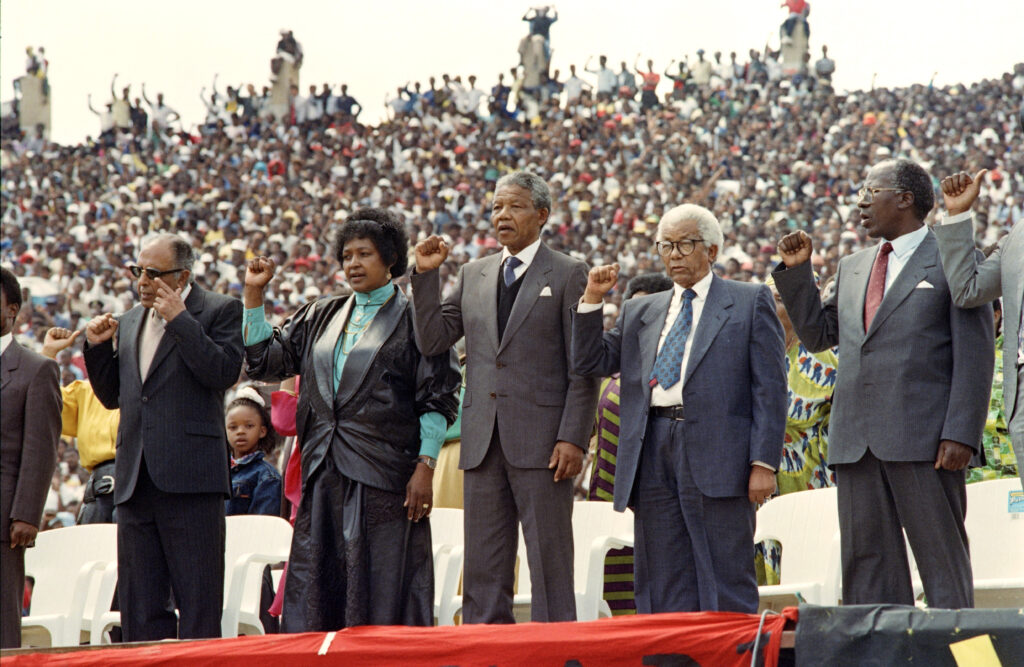 The ANC of the 1980s and early 1990s had an incentive to keep donations secret and allow leaders wide discretionary powers of spending or decision-making under conditions of official illegality. (Photo: Walter Dladla/AFP)
After 1994, Chinese government also became a generous funder to the ANC, replacing Taiwan in its largesse. Some critics at the time said that Chinese funding to the ANC partially contributed to the decision by the party to jettison its policy of dual recognition of both mainland China and Taiwan, to one of only recognising China.
Nevertheless, the receiving of money, without transparency, not accounting to the sources and how it is used, fostered an organisational culture within the party that was replicated in government when the ANC took power. It also fostered a culture of policies being up for sale to donors — which has been the case in many instances in the ANC government.
Reward the corrupt and silent toeing the line
African liberation movements often also allow certain untouchable leaders to create fiefdoms in the organisational departments they run. ANC chief representatives of countries, heads of agencies and units were often accused of running these structures as personal fiefdoms, appointing and promoting handpicked allies not based on competency, and punishing those not toeing the line, through withholding of resources or promotions.
A typical example is former president Jacob Zuma, who was head of the ANC’s intelligence department in 1987. He was accused by rivals of using resources and intelligence information to shore up cadres loyal to him, punishing those perceived to be critical of him by withholding resources and of building networks loyal to him personally, rather than the national leadership.
Zuma’s exile style of management was replicated in the post-apartheid era when he became MEC for finance in KwaZulu-Natal, deputy president of the ANC and South Africa and eventually the president of South Africa.
Difficulty of changing organisational culture
The challenge for current ANC president Cyril Ramaphosa is how to break the culture of corruption that has been an intrinsic part of the organisational culture of the party since its opposition days, when it tolerated corruption by members and leaders to safeguard unity, condoned using corrupt means to attain political ends and allowed those who manage public finances to do so without accountability.
Trying to overhaul the culture of any organisation, let alone the ANC, where corruption has become so entrenched for years, will be met with fierce resistance — as was the case when former president Thabo Mbeki tried to do so, and which Ramaphosa has so far also struggled with. When organisational cultures are deeply entrenched, leaders who want to change it are often deposed by members of the organisation.
One of the fundamental reasons why Mbeki was pushed out in favour of Zuma for leader was his attempts to modernise the ANC. Serious reforms by Ramaphosa to change the ANC organisational culture will likely cause a similar rebellion against him at the party’s December 2022 national elective conference, as happened to Mbeki at the ANC’s 2007 Polokwane conference.
Nevertheless, Ramaphosa will need to introduce shock therapy: be bold and lead, sack all corrupt leaders, and bring in large numbers of new ANC leaders who have not been part of the current ANC corrupt structures. If the ANC does not change its corrupt organisational culture, the party will lose the 2024 national elections.
William Gumede is an associate professor at the School of Governance of the University of the Witwatersrand and author of Restless Nation: Making Sense of Troubled Times (Tafelberg)
[/membership]