Economic Freedom Fighters leader Julius Malema.
This time 10 years ago, it looked like it was game over for Julius Malema.
The suspension of the then-president of the ANC Youth League by the party’s national disciplinary committee for five years was about to be converted to an expulsion after his appeal failed.
Malema, ANCYL spokesperson Floyd Shivambu and several others had been charged with various offences, including storming the party’s national general council meeting in Durban and threatening to bring about regime change in neighbouring Botswana.
A court battle with the South African Revenue Service (Sars) then ensued over Malema’s failure to submit tax returns from 2006 to 2010, leaving him with a tax bill of R16-million plus penalties.
He was arrested for tax evasion not long after his expulsion from the ANC, with the matter dragging through the courts until 2017, when Sars finally withdrew the charges and accepted an earlier agreement with him to settle.
A decade after the expulsion, Malema, 40, is — in his own pretty accurate words — “in a much much better position”.
He is not only still standing, but heads South Africa’s third-largest political party, the Economic Freedom Fighters (EFF), which has grown constantly since its launch in 2013, claiming more than 10.5 % of the vote nationally in the latest local government elections and with a firm footprint in all nine provinces.
Malema’s — and the EFF’s — influence goes far beyond the 3.2-million votes it garnered last November, or those it got in the 2014, 2016 and 2019 local, provincial and national elections.
The EFF has become a kingmaker and -breaker, in the Gauteng metros of Tshwane, Ekurhuleni and Johannesburg since 2016. Since November it has taken on similar roles in the KwaZulu-Natal municipalities it co-governs with the Inkatha Freedom Party.
It has also turned parliament on its head since its first 25 MPs were sworn in after the 2014, most famously with the Pay Back The Money campaign, which eventually saw then-president Jacob Zuma ordered to refund public works more than R248-million spent on “non-security” upgrades to his Nkandla home.
In an exclusive interview with the Mail & Guardian this week to reflect on the decade, Malema arrived at his office in the party’s Winnie Madikizela-Mandela House on Monday well ahead of the arranged time. He had been at the high court a few blocks away defending the action by AfriForum against the EFF over the singing of the struggle song Dubula ibhunu.
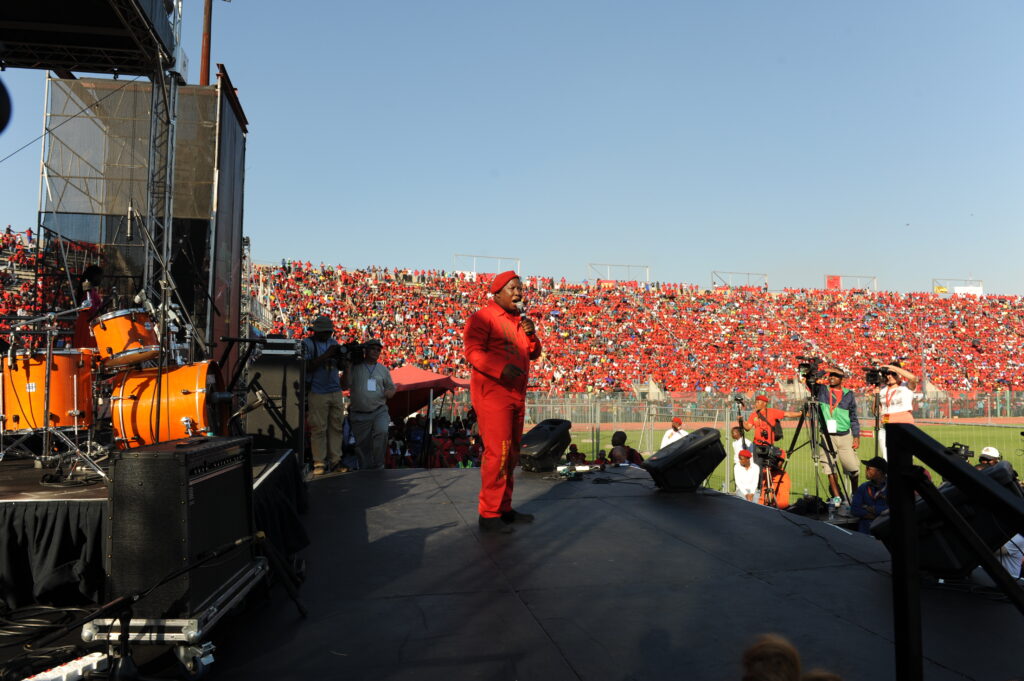 Agitators: The EFF is building a mass-based party with structures in every corner of the country, says its leader. (Madelene Cronjé)
There was no entourage, no fuss as Malema got miked up for the interview and settled at the boardroom table in the corner office of the fifth floor that houses the EFF leaders and support staff. He was focused, charming and frank through the hour-and-a-half discussion, happy to provide minute, intimate detail about key events leading up to the 10-year milestone, which he said he had “forgotten about”.
There is no sense that Malema has lost any of the fire that got him expelled from the party he grew up in, but there’s a maturity, a self-discipline and a pragmatism about him that points to personal and political growth that has come with the passage of time.
Take, for example, Malema’s reflection on the Jonah Fisher incident in 2010 when he ordered the BBC journalist out of the ANCYL offices for saying he was talking “rubbish”.
“I apologised for that incident,” Malema said. “A person at my level should have actually appreciated that from time to time you will come across such journalists, especially the international journalists, and their style of engagement is completely different from ours.
“When that happened, and when it is done by a white, young boy, all of those memories come back of how whites have treated us. You are thinking, he is trying to belittle you and look down on you. The first reaction is being aggressive, that no, you’re not going to do what your parents did to our parents, not with me,” he recalled.
“But when you look at it again, you realise now that it is something that shouldn’t have happened.”
Malema believes his expulsion from the ANC was less about his comments on Botswana and more about removing the proponents of radical economic change from the ANC — and preventing them from backing Kgalema Motlanthe against Zuma at the party’s Mangaung national conference in December 2012.
“We had to come to a realisation that our expulsion from the ANC at that time was not necessarily an expulsion of individuals. It was a suppression of the struggle for economic emancipation,” he said. “We had to take a decision whether we accept the suppression of the struggle for economic emancipation, or we find an alternative to agitate from, so that this struggle doesn’t disappear.”
Malema spoke of how he conceptualised the EFF along with Shivambu and now-ANC national executive committee (NEC) member David Masondo. The idea was born out of conversations with Masondo because they shared the ideology of the economic emancipation of black South Africans.
In the anticipation of their imminent expulsion, the three men initially discussed at his house whether they would form a political party, an NGO or focus on their individual projects and personal development.
“We had a very lengthy discussion. I remember that day. And we didn’t resolve, we therefore left it and then I went to Polokwane, but myself and Floyd then continued the discussion, telephonically and we could see Masondo’s reluctance on the political party.”
Although Masondo was sympathetic, Malema said he still had a strong view that the ideology could still be agitated from within the ANC and therefore there was no need to form an alternative.
“We concluded Masondo was dragging his feet. Then we proceeded and formed the EFF, primarily to fight this agenda of wanting to suppress the real struggle for the economy. At the centre of it was the land question, which is what the establishment is totally opposed to when they expelled us. We accepted our fate.”
Malema remembers vividly the day the ANC cast him out in the wilderness. Like many ANC leaders who have been at the centre of controversy, he turned to the clergy for guidance.
“There was a chaplain of the ANC. We called him to come and pray for us. We prayed in the office and then he told us, whatever happens, you must accept it. They then expelled us.”
Shortly after receiving the news, Malema, as he had done before, also turned to his mentor, Winnie Madikizela-Mandela for comfort and counselling.
Malema believes the party grew both because people bought into the idea of the EFF and because of support for the individuals involved.
“Both the individuals play some role in the revolution … to deny that individuals have got some role they play in agitating and making sure that the revolution catches fire, it will be unscientific,” he said.
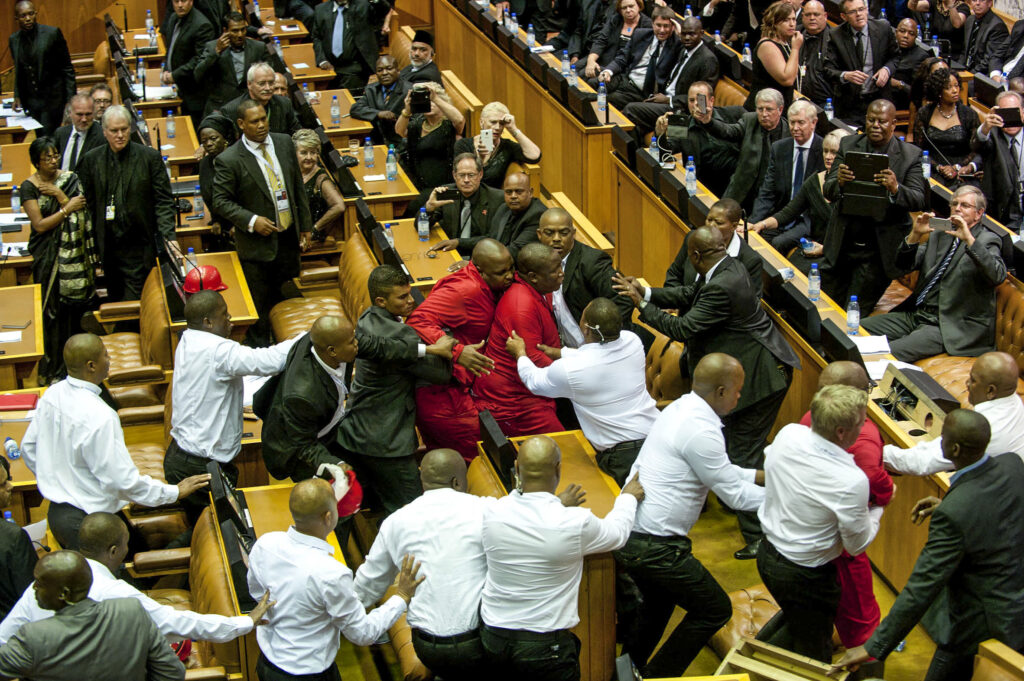 The EFF has made its name as a party that courts disruption and controversy with, among others, its refusal to respect collegial parliamentary traditions. (David Harrison/M&G)
The party attracted those who believed he and his comrades had received a raw deal along with “those who say, this is the real struggle that was abandoned in 1994 … so there will be those who came for Julius, there will be those who came for the idea”.
“What I like about this development we are experiencing today is that the brand of the EFF is now growing and becoming much bigger than the individual. That’s what we seek to do as leadership of the EFF so that when we leave, we leave an organisation that is intact, and those who inherit inherit a functional organisation.”
The EFF’s target for the coming national and general elections remains the same as its objective last November — to break the ANC’s majority and bring it under 50% of the vote nationally and in all nine provinces.
“The problem is that we have not formed a formidable alternative as yet and therefore South Africans, much as they don’t want the ANC, they don’t know where to go,” Malema said. “As a result, they give us this fragmented outcome of pockets of political parties all over the place.”
He said it would “take time” to build the EFF into a viable alternative to the ANC by establishing a track record for its public representatives and by building a mass-based party with structures on the ground in every corner of South Africa.
“Remember, in the beginning it was, like, ‘it is young boys’ and all that. We’ve outgrown that. Now they see us as very serious men and women, with families and with focus. It’s this development that we get to engage in that will make our people come to appreciate that there is an alternative.
“All the parties that failed to remove the ANC, it is because they did not do what the ANC does and operate in each and every ward, each and every village. You can’t sit in Johannesburg and say you are an alternative to the ANC, but you don’t exist in Musina. You have to be everywhere they are,” he said.
Malema is encouraged by the progress the party has made. “What gives us hope is that we’re growing, we’re not declining. And that’s encouraging.”
The EFF’s arrival in parliament after 2014 challenged the staid, collegial approach that had been adopted since 1994, with its representatives fighting constant battles over established parliamentary procedure.
“When we arrived, we did what we did. We revived committees. We gave it life. People were sleeping,” Malema recalled.
Its MPs took the fight to Zuma in the house with the Pay Back The Money campaign, forcing him to abandon the State of the Nation address (Sona) in 2016 and taking serious beatings from security officials in return. They also took to the streets in the marches demanding Zuma’s removal and building his Nkandla neighbour Sithandiwe Hlongwane a house.
Malema is, in retrospect, shocked by the lack of outrage in broader society over the violence inflicted on female EFF MPs in the house.
“It came as a shock that members of parliament can be beaten. EFF women were beaten by men. It was never an outrage that women are being beaten. [One MP] lost her child. No one ever spoke up on that,’’ he said.
Malema said he bears Zuma no ill will over his expulsion and that he had gone to see the former president at Nkandla last year to try to convince him to return to the Zondo commission probing state capture.
“I believe that the highest punishment you can give to a president is to remove them from office before they complete it. They get bitter to the grave. They never heal from that. You can see from Thabo Mbeki. He has never healed from that,” he said. “When we removed Zuma from office [in 2018] that was the end of it.”
“I was his political rival. He saw me as a threat and then he decisively dealt with me. It’s politics. I would have done the same. There are many others I dribbled on the way to become who I am. So it is the game, it’s the rules of the game. He went a little bit too far with it. But I understand it and have no problems at all.”
Malema said he felt obliged to try to convince Zuma to abide by the constitutional court order compelling him to testify at the Zondo commission, whose chairman Acting Chief Justice Raymond Zondo he accused of bias against him. He contacted the ANC Ekurhuleni regional chairperson Mzwandile Masina to facilitate the meeting and act as mediator. It was Zuma’s daughter Duduzile who played a calming role when tempers flared during the “robust” meeting.
“The meeting started, I made my case. I said to him, I don’t think it’s a wise decision not to go whether you like it or you don’t like it. Some of us are going to lead this country, we’re going to inherit it, but we can’t inherit the country where the constitution is not being respected,” Malema said.
“Then, at some point there was a rowdiness, like we’re all speaking, not listening to each other. That’s when the daughter came … and then said, ‘No, let’s maybe try this.’ And then we all calmed down.”
Malema’s efforts were in vain. Weeks after that meeting, Zuma was sentenced to 15 months in prison for contempt of court. The sentence was the catalyst for the unrest, looting and violence last July that resulted in more than 300 people being killed.
“Today we see a lot of people died and a lot of property destroyed, which could have been avoided,” he said.
“We have two elders, Zondo and Zuma, who brought their egos and forgot about South Africa. It is what it is. Today, the country is tense. We don’t know what’s going to happen tomorrow. Every time something burns there, you suspect it might be those Zuma things? These people have brought us to where we are. But I tried. And I failed. But I never failed to try.
“I was the last person Zuma will want to hear from. I could have also just not taken that initiative … I will do anything to make sure that there is peace and stability in our country,” he said.
Although Malema’s media briefings over the years seem to suggest that he still harbours some resentment towards the ANC — and Cyril Ramaphosa, who was part of the disciplinary committee that made a decision to expel him — he denied this.
“I think that I may be in a better space. I’m a principal now, so why do I want to be a teacher? I’ve got a promotion. So I’m fine. I’m at the same level as Cyril.
“Cyril is my counterpart. Now he has to appoint the chief justice, he has to write a letter to me. After expelling me, he must write a letter to me and consult me on who to appoint as a chief justice.”
“I hold no resentment for anyone in the ANC — no one. I relate with all of them. I relate with President Ramaphosa very well. The only person I don’t relate with is Derek [Hanekom]. And I think he’s a racist.”
‘I’m a principal now, so why do I want to be a teacher? I’ve got a promotion. I’m at the same level as Cyril. After expelling me, he must write a letter to me and consult me on who to appoint as chief justice’
EFF leader Julius Malema
In terms of the EFF’s constitution, Malema can serve two more terms as leader and he intends to stand again at the next national assembly, but he said he has no desire to cling to the party presidency forever.
“When I work, I work towards my retirement. I don’t want to stay until I’m very old, to a point where I become an irritation,” he said. “I’m looking at retirement in very little time. I started [in politics] when I was nine years, so I’ve never enjoyed anything in my life. If I were to stay until then I would have lived a single life.”
“I’m a farmer … So that’s where I’m going. I would be retired if it was not [for the] disruption of Pravin [Gordhan, in his time as Sars commissioner]. I am not intending to stay for the rest of my life. My son always tells me that I must quit because they want to enjoy their lives,” he said.
“There will be succession in the EFF, but if the question is in the next conference, if they asked me to stand, I will say yes, I wouldn’t say no.”
Until then, the work continues for Malema.
“Every liberation movement in power for years will self-destruct and when the ANC self-destructs, it must find a solid alternative. Our people might say, the EFF is an obvious choice. Yeah, so that’s what I’m working on.”
Malema believes that as much as the EFF has grown as a political movement, he has undergone significant growth as a human being.
“I’ve grown a lot. I’m a husband now, which I was not when I got expelled. I’ve got three kids now. One of them is a teenager. I’ve accumulated some qualifications from school, which I didn’t have when those thugs expelled me,” he said.
“We are no longer part of a rowdy social life. You are now more interested in making sure that your family grows and becomes better and your children get a better education. We are in a much, much better position now. In the past, we were reacting. We didn’t give ourselves time to think things through.”
Malema believes the EFF will continue to make its mark on South African politics into the next decade.
“When the real history is selected, there is no way they will leave out the role that we have played in South African politics,” he said.
[/membership]