Skilled but no jobs: South Africa’s history of dispossession and exclusion demands purposeful intervention to build a more just and inclusive economy. Photo: Delwyn Verasamy/M&G
On Tuesday, South Africa’s unemployment mark may hit yet another record high when Statistics SA (Stats SA) releases the fourth-quarter labour-force survey. The next day, the country’s 10th finance minister since 1994, Enoch Godongwana, will have to do the bidding of President Cyril Ramaphosa, who recently expressed a long-held ANC view on just how to resolve the jobs crisis.
“We all know that government does not create jobs,” he said in his most recent State of the Nation address (Sona). “Business creates jobs.”
It’s the economic dogma best championed by former US President Ronald Reagan and his partner across the Atlantic in UK Prime Minister Margaret Thatcher that the Mail & Guardian and its Data Desk has sought to unpack. For a state with deep capacity challenges, having business drive employment is easier said than done, experts warn.
Since the mid-1980s, South Africa has been staring down the barrel of a jobs crisis. Its industrial sector has shrunk, initially under the weight of international sanctions, and, as the country returned to the global fold, a flood of cheap imports from the world’s factory — Asia.
The state simply hasn’t been able to create nearly enough jobs to meet an ever-growing demand from an increasingly urbanised population, despite its many well-regarded policy solutions over the past three decades.
After receiving some flack for his comment, Ramaphosa endeavoured to clarify his position this week in response to Sona, saying job creation requires both a developmental state and a vibrant private sector.
In response to the speech, trade union federation Cosatu — a member of the tripartite alliance and a key ally in Ramaphosa’s ascension to ANC president five years ago — said “It is obvious that this administration refuses to acknowledge that the prolonged economic crisis reflects the fact that the prescriptions of big capital have been tried and have dismally failed to provide solutions to our economic and social problems.”
There is, Cosatu said, “a loud cry for alternative policy solutions, but sadly our government continues to subordinate our economy to these failed policies”.
Various commentators have pointed out that Trevor Manuel made a very similar statement to Ramaphosa back in 2000.
“I want someone to tell me how the government is going to create jobs. It’s a terrible admission, but governments around the world are impotent when it comes to creating jobs,” Manuel said. “Government, labour and business can pontificate and collectively lament the absence of jobs, but they aren’t capable of creating jobs.”
Considering South Africa’s current unemployment predicament, one thing is clear: neither the government nor business have done particularly well at creating enough jobs for South Africa’s largely unskilled workforce.
Hannah Dawson, a senior researcher at the Southern Centre for Inequality Studies at the University of the Witwatersrand, said it was interesting that Ramaphosa’s comment has struck such a nerve “because I’m not sure it’s a completely new statement when it comes to ANC policy”.
Dawson’s position, like those of other experts the Mail & Guardian interviewed, is that the private sector cannot become the sole creator of jobs.
“Of course, the private sector has a hugely important role to play in getting our economy growing again, because it has been on a downward decline for a long time. And getting that to shift is crucial for the country,” she said.
“But that doesn’t mean the state doesn’t have an important role. And, if anything, we can’t deny that the last 20 to 25 years we’ve absolutely failed to create employment in the private sector at anywhere near the scale we need.”
Considering the sheer scale of joblessness in South Africa, Dawson added: “Even if the private sector put a lot of its reserve capital — which it has been sitting on — into full operation, yes there is the potential to create a lot more work … but I don’t think we’ll come close to dealing with the unemployment problem we have.”
As Godongwana prepares to deliver his budget speech next week, economists are expecting the minister to stick to the script of fiscal restraint, articulated by his predecessor and in his own medium-term budget policy speech in November.
Carmen Nel, the chief economist at Matrix Fund Managers, said Godongwana may have to address Ramaphosa’s vision for job creation, particularly if it has an effect on public spending. “Is it the government that is creating the jobs? Because then it is going to be very difficult for him to have a wage bill freeze, which is what is currently pencilled into the numbers,” Nel said.
It is more likely, however, that Godongwana will signal the government’s strategy to entice the private sector to create jobs through large-scale investments in infrastructure.
If it wants to keep spending in check, Nel said, the government cannot create jobs. “On the expenditure side, you cannot afford to create jobs yourself. But on the revenue side, you need to encourage the private sector to create jobs.”
Cutting the public-sector wage bill, which it has identified as a burden to the country’s fiscus, has been high on the treasury’s list of priorities for a number of years.
The high wage bill has given credence to a view that South Africa’s public sector is bloated and that the government ought to freeze or cut employment. The treasury’s budget review last February noted that reducing the cost of public-sector wages would be achieved through a combination of early retirement and natural attrition, as well as freezing or abolishing non-critical posts.
But critics of the treasury’s plan have pointed out that the public-sector workforce is not as bloated as it is perceived to be.
A bloated public sector?
“In fact,” Bandile Ngidi of the Institute for Economic Justice (IEJ) said, “there are a great deal of shortages, especially of frontline workers such as doctors, teachers and nurses.”
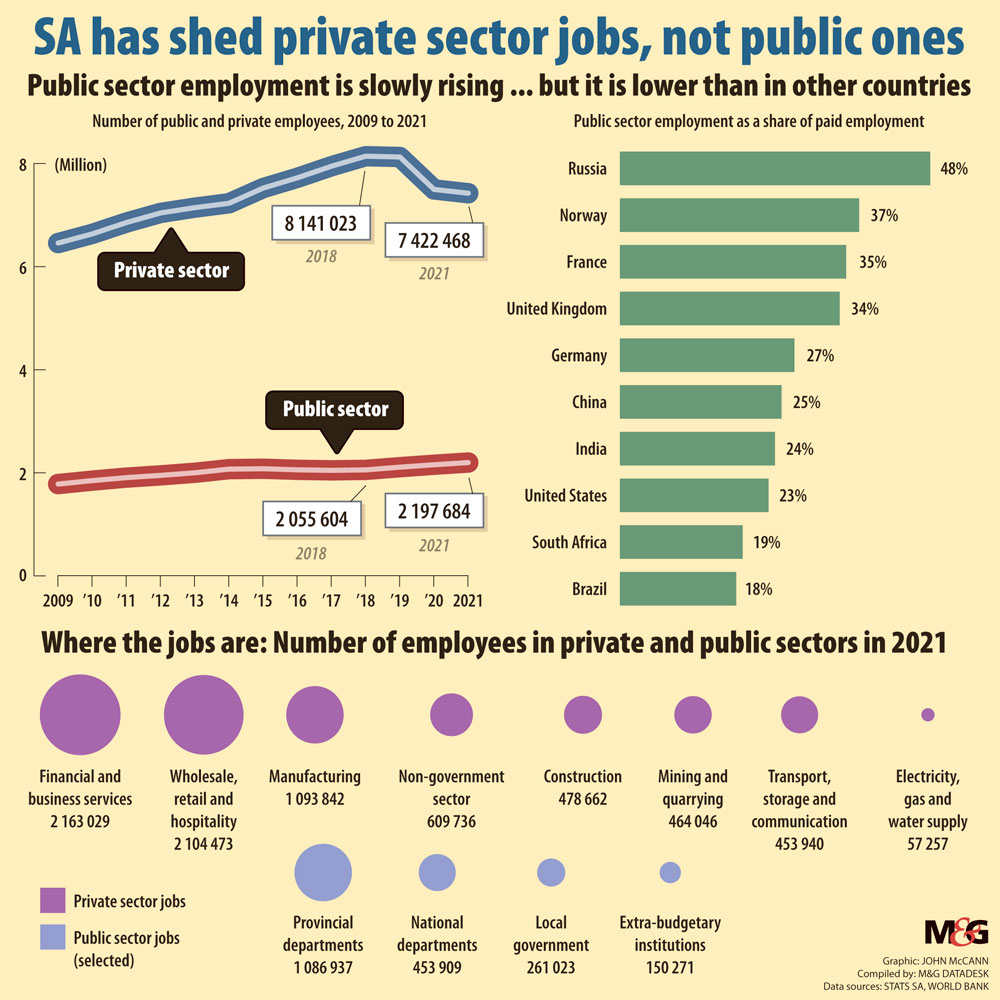
South Africa’s public sector is small by international standards. World Bank data shows that South Africa’s public-sector employment as a share of total paid employment (19%) is low compared to many other countries.
Public sector employment in the UK, France, Norway, Denmark and Russia accounts for more than 34% of total paid employment. In Russia, public sector jobs account for 48% of paid employment. India and China’s public sector employment accounts for 24% and 25% of total paid jobs, respectively.
Jobs in South Africa’s public sector, Ngidi noted, contracted in the 1990s and were stagnant until 2005. Public-sector employment has since increased. “But in more recent years, the government progressively tried to put a tight ceiling on public-sector jobs, because of how expensive the public-sector wage bill has become.”
Sifiso Skenjana, chief economist at IQbusiness, noted that two budgets ago money was taken away from the health, police and other portfolios to bail out SAA. “Those are critical government departments that are under-resourced and undercapacitated,” he said.
“Those are critical portfolios, developmental portfolios, pro-poor portfolios that necessitate that government be an employer.”
The M&G’s data desk analysed Stats SA’s quarterly employment figures going back to 2009.
 (John McCann/M&G)
The data shows that employment in the public sector increased 23% between 2009 and the end of 2021. However, the size of the public-sector workforce remained relatively flat for the majority of that period.
Skenjana noted that the public-sector wage bill began to increase from about 2008, when the government was endeavouring to absorb some of the losses it suffered as a result of the global financial crisis and to capacitate arms of the state to drive development.
“And when we see where a lot of that employment went, a lot of it went to police, nurses and teachers. So when we talk about a bloated wage bill and how government went on a hiring drive, I think that view isn’t contextual. It doesn’t take into account where that hiring is actually taking place.”
But, even as the number of public servants has increased over the years, this has not kept pace with the growth in the economy, the population or service-delivery requirements, the IEJ has pointed out. And South Africa should have a well-capacitated public sector.
In a 2018 policy brief, the IEJ made eight recommendations on where the government needs to add capacity to the public service and employ more civil servants. The institute suggested setting targets to meet critical shortages in key delivery areas, at different levels of government and within selected state-owned entities.
The report heavily focuses on employment to ensure capacitation of the state and service delivery.
“Abandon ‘blunt tool’ fiscal instruments which seek to freeze posts across the board, place caps on personnel et cetera, regardless of the objective needs. Fiscal policy must be adjusted to accommodate delivery imperatives. A deliberate programme of expanding tax revenue must be urgently instituted,” the report says.
The state, Ngidi said, has a constitutional imperative to deliver services. “Because South Africa is a developing country, our development is uneven. And the public sector pulls marginalised people up. Our capitalist sector is one of the most developed on the continent, so if you don’t have a well-capacitated public sector, the capitalist sector kind of pushes on ahead on its own steam,” Ngidi said.
“Public-sector health and education are important to reducing inequality. They ensure that economic development is spread out equally.”
The responsibility to create jobs should not rest with the private sector alone, Ngidi said. “A major reason is that South Africa’s labour market faces a skills mismatch. The jobs that are being created in our strongest sectors require high skills. But our education sector is not producing those skills,” he said.
Public-sector jobs are important because they employ low-skilled workers in, for example, the expanded public works programme. “The government also has a different logic to the private sector. It is not creating jobs for profit, but for development. That is a powerful role,” Ngidi said.
The data analysed by the M&G shows that employment in the finance and business services sector grew significantly from 2014 to about 2018. During this same period, however, government employment stagnated. Labour intensive industries, like mining and manufacturing — which would otherwise absorb members of the low-skilled workforce — also plateaued during this period.
Jobs across all sectors, except for the government, were sent off the deep end when the pandemic hit and, despite South Africa’s economic recovery since, the country’s unemployment crisis has deepened.In the third quarter of 2021, South Africa had an unemployment rate of 34.9%, the highest on record.
Political economist Patrick Bond said a stance that takes the responsibility for job creation out of the government’s hands is an ideological one. “It is in contrast to every [country’s] experience with dealing with mass unemployment and recession.”
Bond referenced English economist John Maynard Keynes, who, in response to the great depression in the 1930s, said the government “should pay people to dig holes in the ground and then fill them up”. Bond said: “When you have so much unemployment, you need to stimulate the economy. Do anything. Be as wild and as crazy as the conditions require.”
It is risky to hand over the responsibility of job creation to the private sector, Bond added, because it is often a job destroyer. “What most of capital is trying to do to keep competitive in the era of overproduction is to automate … So I think this is the greatest negation of Ramaphosa’s statement.”
Citing Manuel’s comment in 2000 about government’s impotence in the job-creation effort, Bond noted Ramaphosa’s announcement that the government had managed to create more than half a million jobs for young people who were appointed as teaching assistants — a programme that proves the public sector’s ability to create jobs.
As well as being an employer, Skenjana said, government must also make it easier to do business in South Africa.
The private sector, he said, “likes to take all the glory when we do have employment gains. But they don’t take into account the investment that was made to enable the environment that was fertile for those businesses to thrive.”
The government, Skenjana said, is the best investor. “It is critical for government not to take its foot off the pedal, but also for the private sector to acknowledge just how important that is to keep them operating.”
Skenjana noted that South Africa’s score in the World Bank’s now discontinued Doing Business rankings has been in decline over the past decade. “Each year we have kept sliding down that ranking, which just shows that the environment is not fertile for enterprises to operate sustainably.”
Even as an enabler, Skenjana said, the government has dropped the ball. “This makes it easy for them to throw the responsibility of employment to everyone else but themselves.”
[/membership]