Rebuild efforts have been mired in concerns about looting, but — if funding is spent properly — it could provide a much-needed stimulus to a province that was hit by two crises in less than a year. Photo: Delwyn Verasamy
Never let a crisis go to waste. The old adage, which Winston Churchill is credited with first proclaiming during the worst of World War II, may apply to current efforts to rehabilitate KwaZulu-Natal — which has been hit by two major crises in under a year.
Government, businesses and civil society are currently labouring to “rebuild” KwaZulu-Natal, which earlier in April was hit by devastating downpours and subsequent flooding that claimed the lives of more than 400 people. The disaster came less than nine months after civil unrest tore through parts of the province. Together these events have cost the province billions.
The costly reconstruction could now provide much-needed stimulus to the province, which generates approximately 16% of the money in South Africa’s economy.
Various departments and businesses are still counting the cost of the latest disaster in KwaZulu-Natal. Earlier this week, KwaZulu-Natal premier Sihle Zikalala said the damage to infrastructure was “unparalleled”.
An opportunity for renewal
The destruction to the province’s infrastructure alone could have a hefty price tag of around R17-billion, according to the KwaZulu-Natal government. On Tuesday, the Passenger Rail Agency of South Africa revealed that damage to rail infrastructure will add up to almost R3-billion.
Reporting on the damage to KwaZulu-Natal’s pipelines earlier this week, which will cost over R1-billion to repair, Minister of Water and Sanitation Senzo Mchunu underlined his department’s intentions to use the crisis to fix the province’s ageing infrastructure.
“Our approach therefore is to take advantage of this situation to not only repair damaged infrastructure but also to renew these ailing infrastructures,” Mchunu said.
“We are making immediate interventions by repairing damaged infrastructure, but at the same time we are embarking on a renewal programme of water and sanitation infrastructure in KwaZulu-Natal province.”
Speaking to the Mail & Guardian this week, chief executive of Trade and Investment KwaZulu-Natal Neville Matjie echoed this sentiment, saying the province needs to “build back better”.
There is a long way to go before the province “shakes off the scars” inflicted by the disaster, Matjie said. “The idea is not to just patch things up. The idea should be to build back better. So it creates that opportunity.”
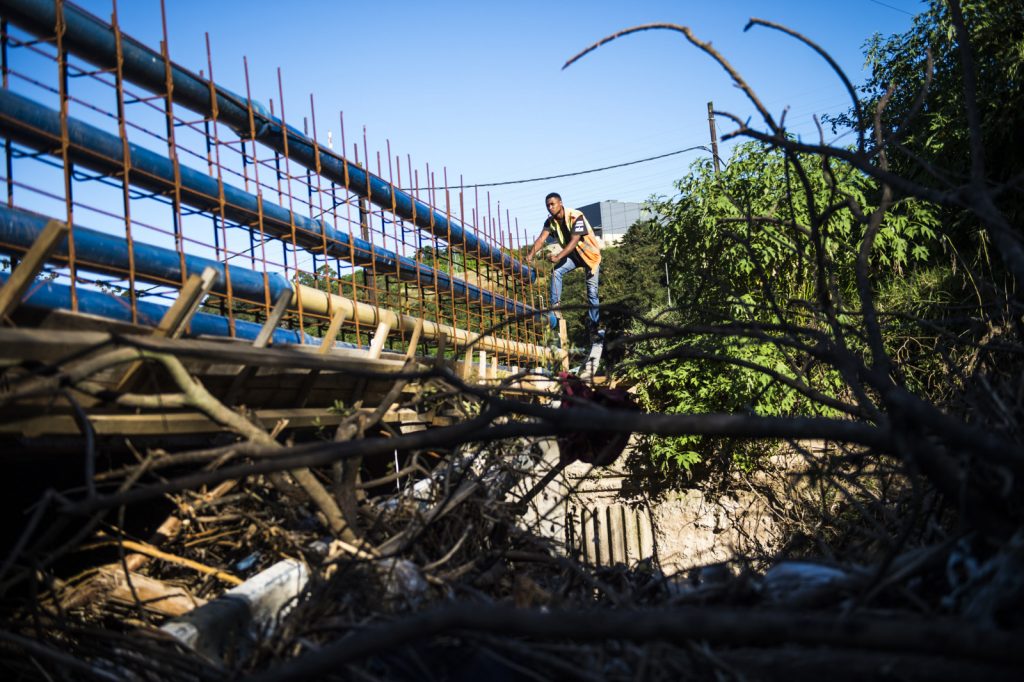 Water Minister Senzo Mchunu plans to use the crisis as an opportunity to fix water pipeline infrastructure (left) at a cost of R1-billion. Photos: Delwyn Verasamy
Prior to the July unrest, Matjie said, KwaZulu-Natal was on an upward trajectory, though — like the rest of the country — it was still reeling from Covid-19’s economic onslaught. KwaZulu-Natal lost the second-highest number of jobs, after Gauteng, in the first months of the pandemic, according to data from Statistics South Africa.
By the end of 2021, the province still had 248 000 fewer jobs than it did prior to the pandemic. Over 120 000 jobs were lost during the period of the unrest, which were considered the most expensive riots in our history by the state insurer, the South African Special Risk Insurance Association.
The July looting and vandalism wiped R50-billion off the South African economy. Recent data from the state insurer, which received unrest-related claims totalling over R30-billion, paints a picture of just how hard a blow KwaZulu-Natal was dealt. More than 13 000 claims, to the tune of R26.7-billion, originated from the province. Durban bore the brunt of the assault, with the city racking up R22.3-billion in claims.
‘Put people into work’
The expert panel that investigated the conditions surrounding the July unrest found that the country’s deepening unemployment crisis added fuel to the riots.
Dick Forslund, the senior economist at the Alternative Information and Development Centre, said the current crisis in KwaZulu-Natal ought to be used to create jobs.
“In this type of situation, when you have a disaster, you almost have a war-like situation. It is kind of like a mini-Ukraine in some townships: houses are destroyed, people are dead, they have lost everything …. The public sector and the state are extremely important in taking charge of those situations,” Forslund said.
“And if you have unemployment, which by the expanded definition is reaching 48% … in order to sort of increase morale — I mean I can imagine now that more people are going hungry and becoming more desperate — you have to put people into work.”
The KwaZulu-Natal disaster, Forslund added, should be used to strengthen calls for a large public employment programme, noting that in many areas road and rail infrastructure has been completely washed away. “This is typically labour-intensive work. So you should take the opportunity of this crisis by creating a massive public employment programme.”
If the government fails to create jobs in KwaZulu-Natal, it risks enduring another bout of unrest, which could end up costing the province even more.
The question becomes whether the government can pull off a clean effort to revive the KwaZulu-Natal economy — or will the large amount of money needed for the rebuild again be misspent or siphoned off through corruption?
President Cyril Ramaphosa has been at pains to assure the money will not be mishandled like it was during the Covid crisis, going so far as to form an oversight structure to ensure the funds are properly accounted for.
This week, the president told MPs that the treasury is also strengthening reporting requirements with respect to expenditure on disaster relief.
“To improve monitoring and ensure greater transparency, the details of all disaster-related procurement by public institutions will be published on the treasury website to allow public scrutiny of these procurement transactions.”
Forslund cautioned against putting all the work needed to fix infrastructure out on tender. “It is a political choice. But it is also a choice, to put it crudely, between encouraging inflated invoicing and corruption or trying to keep it within the public sector as much as possible.”
Where will the money for the KZN rebuild come from?
Efforts to recover from the recent flooding in KwaZulu-Natal, which tore through infrastructure and left thousands homeless, will run into the billions.
When President Cyril Ramaphosa declared a state of disaster, to ensure the necessary reconstruction could be undertaken by the government, he noted that the minister of finance said R1-billion was available immediately. But it is a foregone conclusion that the rebuild will cost far more, with the KwaZulu-Natal government estimating that the damage to infrastructure alone will cost around R17-billion.
According to the treasury, the R1-billion that is already available will be drawn from provincial and municipal sources, disaster relief grants and through the repurposing of existing infrastructure grants.
Funds may also be taken out of the contingency reserve, which contains money set aside to guard against possible future losses, the treasury said. A sum of R10-billion was allocated to the contingency reserve in February’s budget.
Provincial and municipal authorities are still assessing the cost of the damage. Once this is done, the national disaster management centre will verify the provincial and municipal reports before it makes an application to the treasury. The national disaster management centre falls under the department of cooperative governance.
The repurposing of conditional grants to provinces and municipalities to pay for the alleviation of the impact of a declared disaster is done in terms of the Division of Revenue Act.
However, the treasury noted, given that it typically takes longer to assess and plan for the repair of damaged infrastructure, the rebuild is typically funded through ring-fenced allocations in the next budget. Such submissions are received from the national department of cooperative governance and traditional affairs.
In the likely scenario that the cost of the rebuild surpasses the R1-billion that is immediately available, budgets already allocated for this financial year may be reprioritised, the treasury said.
[/membership]