(Photo by Vuk Valcic/SOPA Images/LightRocket via Getty Images)
South Africa is among many countries which failed to ensure that those most responsible for extreme weather and related damage open talks to pave the way for financial claims at a critical United Nations climate change conference.
The Conference of the Parties (COP27) later this year is an Africa COP and the host country, Egypt, should have the privilege of setting the agenda to forward Africa’s interests when countries descend on Sharm el-Sheikh.
Preliminary talks in Bonn last week came at a time when, despite the tangible effects of extreme weather, it is still harder than ever for people to care about the bureaucracy and technicalities of climate change diplomacy.
“The outcome is that we have no agenda items for the COP on loss and damage, which is extremely disappointing for us,” said Maesela Kekana, South Africa’s chief climate negotiator at the United Nations Framework Convention on Climate Change.
Fuel prices are historically high and have prompted extraordinary government intervention to cushion people’s pockets from the ripple effects of a war between what is essentially the world’s breadbasket and the world’s energy.
The rising costs of wheat, oil, gas and other fuel, caused largely by Russia’s invasion of Ukraine, is expected to tease the prospects of global recession.
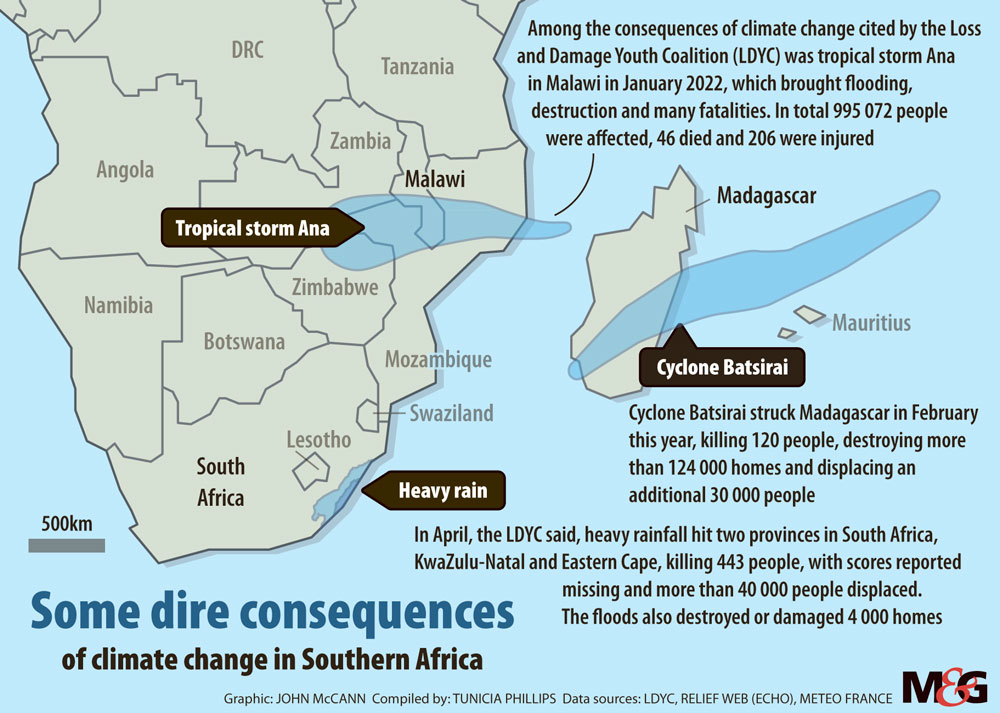
What this means for financing the world’s ability to withstand the consequences of climate change — such as the floods in KwaZulu-Natal in April or implementing measures to cut greenhouse gas emissions driving the crisis — is that we are at the mercy of an uncertain and changing situation, exacerbated by the lingering effects of the pandemic.
The world is in survival mode. The World Bank says the war in Europe has “compounded the damage from the Covid-19 pandemic and magnified the slowdown in the global economy, which is entering what could become a protracted period of feeble growth and elevated inflation”.
The bank’s Global Economic Prospects said this “stagflation” has potentially harmful consequences for middle- and low-income economies. South Africa is no exception, and consumers are struggling to make ends meet with steep increases in the prices of basic goods and services such as food and transport.
Why should people care about the outcome of the preliminary discussions or the November 2022 conference? The answer is not as complicated as climate diplomacy or science.
“Climate change is a global issue and requires a global solution. No single country can solve the climate crisis on its own. It is thus in the best interest of South Africa and her citizens to ensure that there is concerted global effort to deal with the climate crisis,” Kekana said, adding that South Africa was overall pleased with the outcome of last week’s talks on other key issues.
African delegations and other developing countries have often left COP conferences cautiously optimistic but mostly disappointed by the outcome. This is as a result of wealthy and developed nations failing to honour their financial commitments to protect high-risk populations. Wealthy nations also tend to overlook the climate debt owed to people who are already affected by climate change-linked disasters as a direct result of their fossil fueled industrialisation for nearly 200 years.
It amounts to billions of dollars in current, past and future damages. Civil society groups say the cost of loss and damages from climate change will range between $280-billion to $500-billion a year by 2030. This is acknowledged in article 8 of the 2015 Paris Accord between more than 100 countries but it remains one of the most contested issues at the UN climate conference.
“We all know how developing countries are facing the brunt of climate impacts in the form of extreme weather events, slow onset events like sea level rise, glacier melt, and there is no system in the current financial architecture to support people,” said Climate Action Network’s (CAN) Harjeet Singh during an update on last week’s discussions.
“Not a single penny has flown from this system to help people recover from climate impacts.There’s a huge gap in terms of responding to these impacts, helping people recover from these disasters, helping them rebuild their lives, supporting them in relief, rehabilitation, reconstruction, there’s nothing that’s happening from this system.”
At last year’s COP in Glasgow, Scotland, developed nations such as the United States and countries in the European Union were accused of blocking progress on a proposed Glasgow loss and damage facility meant to act as a mechanism for financial claims.
The facility was spearheaded by China and the G77 bloc, an influential negotiating group composed of 134 nations from the developing world, including South Africa.
Although denied, a proposal to begin dialogues was included in the final Glasgow agreement. This dialogue was held on 14 June. The G77 chair under Pakistan, ambassador Munir Akram, said they were not under the impression that a financial mechanism would be an outcome of COP27 but developed countries opposed to resolving the issue of climate damages were not prepared to make any real progress. A loss and damage finance facility would open the flood gates of financial claims against countries most responsible for the climate emergency.
“The G77 made a very strong statement after Glasgow saying that we were extremely disappointed at the Glasgow dialogue [decision] because that is not what we wanted. We wanted to go way beyond that. We just took it because it was a compromise and we thought it was kind of like a foot in the door, at least something to start discussions and to move forward. But this is way less than what we actually wanted,” Akram said.
A loss and damage facility, for example, would have supported recovery efforts in KwaZulu-Natal, where floods caused an estimated R25-billion in damages to public and private infrastructure and killed more than 400 people, with thousands more displaced.
Commenting on the outcomes of the talks, Jeni Miller, the executive director of the Global Climate and Health Alliance, said poor countries have not been the drivers of climate change, wealthy countries have.
“And yet many are facing a much higher toll on their people’s health and well being from climate change, with fewer resources to help them cope. If loss and damage is not dealt with, it will seriously harm trust between developed and vulnerable countries, limiting the progress we all desperately need on climate change, with detrimental consequences for the protection of people’s health worldwide.”
During the formal party dialogue for losses and damage, Saleemul Huq, the director of the International Centre for Climate Change and Development in Bangladesh, tweeted that it was “much like being first class on the sinking Titanic, debating whether we should act instead of talk. While the people in the lower decks are already under water.”
Other countries such as those in the Pacific Islands are ready to exhaust every option available to ensure climate justice for the world’s vulnerable. In an opinion article that coincided with the talks, Prime Minister of Vanuatu, Bob Loughhman Weibur, said his country is seeking an advisory opinion on climate justice and human rights from the International Court of Justice.
“Vanuatu is not responsible for these impacts, contributing to less than 0.0018 percent of global emissions. But our islanders face some of the most devastating consequences. The massive gaps in climate action and support are shouldered by our farmers and fishers, our island women, men and young people, our most vulnerable,” Weibur said in the News Week article.
The international Climate Action Network named countries blocking the important issue from making the agenda.
“The USA, EU and other rich countries blocking this from being on the official agenda must realise that public opinion, both within their nations and outside, is rapidly building up against their immoral and unjust posturing and their outright betrayal of the most vulnerable communities,” the organisation said after the preliminary talks.
Talks on collective action against climate change come after the release of the largest eight-year scientific assessment of climate risks and current impacts in every region of the world. It warns that the window to act against higher levels of global warming is closing — with disastrous consequences for the world’s most vulnerable.
[/membership]