recent shootings were at taverns in Pietermaritzburg, Katlehong and Mamelodi. (Emmanuel Croset/AFP)
As the police grapple with internal struggles, organised, violent criminals run rampant, placing the lives of innocent civilians at risk, a reality that spun into focus after the recent spate of tavern killings that left 22 people dead.
Analysts have warned that the unfair dismissal of honest police officers who dare to report corruption, the unjustified promotion of inexperienced, poorly skilled officers to senior ranks, including those of general and brigadier, graft and poor management are among factors hampering the ability of the South African Police Service to solve serious crimes such as murder.
They say the police will not crack the country’s fast rising murder rate that will not abate short of major reforms and an overhaul in the way officers are hired, fired and managed on the ground.
Over the weekend, gunmen armed with AK47s and a pistol stormed Mdlalose’s Tavern in Orlando East, Soweto, killing 15 people and injuring nine. Another mass murder took place on Saturday evening when two gunmen killed four people and injured eight in a tavern in Sweetwaters near Pietermaritzburg. On Friday, two men were gunned down in Mputlane’s Inn in Katlehong and on Tuesday this week, three armed men killed a man in the Monaco tavern in Mamelodi.
The Institute for Security Studies’ (ISS) programme director for governance, crime and justice, Gareth Newham, described the tavern shootings as the worst incidents of “a random mass shooting of civilians”, bar Marikana, when 34 miners were killed in August 2012, that the country has endured since the end of apartheid.
“There has not been anything like it, and these tavern shootings are becoming more common. They are linked to local level criminality and extortion. Criminals go to hairdressers and small businesses and demand protection money, and if you don’t pay it you get robbed,” Newham said.
“Or, others come onto the scene and want to take over the extortion money from another group and they want to express their dominance. They use violence, and the most violent dominates. It’s massive in every township. I don’t think there are any nightclubs and taverns that do not have to pay protection money.”
Newham said crime was rampant because “police can’t get a grip on organised criminality”.
“Police solved 15% of murders last year, which means perpetrators continue to commit murder. So if you want to obtain dominance in an illicit market, be it drugs or extortion, the most violent get dominance and the police are not there. In most places where the police are functional, they spend resources on shutting you down but the police have lost the ability to do that.”
Newham noted that the murder rate in South Africa is 40 per 100 000 people, seven times the global average of six per 100 000, placing it in the ranking among the top 10 most violent countries. But, he added, South Africa’s murder statistics are more reliable than those of other countries in Africa, South America and Asia.
An average of 53.5 people are murdered every day in South Africa, according to police statistics, which also show that taverns are among the most likely places for murders to be committed.
“We have an unacceptably high murder rate in SA and it has been increasing,” Newham said.
He said the murder rate started rising in 2010-11 and was now about 30% higher than 10 years ago. There were 15 554 murders in 2010-11 and in 2021 there were 24 000.“The biggest shift in trends is the growth of organised criminality. And at the same time as murder is going up, we saw deterioration in the police.”
According to the treasury’s reports, the police budget rose by 65.5% from 2010-11 to 2019-2020 from R58.5‑billion to R96.8-billion, yet the number of personnel declined by 6% from 199 345 to 187 358, and its ability to solve murders dropped by 19%.
“Despite budget increases, their performance dropped in double digits. At its heart is a serial crisis in top management,” Newham said.
According to an ISS report, the key reason behind the decline in the number of employees in the police service was a Safety and Security Sector Bargaining Council agreement that non-commissioned officers receive promotions every four years regardless of performance.
In 2018 and 2019, more than 42 000 personnel were promoted, adding R1.2-billion to the annual salary bill, without improvements in performance,” the report read.
“We need to see a level of recognition that there is a crisis and a need for urgent reform of our police. We need to rejuvenate top management and remove those where there is any doubt as to their capability and integrity and we will see big changes. If we don’t, there is no doubt it will get worse,” Newham added.
“No one is dealing with the issue of extortion and organised crime. They only need to police about 10 000 people who are committing about 80% of the robberies and murders, and if they focused on it, they would be able to reduce it in a few years,” he said.
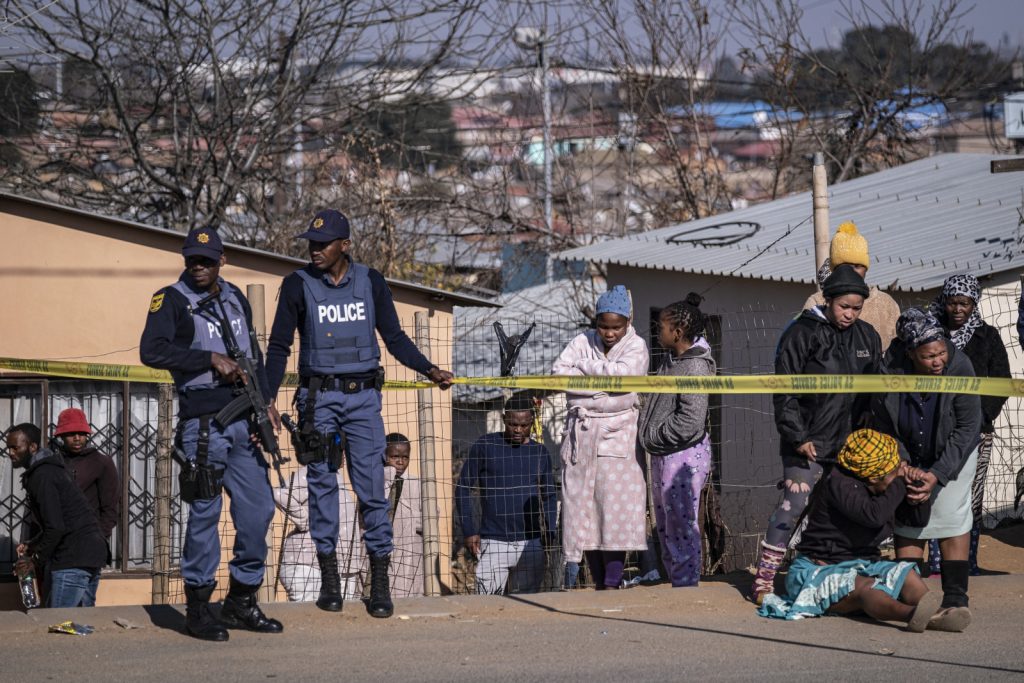 Out of control: Relatives of some of the 15 people shot dead in a Soweto tavern last weekend. (Emmanuel Croset/AFP)
Mary de Haas, an honorary research associate at the University of KwaZulu-Natal’s School of Law, said the police service was in “crisis” and “it starts with management”.
“The crux of the problem is [Police Minister Bheki] Cele is running policing. He is also doing other operational things and interfering with who is being appointed and dismissed. The police are acting completely above the law, dismissing competent policemen illegally.
“The crux of the problem with policing is it starts with the intelligence services, the good guys in intelligence services are outnumbered by the guys [former president Jacob] Zuma sent to China and Russia to get trained.”
She said police stations were supposed to have crime intelligence officers working through informers to report the presence of armed men in the precinct but that this was not the case.
She added that illegal security firms, often set up by councillors and municipal employees to vie for tenders, were “awash with guns” while “the taxi industry is the home of most of the hitmen and illegal guns and the police do nothing about it”.
Cele’s spokesperson, Lirandzu Themba, said, “Allegations of dismissals and appointments by Minister Cele should be backed with facts,” in response to the concerns raised about policing.
A Centre for the Study of Violence and Reconciliation report, titled What Drives Violence in South Africa and based on the work of Brett Bowman of the University of the Witwatersrand, highlighted the causes of violence.
“The most significant risk factors include social and economic inequality, frustrated masculinity, lack of social cohesion, and alcohol and firearms. Inequality is a super-driver of violence,” the report noted.
It said studies suggest that “the hopelessness, shame, guilt and stress associated with inequality, constraints on life opportunities and limited resources give rise to violence in the country”, particularly in the context of the 34.5% unemployment rate.
In addition, more than 50% percent of homicide victims test positive for alcohol, and studies of femicide show most victims and perpetrators had alcohol in their systems. The report also noted that firearms were the highest cause of death among youth between 2001 and 2009.
Adele Kirsten, the director of Gun Free South Africa, said the murder rate dropped between 2000 and 2010 when new gun laws were introduced and the proposed Firearms Control Amendment Bill on the table could make a difference.
“We can do it again and the best way to do that is to put in place stronger gun rules. To suggest that one way to deal with high levels of gun violence is for everyone to be armed is not only ridiculous, it’s dangerous. Imagine that situation if patrons in that tavern had guns? We would’ve seen many more deaths.
“Guns are not the solution. No one has produced any evidence that guns are effective for self-defence. The evidence is overwhelmingly in the other direction — that guns put you at risk. They are not effective at keeping you safe; they are risks for suicide, for men killing their female partners and for children getting hold of the gun accidentally,” she said.
But Paul Oxley, the chairperson of Gun Owners South Africa, said the police needed to control illegal firearms rather than target legal gun owners.
“Firearms are flooding over our border, particularly AK47s. We still have firearms from the struggle; the firearms from the Shell House massacre were never accounted for. We have a lot of military type weapons coming in from Lesotho, Mozambique and Zimbabwe border.”
Oxley said there had been cases where armed civilians had stopped armed attackers, citing the July 2021 riots when civilians protected malls and suburbs, and the St James massacre in July 1993 — 11 people were killed by four members of the Azanian People’s Liberation Army — when an armed civilian fired at the attackers, wounding one.
“All firearm control legislation does is disarm victims. We can’t rely on the police. We need good people to take a stand. Dedicated, trained firearm ownership is part of the solution to the problem … A well-armed and trained citizenry is the final defence of democracy,” Oxley said.
[/membership]