President Cyril Ramaphosa (right) and Gwede Mantashe. (Gianluigi Guercia/AFP)
NEWS ANALYSIS
In paragraph 81 of the ANC policy discussion papers, the authors caution that it should be expected that “there will be opposition from within our ranks to the cause of renewal”.
It is one of the greater understatements of the document, which was written before the Phala Phala scandal deprived President Cyril Ramaphosa and his allies of the moral high ground in the battle of contestation around his renewal drive.
Support for the inquiry into state capture is an integral part of the promise of political renewal and the papers disingenuously credit the commission, like Ramaphosa did on the witness stand last year, with alerting the governing party to just how pervasive corruption in its ranks is. It notes along the way that the report “implicated senior ANC leaders”.
Some of those who risk further consequence have vowed to challenge the findings, while others have called for a somewhat selective application of the report.
Mineral Resources and Energy Minister Gwede Mantashe straddles both camps. Zondo recommended, in volume three of the report, that Mantashe face investigation for possible breach of section 24 of the Prevention and Combating of Corrupt Activities Act.
This stems from his acceptance of security upgrades at three of his private homes, courtesy of Bosasa. It was, the report said, common cause that the installations happened, that Mantashe did not pay a cent and that providing such services to powerful people was part of the corrupt modus operandi of the company.
The scale of the generosity, Zondo said, made it impossible to accept Mantashe’s story that it was a familial gift from a friend who happened to work at the company when it was plain that Bosasa would consider him, as the secretary general of the party at the time, “a brilliant connection”.
The chief justice also suggested that Ramaphosa should reconsider the tenure of the deputy state security minister, Zizi Kodwa, because he became beholden to a former chief executive of tech services company EoH, which donated millions to the ANC in return for tenders.
Speaking earlier this month, Mantashe said he was opposed to the prosecution of party leaders implicated by the report and believed the findings should rather be used as a departure point to review ANC mistakes and rebuild the organisation.
“We can use that report to hunt each other down and destroy everything that is in the movement; we can do that. Or we can use that report to look into the mistakes and weaknesses that are in that report and try to correct them. That is a better option for me.”
The political crisis the ANC president faces ahead of the ANC conference in December, where his foes will throw everything at dislodging him, means he cannot jettison Mantashe, or Kodwa, who was the exception he could trust on intelligence.
Neither can he ignore Zondo’s findings that the ruling party enabled state capture, which links back to organisational renewal and recalcitrance. This is particularly pronounced in the party’s parliamentary caucus, which had no appetite to act on the report.
Ramaphosa dealt with it by sending the final volumes to parliament’s speaker Nosiviwe Mapisa-Nqakula last month, along with a letter reminding her that parliament needed to initiate its own steps to implement the findings where these referenced the legislature. This includes volume five chapter one, which deals with the abuses of the State Security Agency on former boss Arthur Fraser’s watch. More he cannot or need not do.
The policy papers say of the report that the national executive committee (NEC) agreed that “some of the observations and findings are indeed unsettling, but vow that the movement will honestly and openly deal with all aspects of the commission’s report. This should strengthen the renewal of the movement, to identify shortcomings and take the necessary steps to address them.”
The proposed steps include that all individuals implicated in the report, including former ANC leaders, must take the initiative to present themselves to the party’s integrity commission without delay, and “without prejudice” that the NEC should refer legislative changes proposed in the report to subcommittees for reconsideration by the end of August.
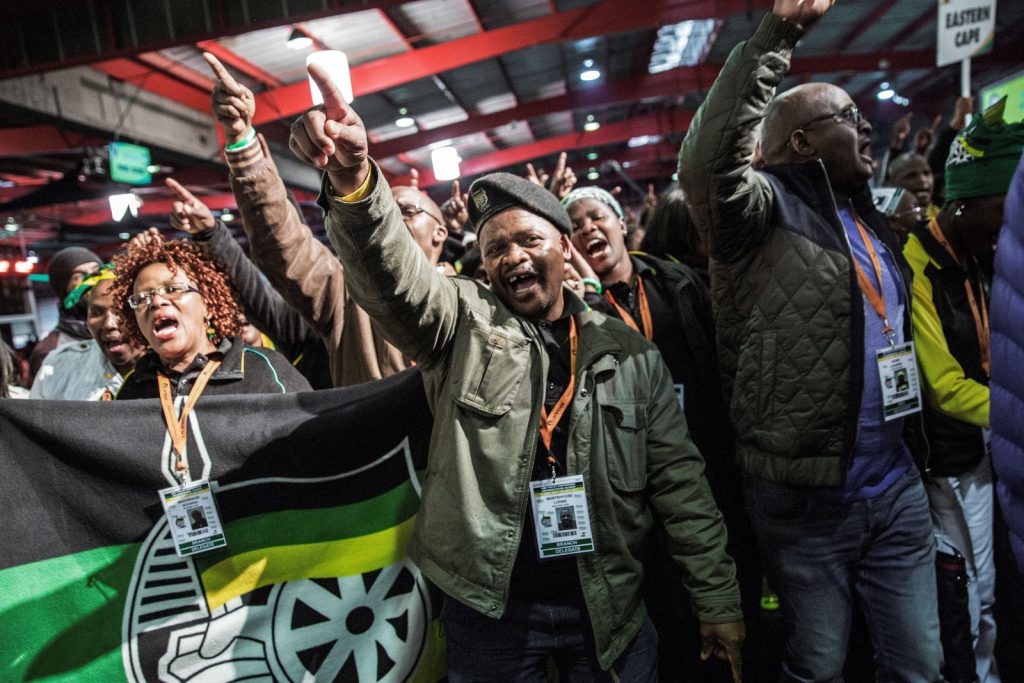 The ANC policy conference has commenced and will end on Sunday. (Ziyaad Douglas/Gallo)
“On findings on weaknesses and lapses by the ANC, the ANC will, among others, review its policies with respect to cadre deployment policy and practice; party funding principles; organisational discipline and accountability; and parliamentary oversight.”
A task team — there are several work streams mulling the party’s response to the report — will make proposals on each of these areas of concern. A paper presented to the NEC on preventing a repeat of state capture will be discussed at the conference.
Analysts say the resolution to implement the commission’s recommendations will survive the storm Ramaphosa faces for concealing the theft of foreign currency from his game farm more readily than, say, the step-aside rule, where he has been forced onto the defensive by Fraser’s revelations.
“I don’t see it making any difference,” said Steven Friedman, a professor of political studies at the University of Johannesburg. “Since his faction will not scrap it, it will be applied to whoever is charged. The only thing they have to decide on Zondo is whether to remove people who have been named.”
“They don’t decide who is prosecuted.”
Political analyst Ralph Mathekga said the Zondo report gave Ramaphosa an easy platform from which to appear to intensify his renewal drive.
“It helps him in this regard,” he told Mail & Guardian.
“The president does not have to work hard to get something out of the Zondo report. You tell other people — the police and the prosecution service — to go do their job and you look good, and then you wait. All he has to do is not interfere with the police and the investigation, and simply encourage them generally as he should.
“It is a low-hanging fruit for him, he can go to parliament tomorrow and all he has to say is government is going to put together programmes to support the prosecution and we are also going to evaluate other government entities with an aim to find out which restructuring is possible, the composition of the boards of the state-owned entities, you can bring people in to help you sort that out.”
“That is all it would take for him to drive the implementation of some of the Zondo recommendations, and he is the champion of the report, even if Zondo mentions him, along with the ANC, in a very bad light.”
Zondo was expectedly scathing of the ruling party’s recent record, and Ramaphosa was not spared. The chief justice did not believe that he mounted sufficient resistance to state capture from within the party, and rejected his rationale that doing more would have ended in calamity.
Even so, Mathekga said this was nothing Ramaphosa could not have survived comfortably because he was essentially found to have erred by omission, rather than to have acted improperly.
But the alleged active wrongdoing of his allies means the nature of his support for the Zondo report will be of a bland and unhurried nature.
Mathekga said the president is too weak to beat off resistance to implementing the step-aside rule, which cannot indefinitely be read in isolation of the Zondo report, because of the implications if any of his allies were charged in months to come.
“He is going to have to compromise. When someone says he will not be deterred you need to understand they are already considering compromising on certain things. They are pushing him back on the step-aside rule; I don’t think he will push back significantly. I don’t think he is in a position to do so.
“So he is not enthusiastic, he is on the defensive. Do you now say the step-aside rule does not apply to Gwede but it applies to Zandile Gumede?”
If Phala Phala has given the so-called radical economic transformation faction a reprieve, it has also weakened Ramaphosa’s public platform and made it plain that within the ruling party nobody near the centre of power can claim not to be tainted.
It leaves him to negotiate his own party with great pragmatism, Mathekga said, and to play for time.
“You don’t want Gwede to fall, but yet you don’t necessarily have to defend him.
“If they go after Gwede, Gwede will no longer find time to defend you because he has got to fight for his own political life. Gwede might find himself in KwaZulu-Natal by mistake, as people tend to gather there when they have a problem with law and authority, and that is what the president does not want. At least not before the December conference.
“If there is anything the president can do, it is to suspend any attempt to round up people until December.”
[/membership]