The Jagersfontein-Charlesville area in the Free State where a mudslide claimed life and destroyed homes nearly two years ago. Photo: Supplied
On Sunday, the collapse of the wall of a slimes dam at the Jagersfontein diamond mine in the Free State led to a 1.5km wide wave of grey mud gushing into the area. It inundated homes, killed one person, injuring more than 70 and displacing hundreds.
“This is not a natural disaster,” said Sputnik Ratau, spokesperson for the water and sanitation department. “That is why, from our point of view, we really are saying to the mine that this is a disaster.”
Another sludge-filled tailings compartment at the mine is also at risk of failing and intervention is needed “as urgently as yesterday” to prevent an even more serious disaster from unfolding, the department has warned.
“They need to empty that compartment,” Ratau said. “There is a pit that we are saying we can give them authorisation immediately to use to reduce the content of that compartment.
“Their engineers will just have to make sure this thing happens, like, yesterday. That is the starting point and we can then follow up with all the other things that need to happen, including the issue of rehabilitation and water quality.”
‘Pawpaw has hit the fan’
The Jagersfontein disaster was preventable, said water governance expert Carin Bosman. “Slimes dams, tailings dams, have been used all over the world for more than 100 years. The engineering principle behind slippage and failure is well known … Too much water and the wall will give way.”
“Kilometres will be written” in the weeks to come about who should have done what to prevent the disaster but that ship had sailed, she said. “The pawpaw has hit the fan. We need to talk about what we can do now to prevent this impact from going further and becoming worse.”
The pollution plume is estimated to have travelled about 8km.
“Apart from the immediate humanitarian disaster, those slimes went down the valley and are in the upper dry reaches of the river. As soon as the rainy season starts, that shit is going to flow further downstream and is part of the Orange catchment,” said Bosman. “So, if we don’t start immediate blocking efforts into that little stream, and start cleaning from the stream backwards, we will see this pollution in the dam very shortly.”
The area’s sewage works seems to have also been taken out by the spillage, Bosman said, “which means that raw sewage has now mixed with the slimes and is following that path down the river and that poses a significant health risk”.
Ratau said the sludge had moved into the Riet River, which supplies water to the Kalkfontein Dam, which is in a nature reserve. The department’s officials are conducting water quality tests “for acidity, alkalinity, nitrates and the works” as well as for the main threat — arsenic. “That will inform us of what is exactly in there.”
Directives
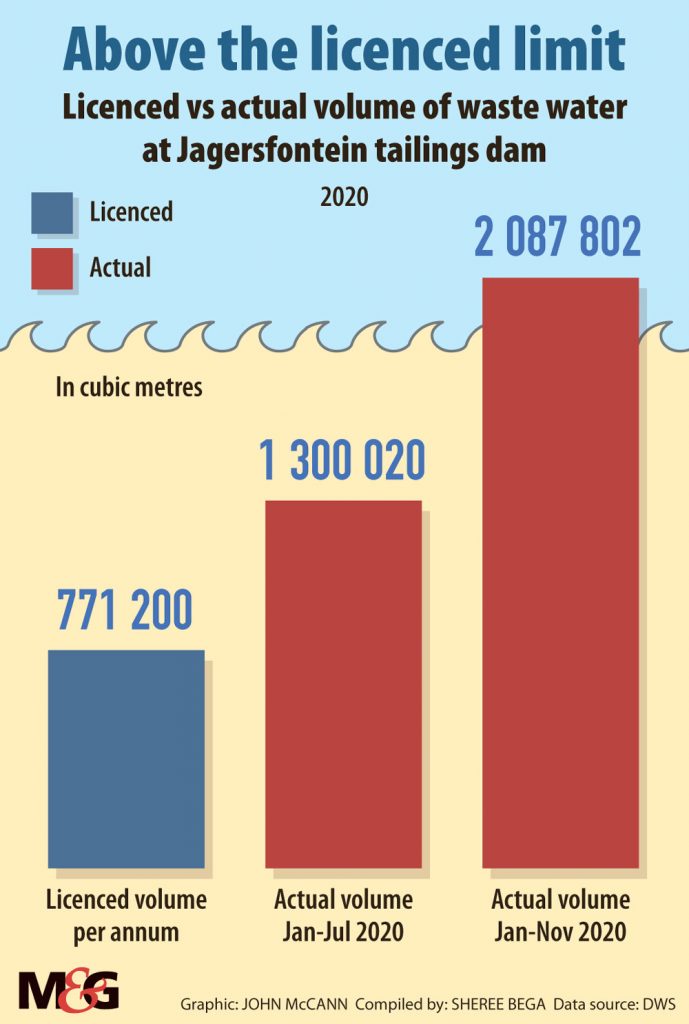
In December 2020, the department issued a directive against the mine’s owner, Jagersfontein Developments, which extracts diamonds from the waste tailings of mining operations, ordering it to cease operations for disposing volumes above authorised limits. Action plans were requested to rectify identified contraventions and the company advised with regard to dam safety requirements of the department, Ratau said.
The directive notes how, on 29 September 2020, the department said the firm had exceeded the volumes authorised for the disposal on the fine tailings storage facility in contravention of the water use licence conditions, describing how the lack of adequate planning and “blatant non-compliance” has “placed all parties in a precarious situation”.
It cited a report by SRK Consulting in November 2020, in which engineers identified a “serious risk” in association with the fine tailings disposal facility. The directive, too, noted how since the department’s notice was issued “wherein you were notified not to dispose of further volumes of waste … your operations have disposed of further volumes of waste”.
On the directives that were issued, Jagersfontein Developments told Mail & Guardian: “Under previous ownership, operations were briefly suspended in 2020 to rectify some concerns during regulatory inspections. These matters were addressed and the dam passed subsequent inspections, including in July 2022 when the dam was declared safe and volumes within limits.”
Ownership
The company said it had earmarked R20-million in emergency funds quickly to assist with relief efforts, “which will be spent with priority to people’s health and safety and returning residents to their homes. Food parcels and necessary supplies are being provided to displaced residents. Medical and hospital bills are also being settled”.
An independent investigation, it said, will be undertaken to determine the cause of the collapse. “Our immediate priority is the safety and health of the people and returning them to their homes. Experts have already been engaged by the company to comprehensively assess the situation and develop a clean-up and remediation plan to address the spillage.”
Jagersfontein is home to the oldest and largest diamond mine hole in the world, and remained in service until the early 1970s when the owner, De Beers, shut it down.
Twelve years ago, De Beers sold the mine’s tailings dumps to the Sonop Superkolong Consortium. According to Jagersfontein Developments, Superkolong “exited the transaction shortly thereafter” with Reinet Investments, a Luxembourg-based business run by luxury tycoon and Richemont chairperson Johann Rupert, taking control. He is reported to have sold the assets a few months before the incident.
In April this year, Reinet concluded a transaction to sell its interest in Jagersfontein to Dubai’s Stargems Group, a diamond-sourcing and supply company, which has stated the tailings storage facility was “safe and secure”.
‘De Beers must be held accountable’
The nonprofit groundWork said De Beers and its subsidiaries must be held accountable and pay for the clean-up and rehabilitation, maintenance and closure of the mine, and develop a just transition plan for the residents of Jagersfontein. “This must start with immediate compensation for damages from the spill and the lives lost.”
The Jagersfontein mine was one of the largest De Beers mines during the colonial and apartheid times. “In 2010, De Beers offloaded the legacy of their wealth creation — the toxic waste of past mining — onto the local community through the Superkolong Consortium,” said groundWork.
“De Beers claimed that the deal … met the criteria set by De Beers including technical, economic, community, technical competence, available funding to develop the new processing operation … We need to understand what due diligence was done by De Beers and the government to allow this deal to go through.
“If it is found that the company operating the mine has contravened its water use licence, groundWork calls for the present directors and owners to be held responsible for the disaster and, more importantly, for De Beers … to take responsibility for their historical operations.”
De Beers Group spokesperson Jackie Mapiloko did not respond to groundWork’s statement, referring Mail & Guardian to the statement it issued on Monday, which noted how the company ceased operations at Jagersfontein in 1971 and despite having sold the operation, along with its associated liabilities in 2010, “we stand ready to provide technical assistance and support to the government should it be requested by the Minerals Council South Africa”.
 (John McCann/M&G)
Pass the parcel
Mariette Liefferink, the chief executive of the Federation for a Sustainable Environment, said this was typical of “pass the parcel”; mines are sold close to closure to poorer-resourced companies, which relieves them of the responsibility and liability of dealing with the problems of closure.
She said the departments of water and sanitation and of mineral resources and energy ought to have enforced non-compliances. “It would appear that directives were issued for non-compliances but these must be enforced. You cannot wait for a disaster before you enforce directives.”
Jagersfontein Developments said it had confirmation that the wastewater “is not hazardous … An independent water analysis report defines the waste in the alkaline pH range and classifies the sludge cake and liquid as Type 3 (low risk). This means that the waste does not provide any health threat to anybody exposed to it. The process is a water process with no chemical utilisation.”
Liefferink, however, disputed this. “If that claim is made, the public would like to see their water quality results … It is necessary for them to give evidence that that water is not hazardous to health, well-being and the environment. The reason it is stored in a dam is obviously because there are certain risks and hazards inherent to mining waste … We don’t know what the long-term impact is on human health and the environment.”
She has just completed the curriculum to train mining communities about the risks and hazards of tailings storage facilities and to prepare them for catastrophic events.
“This is part of what the investor community has called upon after the Brumadinho mine dam failure. In South Africa, our tailings storage facilities and tailings dams are all upstream which means that it is the lower cost, but the higher risk. That is why constant vigilance, monitoring and management must be ensured. And the fact that our communities live so close to these dams or tailings storage facilities is also a significant risk.”
Impending disaster
Palesa Chubisi, spokesperson for Free State Premier Sisi Ntombela, said the one person confirmed dead was a 70-year-old man while a 50-year-old woman remains unaccounted for.
A pregnant woman who sustained a fracture is the only person who remains in hospital and is responding well to treatment.
Karabo Khakhau, the Democratic Alliance member of the Free State legislature, said residents had flagged concerns about the mining operation, including their proximity to the dumps, for years. “If the Free State provincial government had a disaster management centre as mandated by the law, it would have been able to assess the risk and have precautionary measures in place to ensure that residents are protected …
“The disaster here in Jagersfontein is not a mere disaster that happened overnight. It is a question of negligence on the part of local authorities here and the provincial government because all the community members’ cries fell on deaf ears.”
[/membership]