The project, too, has drawn strong opposition from conservationists in India, who have described it as a “vanity project” and a waste of taxpayers money. (Photo by David Silverman/Getty Images)
South Africa’s involvement in a controversial project to send an initial batch of 12 African cheetahs to India is fraught with problems, conservationists have warned.
Next month, the big cats from South Africa are expected to join eight cheetahs that were flown from Namibia to India earlier this month, more than 70 years after its Asiatic cheetah was declared extinct.
The Namibian cheetahs – five females and three males – were introduced to the Kuno National Park in Central India to celebrate Prime Minister Narendra Modi’s birthday.
The introduction of African cheetahs is being done under the auspices of Project Cheetah, which the Indian government has billed as “the world’s first inter-continental large wild carnivore translocation project”.
At the release of the Namibian cheetahs, Modi said the introduction of the cheetahs “will help restore open forest and grassland ecosystems”. This will help conserve biodiversity and enhance ecosystem services like water security, carbon sequestration and soil moisture conservation, benefiting society at large and wildlife conservation”. It will also lead to “enhanced livelihood opportunities for the local community through eco-development and ecotourism activities”.
Conservation experts in India and South Africa are opposed to moving the cheetahs to India and have strongly condemned it.
No MoU – yet
In July 2022, a request was made to the department of forestry, fisheries and the environment (DFFE) to supply India with 12 cheetahs “as part of their first reintroduction attempt”.
The proposed relocation date for the shipment was due to coincide with India’s Independence Day in August. South Africa, however, has not yet signed off on the translocation.
“The department cannot comment on the memorandum of understanding (MoU) and related processes at this stage,” said Albi Modise, the spokesperson for the department. Earlier this month, a team from the department visited Kuno National Park.
Vincent van der Merwe, the manager of the Metapopulation Initiative, is working with the University of Pretoria, the Wildlife Institute of India and the National Tiger Conservation Authority on the project.
“In our exchanges with these DFFE officials [who visited Kuno], they appear supportive of the reintroduction and are making a concerted effort to fast track the MoU. Government MoU’s take time, which is a little frustrating,” he said.
The founder cheetah population from South Africa was due to arrive at Kuno late this month, “in time to experience the tail end of the monsoon while still in holding bomas”, he said. This will familiarise them with the heavy tropical rains of India, preparing them for future exposure in free-ranging conditions. They are expected to be released in late October, at the onset of the dry season.
Loss of credibility
But Gus Mills, who has conducted research on African carnivores for over 40 years with SANParks, described the translocation project as “crazy” and as “being driven by politicians” in India.
“The whole thing is built on such an unscientific, unsustainable, nonsensical basis,” he said. “Firstly, it’s the wrong subspecies so we’re bringing African cheetahs – cheetahs from the southern tip of Africa, which is as far away from India as you get in cheetah ranges, and trying to introduce them to this environment, which is fundamentally from a biodiversity aspect, very bad.”
The project, too, is “getting in the way” of a “long-standing” Supreme Court of India judgement that endangered Asiatic lions, and not African cheetahs, be moved to Kuno.
Kuno is too small, he said. “In the best habitats of cheetahs, like the Serengeti and the Kalahari, you get about one cheetah per 100 square kilometre so the carrying capacity [in Kuno] is not going to be able to ever sustain a viable population.”
South Africa would lose a lot of credibility in the scientific conservation world if it agreed to the project. “There are so many eminent scientists who are outspoken against this project.”
Strong opposition
The project, too, has drawn strong opposition from conservationists in India, who have described it as a “vanity project” and a waste of taxpayers money. The country, they say, does not have the habitat or prey species to support viable populations of wild, free-roaming African cheetahs.
Wildlife biologist and conservation scientist Ravi Chellam said: “The current plan is to translocate cheetahs from fenced reserves within South Africa and release them into an extremely small unfenced reserve, Kuno, which is only 748 square kilometres in an area with 169 villages in the larger landscape in which Kuno is located.
“Free-ranging cheetahs are known to have home ranges larger than what the unfenced park can support … Given the propensity of cheetahs to come into conflict with humans, why is South Africa supporting this idea?”
India does not seem to have sufficient suitable habitat “in terms of area/extent” to host a population of cheetahs, even as a metapopulation. “How does South Africa plan to address this issue while sending cheetahs to India?” he wondered.
‘Recipe for potential disaster’
Jan Venter, the head of department and associate professor at the department of conservation management at Nelson Mandela University, foresees a “recipe for potential disaster.
“Cheetahs do roam quite widely and I think if you have a place that size, especially surrounded by communities that have livestock, it’s just a recipe for potential conflict with predators … We’re very good at fencing places in South Africa and managing predators in confined spaces like that but it’s a different ballgame if there is no fence.”
If “this blows up into a mess”, Venter said “it could be quite an embarrassment” for South Africa. “It sounds very sexy to put predators that were extinct, or exterminated from a place back … but the chance of failure … is very high.”
Van der Merwe said Kuno boasts sufficient prey and suitable habitat and that all founder cheetahs were sourced from fenced reserves in South Africa that have no history of taking livestock.
“Regardless, there does exist potential for human-wildlife conflict in both the 48 700ha buffer zone surrounding Kuno … as well as sheep and goat farming areas on the periphery of this protected area. India has a well-established compensation scheme for livestock losses.”
Long-term conservation effort
The “proposed reintroduction” is a long-term conservation effort, he said. “If you look at our initial cheetah reintroduction efforts in South Africa, it really took decades to get it right. Most initial cheetah reintroductions failed in South Africa. Almost 200 cheetahs sourced from Namibia were lost in the process.
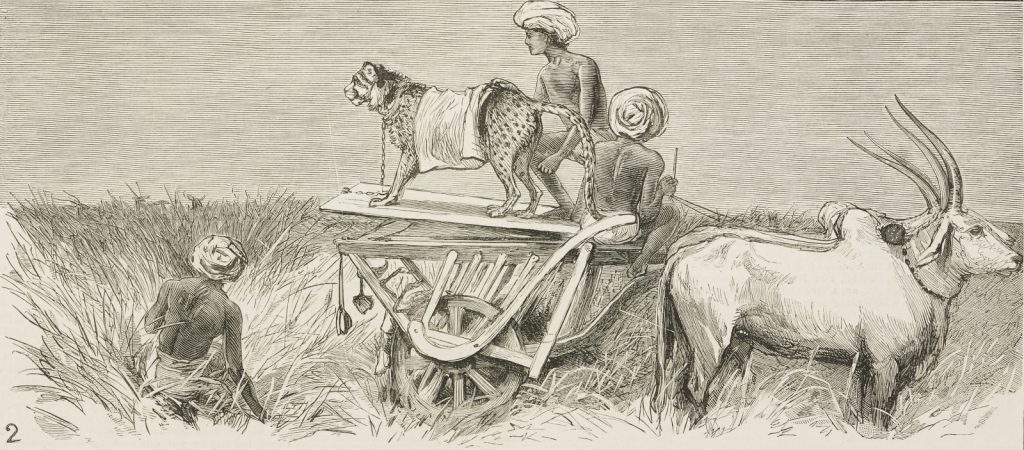 Hunting blackbuck or Indian antelope with the cheetah in Baroda, India, illustration from the magazine The Graphic, volume XXVI, no 673, October 21, 1882.
Mistakes were made but “valuable lessons were learnt”, and reintroduction techniques refined, he said. “Since 2011, we have coordinated 30 successful reintroductions, while only two have failed. We expect similar losses in India initially, and regular supplementation from the South Africa metapopulation will be key to the long-term success of the project.”
South Africa has a growing wild cheetah population and “unless we supply animals for reintroduction efforts elsewhere, we are going to initiate costly and invasive contraception programmes”. The worst-case scenario is that euthanasia will have to be considered as a management tool.
The India population will need to form part of the southern African until at least 500 individuals are established in India. “We will need to supplement India with a small number of individuals every year, until they’ve established a sustainable metapopulation of their own,” he said, adding Kuno will constitute the first reintroduction site and “hopefully, many more will follow”.
But Mills asked: “How many cheetahs are going to die? If they’re thinking of bringing 500 to 1000 cheetahs and they admit that a lot of cheetahs are going to die, from a welfare issue, can you just throw hundreds of cheetahs and let them die in an experiment?”
[/membership]