: Convicted fraudster Johan Fouche, known as the Casanova fraudster for his smooth demeanour
A Western Cape high court judge has described as “unconscionable” a contract that the firm of Leonie Dempers, a business associate of former magistrate and fraudster Johan Fouche, entered into with Dirk and Nadia Burger.
The Burgers entered into a contract with Edenglo to save their home from foreclosure, but it led to their house being sold — twice — to strangers.
First National Bank is appealing the high court judgment that ruled the first deal was “void” and that the property be transferred back into the Burgers’ names.
The respondents in the matter are Edenglo Holdings, Dempers, Minerva Baugaard, Ian Baugaard, First National Bank, Registrar of Deeds Cape Town, Wonderful Choice Investments, Gert de Wet NO and Gladys Ngobeni.
Dempers appeared before Western Cape high court Judge Robert Henny on Monday for the FNB appeal. She told the court that she was not registered as a VAT vendor — although she had allegedly charged the Burgers VAT — nor with Financial Sector Conduct Authority and the Property Practitioners Regulatory Authority, which are requirements for the provision of financial and property services. The matter is expected to be back in court on 18 January next year.
In her judgment in 2021, Judge Tandazwa Ndita said the Burgers had asked the court to set aside the transfer of their Brackenfell home in the Western Cape.
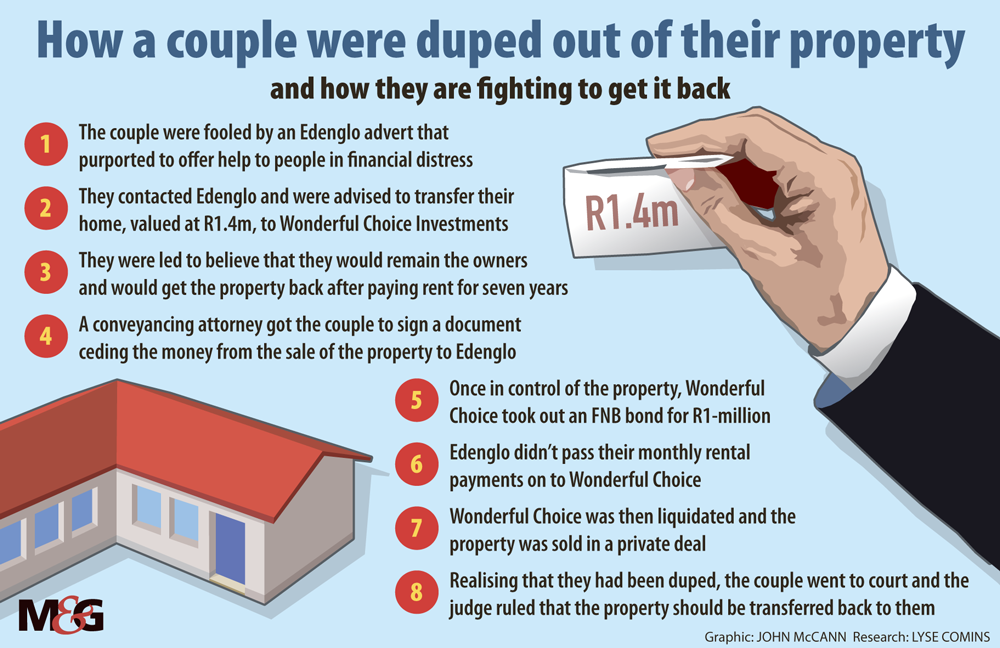
The couple stated in court papers that they had fallen on difficult financial times when they spotted an Edenglo Holdings advert. It stated that the firm assists people experiencing financial hardship, and who could not afford their bond repayments, to save their property from execution. The Burgers responded to the advert and Dempers advised them that Edenglo would facilitate the sale of the property to an investor, Wonderful Choice Investments, for R1.4-million.
Dempers is part of the alleged scam a Mail & Guardian investigation uncovered in September involving former KwaZulu-Natal magistrate Johan Fouche, dubbed the Casanova fraudster. He was jailed for 70 counts of fraud and is allegedly on the prowl again. He seems to have found up to 30 new victims, whom he has cheated out of hundreds of thousands of rand.
 Leonie Dempers is being investigated by the Hawks for at least five cases of fraud.
Fouche is the chief operating officer of Asiphakame Financial Services, which he runs with Dempers, the chief executive. The firm describes itself as “a complete financial wellness partner to our clients” and promises to help over-indebted consumers with services that include “loan sourcing”, “credit record rehabilitation”, “bond originating” and “bond rescue”.
According to court papers, the terms of the Edenglo scheme, as explained to the Burgers back in 2017 by Dempers, were that “for all practical purposes” they would remain the owners of the property and in possession or occupation of the property.
In terms of the scheme, they would be permitted to rent the property for seven years, whereafter they had a right to buy it back from the investor.
Dempers told the couple that the purchase price for the property would, after certain deductions, be paid into a trust account for investment purposes. But a portion of the capital would be made available to the Burgers at the end of the period, to enable them to buy back their own property “for an amount not exceeding that of the outstanding bond at the time of transfer of the property to the investor”.
It was agreed that the Burgers would pay a subsidised R3 500 monthly rent to Edenglo, which would in turn, pay the rent to Wonderful Choice. In terms of the agreement, an amount of R400 000 from the purchase price would be paid to Wonderful Choice to subsidise the monthly rent for seven years, without which the rent would have been R5 595.
Pursuant to the sale agreement, the Burgers were required by the conveyancing attorney, MD Mitchell Inc, to sign an affidavit confirming that Edenglo would receive the proceeds of the sale of the property and administer them on their behalf.
“According to the applicants [Burgers], at the time of the signing of the agreement they were happy to depose to the above affidavit, as it was never their intention to sell the property ‘in the ordinary sense of the word’. They were satisfied with the fact that the property would be registered in the name of the investor for a limited time, subject to their right to remain in possession … they believed that they would receive no financial benefit from the sale of the property as the truest purpose of the scheme was to rescue their home, as opposed to selling it,” Ndita said in her judgment.
In addition, the Burgers had said that Dempers had advised that she would pay off some of their debt and invest the balance.
“The aforegoing as well as desperate attempt to save their property, caused them to agree to sell their property, which still had a bond of R400 000 registered over it,” Ndita said.
Wonderful Choice paid the R400 000 deposit allocated as rental and obtained a bond for R1-million from FNB.
On 7 October 2015, the Burgers received a letter from Venn & Muller Attorneys, who advised them that Edenglo had failed to make payment of the monthly rental instalments to Wonderful Choice, and that this had resulted in the latter failing to make bond payments. The Burgers were requested to tender all further rent payments directly to FNB. But the court papers did not show any payments tendered to the bank, which resulted in the liquidation of Wonderful Choice and the sale of the property to the Baugaards.
According to the Burgers, during May 2017, they discovered that the Edenglo scheme “was a scam”, and that Edenglo and Dempers were being investigated by the Directorate for Priority Crime Investigation (the Hawks) for fraud.
Zinzi Hani, the Hawks’ Western Cape spokesperson, earlier told the M&G that Dempers and Fouche are being investigated for at least five cases of fraud.
In her judgment, Ndita said: “The [Burgers] state that at the auction of the property they informed the respondents that they were fraudulently dispossessed of the property, and that they intended to institute legal proceedings to set aside the fraudulent transactions and get their property back.”
The Baugaards, who subsequently bought the property from Wonderful Choice’s liquidators, told the court that they had purchased the property privately, and not on auction, saying that the Burgers’ had not informed them of the alleged scam.
 (John McCann/M&G)
But Ndita found the facts of the matter were in favour of the Burgers.
“It is undisputed that the applicants do not know what happened to the balance of the purchase price paid by Wonderful Choice, as well as the once off rental payment in the sum of R400 000. All they know is that the scheme was fraudulent, in that it resulted in them losing their home without receiving any real benefit or payment. Furthermore, had they known that that would be the case, they would not have agreed to the transfer of the property to Wonderful Choice,” Ndita said.
“The facts of the matter at hand exhibit features which, when cumulatively considered, show a probability that unconscionable, immoral or illegal conduct will result from the implementation of the provisions of the contract according to their tenor.”
Ndita said that although the contracts did not appear to be fraudulent “their intrinsic unconscionableness shows that they are against public policy”.
She added that it was telling that the first respondent, Edenglo, and the second respondent, Dempers, have not opposed the application.
“In my view, based on what I have alluded to above, the applicants could not have intended to transfer the property in these circumstances. I therefore declare the terms of the scheme and the pursuant agreements between the applicants and the first and second respondents as being contrary to public policy, and the contracts void ab initio [from the beginning],” she said.
Ndita ruled that the terms were “clearly oppressive to the borrowers, as they would not be able to determine the authenticity of the actual amounts paid”.
She said the lease agreement did not reflect the name of the lessor nor the date on which the transaction was entered into and the Burgers had not been informed that any rental default would affect Wonderful Choice’s ability to pay its bond.
She ordered the Registrar of Deeds to give effect to her ruling by transferring the property back into the Burgers’ names.
Fouche and Dempers referred questions regarding the matter to their attorney, Pieter Smit, who had not responded to questions at the time of going to print.
[/membership]