President Cyril Ramaphosa and Deputy President Paul Mashatile.
With the stars aligned for President Cyril Ramaphosa to survive as ANC president at the party’s elective conference next month, those who divine his political demise now say it is written in the foreign exchange control regime.
The debate in political circles has increasingly turned to what the implications will be for the president if, in the new year, the South African Reserve Bank found there were forex control violations at his Phala Phala game farm and imposed a sanction.
It is a fair question and naturally extends to whether an adverse finding would trigger the ANC’s step-aside rule. If so, having championed the measure and staked his presidency on an anti-corruption drive, he will have to take leave of absence as leader of the party.
It then becomes likely history will repeat itself and, like his predecessors, he will be recalled as president. Both Jacob Zuma in 2018 and Thabo Mbeki 10 years earlier were forced to resign on orders of the party.
The National Assembly would then elect a new president, probably the deputy president, as happened when Mbeki was succeeded by Kgalema Motlanthe, who served as caretaker president for six months until Zuma came to power in national elections.
Some who foresee this scenario think that, given the instability within the ANC, it could prompt early elections.
The flaws in this hypothesis may be obvious, but so is its appeal for those still feeling the hurt and humiliation of what happened on 20 September 2008. Since it is accepted that Ramaphosa was among those who agreed that Mbeki should step down, there might also be an element of schadenfreude.
But the narrative can only unfold, and then only to some extent, if evidence of serious wrongdoing is found by the Reserve Bank or any of the other entities investigating the hoarding of foreign currency in furniture on the Limpopo game farm, the failure to open a police docket of theft and clandestine efforts to recover the money.
The SARB confirmed months ago it had opened an investigation and has, rightly, refused to comment further.
What is known, from a response by SARB governor Lesetja Kganyago to opposition parties, is that the financial surveillance department wrote to Ramaphosa’s legal advisers in June “to provide information and details regarding the origin of the foreign currency and any underlying transaction that it may pertain to”.
They were given 21 business days to respond, which was later extended by 15 days. The department received a response and requested further details by 8 September.
Two weeks ago, Ramaphosa told a national executive committee meeting that he had replied to the questions put to him by the bank. He has conceded that a large sum of money, though much less than the $4 million Arthur Fraser claimed, was stolen from the farm in February 2020.
It has for many months been an educated guess in legal and financial circles that the most obvious risk the financial scandal poses for the president lies in section 6 of the regulations. It reads: “Every person resident in the republic who becomes entitled to sell or to procure the sale of any foreign currency, shall within 30 days after becoming so entitled, make or cause to be made, a declaration in writing of such foreign currency to the treasury or to an authorised dealer.”
Contravening the regulation carries a fine of up to R250 000 or a prison term not exceeding five years.
The president reportedly told the public protector that the money came from a transaction concluded 45 days before the burglary at his farm, which was brought to light by Fraser more than two years after the fact.
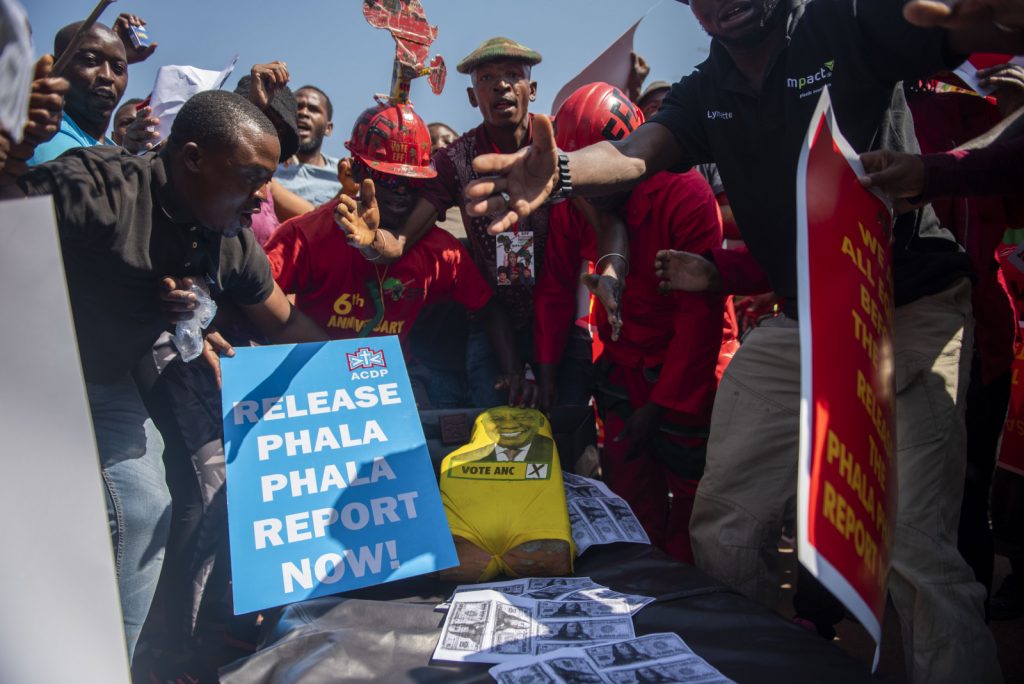 Members of opposition parties picket outside the office of the public protector about the report on the money found at Ramaphosa’s Phala Phala game farm. Photo: Alet Pretorius/Gallo Images
Sources in the Ramaphosa camp suggest that if there was a breach, the farm could be cast as a juristic entity and the president could escape personal liability, with management who should be made to shoulder the responsibility. They further point out nothing as flagrant as the president being caught carrying undeclared foreign denomination into the country transpired.
“He did not bring the money in, the buyer did,” one source said, referring to the Sudanese businessman who, in Ramaphosa’s version, paid a farm employee $580 000 for a buffalo.
It might seem plain the timeframe in the regulations was exceeded, but other considerations could include when he was told that the money was received and what his intentions were regarding banking it. And if an administrative penalty were to follow, he could arguably pay it and walk away without the step-aside rule coming into play.
Unlike the responses given to the public protector by both Ramaphosa and Wally Rhoode, the head of the presidential protection unit, his replies to the South African Reserve Bank have not leaked into the public domain.
Nor does one know whether any of the entities investigating the incident will find evidence of wrongdoing, either in the official version, which the president also conveyed to the ANC’s integrity commission, or in conflicting evidence advanced by his opponents.
“We have a criminal justice [system] for a reason,” academic and political analyst Steven Friedman said, quipping investigators did not divulge their findings to the person in the street, political pundits — or retired politicians.
“I’m pretty sure they don’t tell Thabo Mbeki.”
He said the salient point about the former president and those close to him was they were to this day motivated by a desire to redeem his legacy.
“Instead of doing what somebody in his position should be doing, which is to give an opinion on the state of the country, essentially everything he does is designed to vindicate him and to get back at people who he feels were responsible for the fact he was recalled,” Friedman said.
“Mbeki’s whole pitch is this guy brought me down and he is going to be brought down. That is obviously what he hopes but it does not mean that is what he is going to get.”
Mbeki’s spokesperson said the former president was not available for comment.
The independent panel headed by retired Chief Justice Sandile Ngcobo, to establish whether there is prima facie evidence that Ramaphosa breached the Constitution or the law and should face an impeachment inquiry, is due to deliver its report on 30 November.
It will be debated by the National Assembly on 6 December, leaving too little time for any process, regardless of the outcome, to derail Ramaphosa’s hopes of re-election as ANC president next month.
But if he did come unstuck in the new year and was recalled by the ANC, the notion that the ruling party would precipitate elections normally due in 2024 makes no sense, Friedman said.
“It is not in their interest and it is not necessary.”
Early elections would only follow before the end of the legislated five-year interval if the government fell, and are not what a party in decline at the polls wishes for itself.
The Social Research Foundation in August forecast the ANC could still win the next national election but that it is likely to see its vote share dip to below 50% for the first time, in a repeat of the historic setback it suffered in municipal elections last year. A survey by the Brenthurst Foundation released on Wednesday predicted a similar outcome.
In 2008, the picture was different. An election was around the corner, with Zuma as the newly elected ANC president waiting in the wings. His victory at the party’s Polokwane conference was the reason for Mbeki’s recall. There was the obstacle of corruption charges, but these were soon withdrawn by the then acting national director of public prosecutions Mokotedi Mpshe in a decision later set aside on review.
If Paul Mashatile emerges as deputy president of the ANC next month, as suggested by the nominations for the top six positions revealed this week, he would be Ramaphosa’s natural successor if all went wrong. The president’s main challenger, former health minister Zweli Mkhize, faces his own reckoning with law enforcement agencies over the Digital Vibes scandal, though he remains a backbencher in parliament.
“Even if Ramaphosa is found guilty of something, or he is charged with something, even if he has to step aside, it does not mean the government is going to fall.
“It seems like wishful thinking that somebody puts out when they are very angry about the way they were treated and they think that the people who were responsible for their downfall would end up meeting the same fate,” Friedman said.
“My very strong expectation is that if Ramaphosa were forced to step aside, he will be replaced by whoever the deputy president is at the time, which is probably going to be Mashatile the way things are going, who will lead the ANC into the next election and lose.”
Political analyst Moeletsi Mbeki said the true crisis facing the ANC was looming poll defeat, not who would lead the party.
“The issue is not Cyril, the big issue is the existential challenge that the ANC is faced with because African nationalist movements, when they lose political control, they collapse and die.
“So that is the real issue about the ANC and, from what the polling experts are saying, it is almost an open-and-shut case that the ANC won’t get 50% of the vote.”
No coalition arrangement, regardless of the partner, could remedy the situation, because said partner would be calling the shots, he said.
“It will be finished.”
[/membership]