President Cyril Ramaphosa. (Photo by Michele Spatari/NurPhoto via Getty Images)
President Cyril Ramaphosa has emerged as the biggest winner in the ANC nomination process, securing the endorsement of more ANC branches than any other candidate, but most of the top six positions are still fair game.
Ramaphosa appears set for a successful bid for a second term as leader of the party, with only a negative finding from the parliamentary panel tasked with investigating whether he has a case to answer over the Phala Phala scandal standing in his way.
The three-person panel appointed to determine whether Ramaphosa should face impeachment is set to deliver its report on 6 December, having already sought an extension to consider representations from the head of state and others.
The first part of the nominations process came to a close on Tuesday when the party’s electoral committee head Kgalema Motlanthe announced 16 party leaders were eligible to battle it out for the top positions at the party’s elective conference next month. As expected, Ramaphosa emerged as the frontrunner for a second term as party leader ahead of Zweli Mkhize, who received less than half of Ramaphosa’s votes.
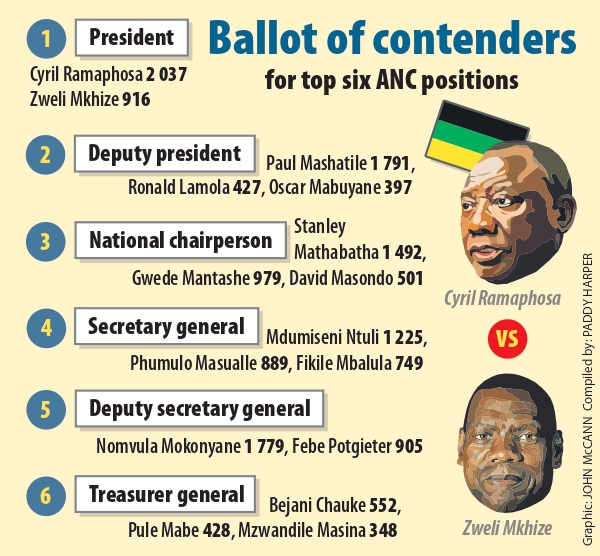 (John McCann/M&G)
Zweli Mkhize
Mkhize, who enjoys support from the ANC’s biggest province, KwaZulu-Natal, will have to convince his former allies Nkosazana Dlamini-Zuma and Lindiwe Sisulu to endorse his campaign and barter with some provinces to have any chance at beating Ramaphosa.
Dlamini-Zuma and Sisulu had initially entertained the possibility of a marriage with Mkhize in the early days of campaigning this year. Dlamini-Zuma received nominations from 81 branches, while Sisulu received 66.
Current ANC deputy president David Mabuza, who also failed to meet the threshold for nomination, could help Mkhize, having received 196 branch nominations. They are more likely to throw their weight behind Mkhize than Ramaphosa.
A major headache for Mkhize has been the breakdown in the relationship with Paul Mashatile, the current frontrunner for the position of deputy president. Those lobbying for Mkhize had initially thought Mashatile would put his weight behind their campaign for party president, with the support of KwaZulu-Natal as the trade-off.
This was clear when the KwaZulu-Natal provincial executive committee pronounced on Mashatile in September.
Mashatile has also garnered the biggest chunk of support, with 521 branches in KwaZulu-Natal nominating him, ahead of Oscar Mabuyane and Ronald Lamola.
But the relationship between Mkhize and Mashatile has buckled under pressure, leading to KwaZulu-Natal regions threatening to re-
assess their support for the latter. They have now begun lobbying Senzo Mchunu, who had failed to make the ballot as deputy president, to accept nomination from the floor.
Cyril Ramaphosa
The ANC president has received a resounding nod for a second term from ANC branches across the country. His anchor province of Eastern Cape delivered the highest nomination, with 420 branches choosing him ahead of other contenders.
This is despite a recent outcry from Eastern Cape provincial leaders following a pronouncement by Ramaphosa’s chief lobbyist supporting Mchunu for deputy president ahead of Mabuyane.
While Ramaphosa sits comfortably at the head of the table in the nominations, some of his allies are starting to get unsettled by his reluctance to pronounce on his preferred running mate, which could fuel confusion as some contenders are relying on his endorsement to convince branches of their nomination.
Ntuli emerged as the frontrunner for the position of ANC secretary general, with 1 225 branch nominations, ahead of 889 and 749 for Masualle and Mbalula, respectively.
But Ntuli will not sleep peacefully as he and Mbalula are expected to eat away at each other’s constituencies in the period leading up to the conference. Both have hitched themselves to Ramaphosa’s wagon, despite earlier indications that Ntuli was aligned to Mashatile, and by extension, Nomvula Mokonyane.
Mbalula, whose own campaign started in the middle of branch general meetings, will rely on the generational mix and his ANC youth league credentials for his election, much like Ntuli.
Masualle is expected to leverage the ANC branches which are anti-Ramaphosa or aligned to Mkhize.
Paul Mashatile
The party treasurer general is the leading contender for the deputy president position with a significant margin between him and Mabuyane and Lamola.
Mashatile has also been touted to run against Ramaphosa and Mkhize for party president and recently told journalists he would be receptive to the idea if nominated from the floor and should Mkhize and Ramaphosa be barred from standing.
Despite KwaZulu-Natal’s threat to reconsider its nomination of Mashatile, this should not make a huge dent in his lead. He could be the biggest winner in the nomination process as most of his known allies including Stan Mathabatha, Mzwandile Masina, Pule Mabe and Mdumiseni Ntuli have made ballot and are currently leading their respective positions.
Mokonyane has been the frontrunner for the position of deputy secretary general during the entire ANC campaign season, with provinces electing to nominate her, despite a call by those aligned to Ramaphosa for Potgieter to emerge.
Mokonyane and Mashatile both received endorsements from the same provincial executive committees. While Mokonyane was an unlikely candidate for the position in the months leading up to the branch general meetings, she has since surpassed the likes of the popular Gwen Ramokgopa.
Gwede Mantashe, David Masondo & Stan Mathabatha
Mathabatha has emerged as the frontrunner for the national chairperson’s position, securing the backing of nearly 500 more branches than the incumbent, Mantashe, and nearly 1 000 more than Masondo.
But Mathabatha, an ally of Mashatile, will be worried that Masondo led the nominations for chairperson in Gauteng, Mashatile’s home province.
Pule Mabe, Bejani Chauke and Mzwandile Masina
Chauke, a close ally of the president, has emerged as the strongest contender for treasurer general, but has a narrow margin over both Mabe and Masina. Well under half the branches nationwide nominated for the position, which could create space for a fourth contender to be nominated from the floor.
At least three of the top six contenders who spoke to the Mail & Guardian said that while the nominations were vital, they would not attach much significance to them as there was still lobbying and horse trading to take place among the provinces ahead of the conference.
Provincial leaders will probably start to hold delegate caucuses to assess numbers for their preferred candidates, while lobbyists will work to convince provincial players to pick their favourites.
Party electoral committee secretary Chief Livhuwani Matsila told reporters on Tuesday there was still a good chance that some party leaders would be nominated from the floor, although they would need 25% from delegates to make it to the ballot.
The ANC is likely to be criticised after only two women met the threshold for nomination, although Matsila said the rules for nomination had been designed to reflect women and the youth.
The electoral committee said that 50:50 gender parity would be properly constituted in the election of national executive committee members.
[/membership]