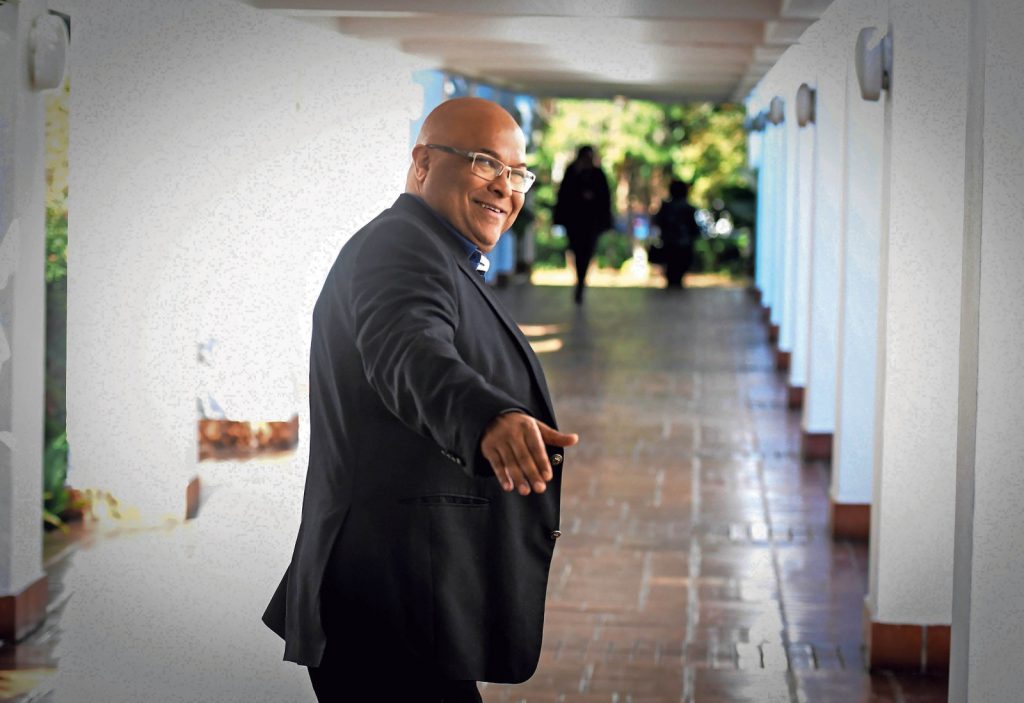
Doubt: The independent panel chaired by former chief justice Sandile Ngcobo (left) found that President Cyril Ramaphosa had a case to answer regarding the money stolen from his farm.
Hearing both sides is only proper but can make it hard to know who or what to believe.
The panel that has recommended parliament proceed with an inquiry to determine whether there was cause in the Phala Phala scandal to remove President Cyril Ramaphosa from office found itself in this position.
So do those who have read both their report and the president’s application to the apex court to have it reviewed and set aside.
The president’s founding affidavit makes forceful arguments.
One of them is that the panel chaired by former chief justice Sandile Ngcobo need not have ventured far into the conflict between the submissions of opposition parties calling for his removal, rooted in allegations made by former intelligence chief Arthur Fraser, and his own explanation of the provenance of the foreign currency stolen from his farm in February 2020.
The panel noted at the outset that it could not take Fraser’s claim that the money came from foreign states, not a Christmas Day cattle sale, at face value because he did not give a source for the information. But nor, it said, would it be fair to ignore it.
At this point, the president said, it should have applied the legal framework for the admissibility of hearsay evidence and been done.
“The panel should have stopped there: if Mr Fraser did not ‘indicate the basis for his allegations’ and did not explain the source of his ‘information’, then considering what he had to say served no rational purpose.”
Ramaphosa submitted that it had to consider the credibility and probative value of Fraser’s information, and whether it was obtained in a lawful manner. How, for example, did he get a redacted version of a Namibian police crime intelligence report?
Instead, he said, it drew conclusions from hearsay without regard for the law, after resolving, in paragraph 97 of the report, that the only option was testing it “against the president’s version and the probabilities”.
Fraser claimed that the money was part of a small fortune presidential adviser Bejani Chauke smuggled into the country from Saudi Arabia, Morocco, Egypt and Equatorial Guinea. Chauke then stashed dollars in a sofa in his Hyde Park home that was later taken to Phala Phala with the help of the head of the presidential protection unit, General Wally Rhoode.
In his court papers, the president dismisses this as fiction. “If anything it is charitable to describe Mr Fraser’s allegations as hearsay.”
Fraser told the Hawks that obtaining Chauke’s travel and telephone records and a list of other documents may help them take the matter further. And the panel accepted that if this information was obtained it might help to establish the veracity of his version.
But Ramaphosa countered that it was merely “a wish list” of evidence that may exist and did not assist the panel, but left it to fall back time and again on Fraser’s say so.
 Beans: Former spy Arthur Fraser
In the report, it stressed that its limited powers did not allow it to verify information. It could only read it alongside Ramaphosa’s version, which was “vague and leaves unsettling gaps”, and also relied on hearsay in part.
“We neither have the tools nor the power to excavate beneath the information that we have been provided with to uncover the answers to the unanswered questions,” it said.
“We believe the truth of what really happened lies beneath the unanswered questions that are foreshadowed by what we are told from the information placed before us.”
The president said the panel arrived here by taking the wrong path.
“It is understandable why the panel ended up like this — it drew no distinction between evidence and information. Yet the rules of parliament require it to focus on evidence.”
It was unfair, he argued, to find a case to answer in his perceived failure to remove all doubt about the source of the stolen money, the strangeness of hiding it in a sofa when a safe was at hand and the extent of Rhoode’s efforts to investigate the crime.
These questions may have puzzled the country for the past six months but the court papers make the point that the panel did not put them to the president, and could not impose a reverse onus to refute Fraser’s hearsay.
“An absence of evidence is not evidence of absence. The panel’s approach reduced to this: anything I did not answer is prima facie true.”
For the president, this is the faultline that runs through the exercise: the panel conflated the meaning of “prima facie evidence” and “sufficient evidence”, where the latter is the more stringent and correct test.
Furthermore, it seemingly forgot that the rules define serious violations of the law demanding the removal of a president as deliberate misconduct carried out in bad faith.
“The panel did not inquire into the president’s bad faith at all.”
His review bid invites the constitutional court to interpret the panel’s terms of reference and to determine how this first step in an impeachment process should unfold in future, including if the standards should be those of fair criminal trial.
Early in the report, the panel interrogates its mandate and embarks on an interpretation of the rules that have been in place since in 2018 but have never been applied before.
“There is some issue on the scope of the mandate of the panel,” it says, noting that the opposition parties calling for Ramaphosa’s removal were at odds on the subject.
The African Transformation Movement (ATM) and the Economic Freedom Fighters (EFF) believed the panel had to determine whether the president had a case to answer. But for the United Democratic Movement, it had to determine the veracity of the information before it, including Fraser’s allegations.
The panel solves the problem by looking at the overall scheme for impeachment and arrives at the same view as the ATM and EFF.
If the National Assembly adopts the panel’s recommendation that the president should face a section 89 inquiry, the next step is for it to appoint an impeachment committee with investigative powers. That committee must then determine whether the president is guilty of an act that warrants his removal.
“It is inconceivable that the National Assembly would have given both the panel and the impeachment committee the same powers, namely, to recommend whether the president is in fact guilty on any of the grounds for the removal of the president from office,” the panel said.
“Were that to be the case, the work of the impeachment committee would be superfluous.”
It understood its function as a filtering process, similar to the independent panel that weighed whether there was “prima facie evidence” to warrant the ongoing inquiry into the impeachment of the public protector, even if the wording of their terms of reference differed.
Nor did it matter that these featured the word evidence instead of information.
It could only be the latter, because rule 129G(1)(c)(iv) in the terms of reference made plain that the panel “must limit its inquiry to the relevant written and recorded information placed before it by members in terms of this rule”, plus the response of the president.
“We therefore construe the phrase ‘whether sufficient evidence exists’ to mean whether, based on the information received, the president has a case to answer.
“Put differently, we construe the phrase to require the panel to determine whether there is a prima facie case against the president. In the context, ‘evidence’ must be construed to mean information referred to in the rules.”
The president filed court papers on Monday, and Ngcobo indicated on Tuesday that he would abide by the outcome.
It is a hard case, because it asks the court to determine the course of a political crisis.
The report brought the president to the brink of resignation and exacerbated the existential battle within the ruling party. Filing for review 10 days before the ANC’s elective conference was not only a legal strategy but also a political one.
It shifted focus away from doubts about the credibility of the president’s account about what happened at Phala Phala to the credibility and integrity of its findings.
The rules were written in response to its 2017 ruling in Economic Freedom Fighters and Others vs Speaker of the National Assembly and Another.
The case saw opposition parties turn to court in frustration at parliament’s failure to sanction then president Jacob Zuma for breaching the Constitution by ignoring the public protector’s findings on the Nkandla scandal.
In a majority judgment, the court held that the Constitution requires a specific procedure and set of rules for impeachment. There was a rare public clash among judges at the apex court about the wisdom of intervening in a dispute involving the processes followed by the legislature to address the misconduct of the executive.
Then chief justice Mogoeng Mogoeng, who dissented, famously and in ill-tempered fashion, termed it “a textbook case of judicial overreach — a constitutionally impermissible intrusion by the judiciary into the exclusive domain of parliament”.
Mogoeng may be gone but the burden an immature democracy places on judges, past and present, remains.
[/membership]