The ANC needs to be more than restored, it needs to be rebuilt and repurposed.
In the renaming of towns since 1994, Mangaung is probably the most fitting new name. Meaning “a place of cheetahs”, the name predates the colonial period. Natives referred to the place as Mangaung and continued even after Boers imposed the name, Bloemfontein, which is derived from Dutch, meaning “a fountain of flowers”.
Unlike other new names that are hardly used in everyday life, and come across as an imposition, the official recognition of Mangaung was a truly restorative act. And the town was the best celebratory spot for the ANC’s 111 birthday on 8 January.
Mangaung was most fitting for this celebratory moment because of its contradictory history in the life of the ANC. It is a place of both birth and near death of the ANC. The central location of the town made it the favourite to host the founding of the organisation in 1912, when it was known as the South African Native National Congress. It also helped that Mangaung was, and remains, a fairly multilingual town.
That worked in favour of one of its most prominent adopted sons, Mthobi Thomas Mapikela. Born in the Cape, Mapikela trained as a carpenter in Grahamstown, today’s Makana, and went on to become a successful businessman in Mangaung.
Both his multilingualism and distinguished social status made Mapikela a natural choice for the speaker (or chairperson) position in the newly formed nationalist organisation. He’d go on to occupy that position for more than 25 years, helping to fortify the organisation to survive many challenges in the years ahead.
At the celebration of its centenary in 2012, Mangaung in the Free State — the place of the ANC’s birth — became the same spot where it emitted its first serious signs of decay. The party’s provincial executive committee (PEC), which effectively hosted the centenary celebration, had no official status at the organisation’s historic gathering. It was disbanded by a court judgment after a complaint that it had been illegally elected.
The chairperson then was Ace Magashule, and that wouldn’t be the only time that Magashule’s PEC was disbanded. It was repeatedly disbanded, even around the period Magashule was elected secretary general in 2017. The organisation obviously had a death wish.
Fikile Mbalula, a native of Mangaung, raised alarm at the fatal effect the election of his home boy was likely to have on the ANC. Mbalula was ignored. Just a few months into the office, Magashule went on to do something that no previous occupant had ever done — he publicly declared his own president an enemy, whose demise he’d work towards. And, Magashule did exactly that, leading to the ANC remaining dysfunctional. He simply transplanted the pathology that had infested the Free State to the national office, ensuring its spread throughout the country.
A location of the ANC’s near death, Mangaung was most suitable to host an anniversary celebration, marking the organisation’s most real opportunity for a revival. Mbalula has not only replaced Magashule, but the latter will probably be expelled and about 75% of the newly elected national executive committee (NEC) is supportive of its president.
The birthday speech, which lays out the challenges for the year — umkhomba ndlela — has correctly identified the calibre of ANC members as a priority. Attendance at the party’s political school, the OR Tambo Leadership Institute, will be a prerequisite for election into leadership. The idea is not only to educate members about the ANC, but also to impart the knowledge and tools of analysis that will enable them to make informed decisions.
Part of that curriculum will hopefully include ethics, with some reference to the effect of corruption on society. Institutionalised corruption not only denies poor people of resources, but also breeds violence. Theft shows a penchant for an easy route to a comfortable lifestyle. Because of its hardships, prison is avoided by all means, including resorting to killing.
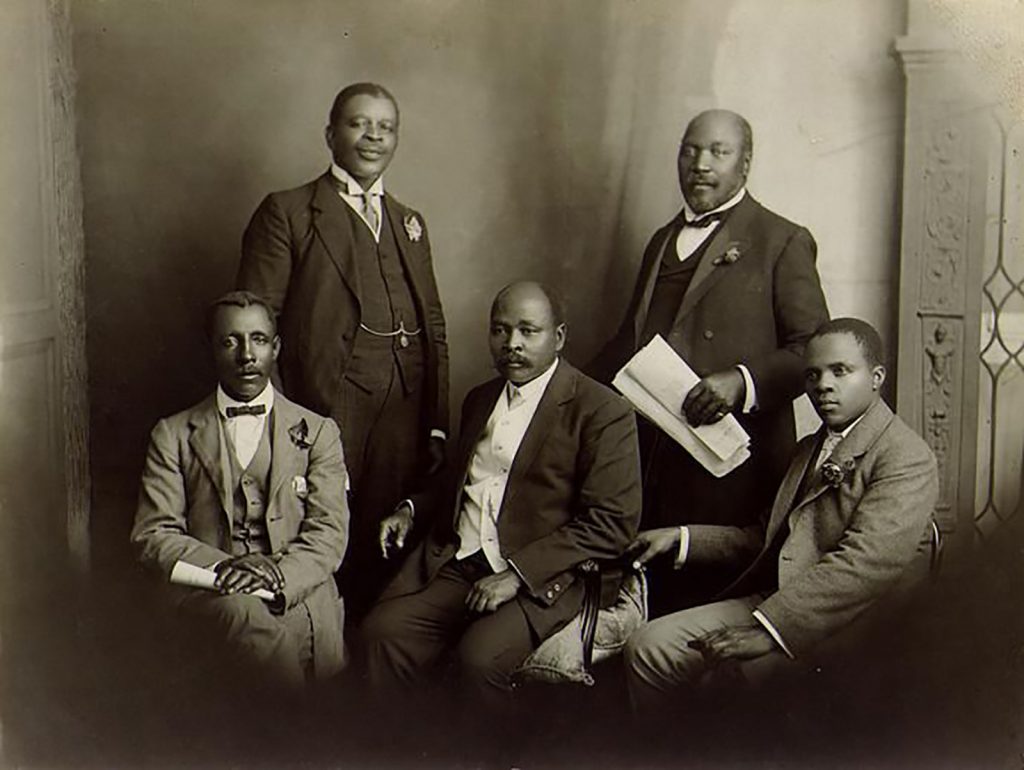 The 1914 South African Native National Congress delegation to Britain (L-R: Thomas Mapikela, Walter Rubusana, John Dube, Saul Msane, and Sol Plaatje)
The latest assassination attempt on the vice-chancellor of Fort Hare University, Sakhela Buhlungu, was meant to foil investigations into corruption at the institution, which will lead to prosecutions. The Special Investigating Unit is hard at work there. People who steal can easily kill. They may not kill directly, but do so through hitmen.
The academic lessons at the party’s political school will be more effective among the youth. But, this can only be done effectively once the organisation has rebuilt its youth league. The commitment to doing so urgently, after several years without an elected leadership, is noted. And, the collapse of the youth organisation is most regrettable.
National organisations are critical to building national consciousness, especially in a country like ours that still suffers from pockets of ethnic prejudice. But the ANC should not only be rebuilding the youth league, but also rethinking what role the organisation prepares its youth for.
The emphasis thus far seems to be on channelling the youth towards leadership in the organisation. This has, in turn, encouraged dependence on the party as a source of livelihood. The ANC is incapable of providing a living to all its cadres, nor should it be expected to do so. There’s just a limited number of deployments. This explains the prevalent use of positions to secure patronage.
The recent decision by the youth league’s interim leadership, to support Zweli Mkhize’s candidature for party president, is a shining example of exchanging votes for patronage. For a party that needs to rebuild its credentials as an ethical organisation, Mkhize’s candidature was hopelessly inappropriate.
The Digital Vibes scandal is an albatross that Mkhize still has to explain in court. But, the appointed leaders of the youth league don’t seem to have been bothered by the bleak future of their own party. It may well be that they were offered incentives to ignore the certainty of a destructive future that would have resulted from their decision.
Rather than train the youth for a role in the party per se, the ANC’s political school must prepare the party’s youth for a transformative role in society. Their education should not channel them towards the party, but toward the various societal roles. It should be a universal and progressive tuition that augments formal education.
This will imbue the attendees with technical skills, coupled with a progressive mindset in pursuit of the public good. Socialised in this manner, the youth will not preoccupy their time fighting for positions in the party and acting as proxies. They will focus towards public service.
It’s not enough, therefore, to simply rebuild organisational structures. The point should not be to restore them to their former state. The rebuilding should also be guided by what is required at the moment. Such introspection is perhaps even more important in the case of rebuilding the alliance — with organised labour, in the form of union federation Cosatu, and the South African Communist Party — as promised in the birthday statement.
Some of the critical questions that should be posed in this rebuilding exercise are: how supportive is labour towards the governing party’s economic reconstruction exercise? Is labour alert to the importance of protecting and growing the country’s economic assets.
It’s not clear that workers are alert to this critical role. One finds it hard to believe that workers at Eskom, for instance, are oblivious to the sabotage happening at power-generating plants. If they’re consciously turning a blind eye to economic sabotage, what then is the purpose of their partnership with the governing party entrusted with economic reconstruction?
Here’s the bottom line: it is insufficient to provide a list of what the governing party aims to do this year. An equally critical requirement is ensuring that a rebuilt alliance and organisation is fit for purpose. The priority, therefore, should be repairing these relations and organisations, which serve as channels and instruments that enable the governing party to achieve its stated goals. Without this heavy lifting, the birthday speech will simply amount to hot air.
Mcebisi Ndletyana is professor of political science at the University of Johannesburg and co-author of a forthcoming book on the centenary history of Fort Hare University.
The views expressed are those of the author and do not necessarily reflect the official policy or position of the Mail & Guardian.
[/membership]