There has been a 40% increase in queries for boxes at IBV International Vaults since January last year as cases of housebreaking rise. Photographer: Waldo Swiegers/Bloomberg via Getty Images
As load-shedding ramped up, Anne McCrindle was woken by the sounds of a beeping alarm warning her that the eight-hour battery for the ventilator that helps her quadriplegic husband, Brian, to breathe, was going flat.
“Because he is dependent on all those things [devices] at night, they all require batteries and the batteries have to be charged. Even with all the other things like the inverters and stuff we tried, we were running out of charging time and battery. It was grim.”
The couple, who live in Plumstead in Cape Town, have had to dig into their savings to install a “proper get-off-the-grid inverter and battery system” and are working on adding solar panels.
Brian can breathe on his own during the day, but is exhausted by the evening and needs the ventilator. “We had to get a proper inverter with long batteries, all that at a huge cost just so I can stay alive,” he said. “After a four-hour blackout, you need another eight hours to charge the battery. Of course, when you’re on stage six [load-shedding], it’s simply not going to happen.”
‘Disabling effect’
The extended load-shedding has had a disabling effect on people with disabilities, said Ari Seirlis, a member of the Presidential Working Group on Disability, and who serves on the executive of the South African Disability Alliance.
He said people who use assistive devices and mobility aids are immobilised because they struggle to charge them, adding that people with high-level spinal cord injury using continuous positive airway pressure therapy and oxygen have been at risk.
“There has been more than one case of a person with quadriplegia having passed away as a result of load-shedding — its highest impact level. The ventilation systems have failed, which caused tragic consequences.”
Power outages
Riverlea in southwestern Johannesburg is built around a mine dump. Martin Taaibos suffers from lung disease and is dependent on a nebuliser and a home oxygen tank to help him breathe. “A lot of people here are crying with their chests,” he said. “It’s bad when there is no electricity because I cannot use my nebuliser.”
 Martin Taaibos. (Photo: Delwyn Verasamy, M&G)
Charles van der Merwe, the local community monitor for the Bench Marks Foundation, said the home oxygen tanks were a “lifesaver” during load-shedding for residents with respiratory conditions.
Riverlea resident Dulcie Peffer, who has asthma, said: “If there is loadshedding, I can’t use the respirator or nebuliser. But I have my asthma pump and my oxygen tank and that really helps me a lot.”
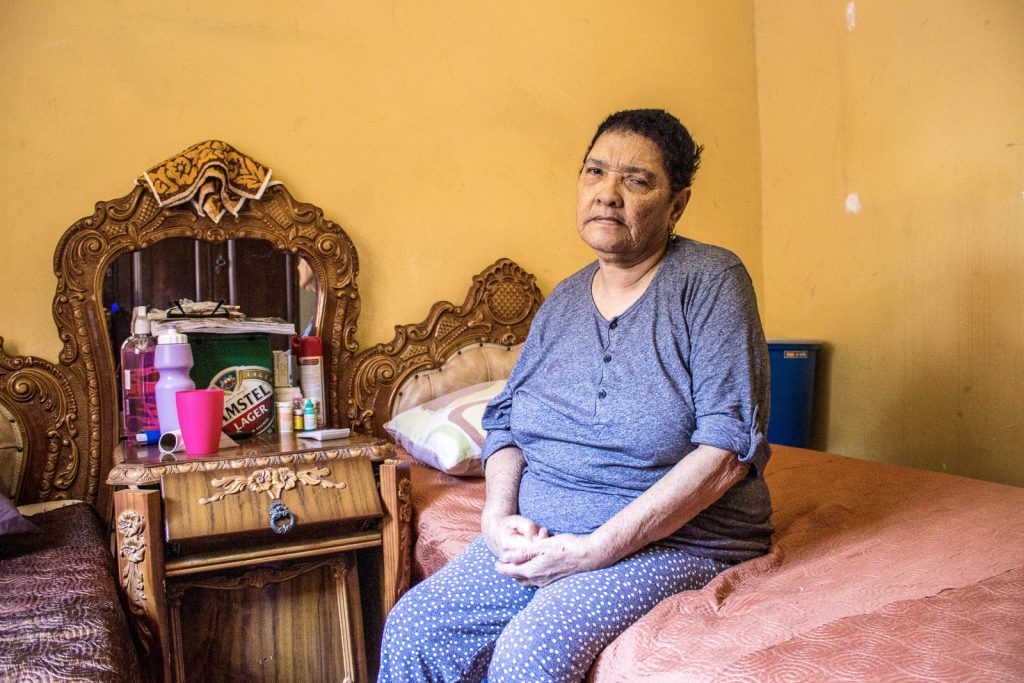 Dulcie Peffer. (Photo: Delwyn Verasamy, M&G)
Mark Keyter, the chairperson of the Riverlea Mining Forum, said: “Outages are expected for plus minus two hours … or four hours, so you can compensate for that but the added challenge is that once there’s load-shedding, the cables get stolen and then they have to come out and replace those and that takes sometimes upwards of two to three days.”
Suffering in silence
Seirlis said load-shedding has paralysed people with mobility impairments. “People using communication devices have been cut off from their communities as very few people who depend on power for their functional existence can afford inverters or the opportunity to be off the grid.”
Article 19 of the United Nations Convention on the Rights of Persons with Disabilities protects accessibility for people with disabilities to live independently and participate fully and equally in society. But, Seirlis said, load-shedding “completely compromises” Article 19 and the Equality Act.
“Most deaf people — rich and poor equally — are affected by load-shedding periods, especially hearing impaired people in our country who are suffering in silence as they can longer communicate or socialise in the darkness as power outages continue.”
Communication for non-speaking people is severely affected because communication devices don’t function during load-shedding. “Charging of cochlear implants and hearing aid batteries is severely impacted.”
Harmful consequences
The negative effect of load-shedding on economic participation and job security for people who have hearing problems is severe; it curtails their participation on virtual platforms because cell phone networks are not connected during load-shedding, Seirlis said, adding that virtual meeting platforms with captions are not accessible.
The hundreds of homes, institutions and self-help centres cannot afford solar solutions or batteries and inverters and “are already compromised in their sustainability as a result of poor support from the government”.
Many people with disabilities have been able to work from home, following the Covid-19 lockdowns. “Most of those persons with disabilities are now compromised by not having any backup systems in their homes to continue employment,” Seirlis said, adding the 18% electricity tariff hike is “now a final straw on the pocket of people with disabilities whose pension is meagre as it is”.
An immediate solution would be for inverters to be provided for all people with disabilities because they depend on electricity for their mobility aids, assistive devices and communication devices.
“Until then, there is an immediate risk to life as well as a disruption in the functionality within communities of people with disabilities. Surely the government has learnt from the tragic case of Life Esidimeni and should respond immediately for this call to action and resolving the electricity crisis.”
Solar plan
This week, The Association for the Aged (Tafta) announced it will start installing solar energy in stages at its various facilities. The nonprofit recorded its expenditure on municipal costs at R12.8 million in the last financial year, excluding the cost of fuel to power generators during load-shedding.
“Not only are our elders affected by the lack of constant power supply, but our organisation faces increasing expenses by the hike in prices due to inflation,” said its chief executive, Femada Shamam, adding that caring for older people with special needs such as dependency on oxygen is also made difficult with the intermittent supply of electricity.
“With the average cost to purchase a 200kVA generator being about R449 000 excluding the annual maintenance, fuel and service costs, this makes it a costly alternative” given that there are 13 facilities.
Shamam said the move to solar power was a step towards providing some relief from the high municipal service costs, although it wouldn’t take the facilities off the grid or reduce their dependence on municipal power. It would, however, decrease the carbon footprint of the homes, allow for more money to be allocated to caring for people and improve the quality of their lives.
[/membership]