Things fall apart: The coalitions running the city for seven years have been fractious and service delivery has suffered. Photo: Moeletsi Mabe
The mismanagement of finances and the illegal occupation of land — which recently saw the killing of a 31-year-old man in a case allegedly involving Al Jama-ah, the party leading Johannesburg’s new coalition government — are some of the highlights of the instability that has rocked the city since 2016.
Sioga Pfananani Mudogwa — a resident of Lenasia, south of Johannesburg — was killed with a shotgun on 15 December, according to an autopsy report from his family, during an operation to bulldoze homes being illegally built on land belonging to the city.
Mudogwa’s family and residents have accused Imraan Moosa, a councillor from Lenasia and a close confidant of Johannesburg’s new mayor, Thapelo Amad, of spurring on the local community policing forum (CPF) as well as Johannesburg metropolitan police department (JMPD) officers to destroy homes built by blacks in the predominantly Indian community.
In his first public event after his 27 January election at a council meeting, Amad took part in a clean-up programme organised by Moosa a day after being installed as the city’s first citizen. The Mail & Guardian sent questions to Amad but he had not responded by the time of publication.
The contentious issue of land occupation in Johannesburg was championed by Economic Freedom Fighters (EFF) leader Julius Malema, who told parliament in May 2018 that “the land belonged to us”. He said if the ANC “wants to kill our people for rightfully claiming their land, do so”.
The EFF, which is the fourth-largest party in the Johannesburg council, played a role in electing Amad as mayor, after the removal of Mpho Phalatse of the Democratic Alliance (DA). EFF Gauteng chairperson Nkululeko Dunga acknowledged receipt of questions about whether the party had changed its stance on land occupation in the city but had not responded at the time of going to print.
Like the land issue, the city’s finance management has consistently been a political football kicked around since the 2016 local government elections, when the ANC lost control of Johannesburg and no other party won an outright majority. This was again the case in the 2021 elections.
The coalitions running the city over the past seven years have been fractious and service delivery has suffered as a result.
The first coalition government, which was led by the DA with Herman Mashaba as mayor from August 2016 until his resignation in October 2019, stated that it had investigated 5 597 corrupt projects under the ANC administrations preceding 2016, where R34 billion of alleged graft was unearthed discovered.
When Geoff Makhubo, of the ANC, became mayor in December 2019, in another short-lived coalition government, he accused Mashaba’s administration of financial mismanagement, saying it had allowed Johannesburg’s energy company, City Power, to incur liabilities of R3.9 billion.
“These challenges may result in the collapse of this great city. Johannesburg is one of the worst culprits in terms of finance management, according to the auditor general,” Makhubo said at the time.
But during Makhubo’s mayoral tenure, more than R530 million of corrupt spending linked to the Covid-19 pandemic was discovered by the Special Investigating Unit (SIU), including the irregular awarding of deep-cleaning contracts in 2020. About R500 million, according to the SIU’s report, was misappropriated by the Johannesburg Property Company, and the matter is at the Special Tribunal for the state to retrieve its lost funds.
In the SIU’s latest annual report, covering the period from April 2021 to March last year, the unit said it had instituted civil proceedings to recover more than R453 million in corrupt contracts, referring 13 city officials to the National Prosecuting Authority for criminal prosecution.
For the 2021-22 financial year, the auditor general found that irregular, fruitless and wasteful expenditure amounted to R5.4 billion, up from R3 billion in 2018-19.
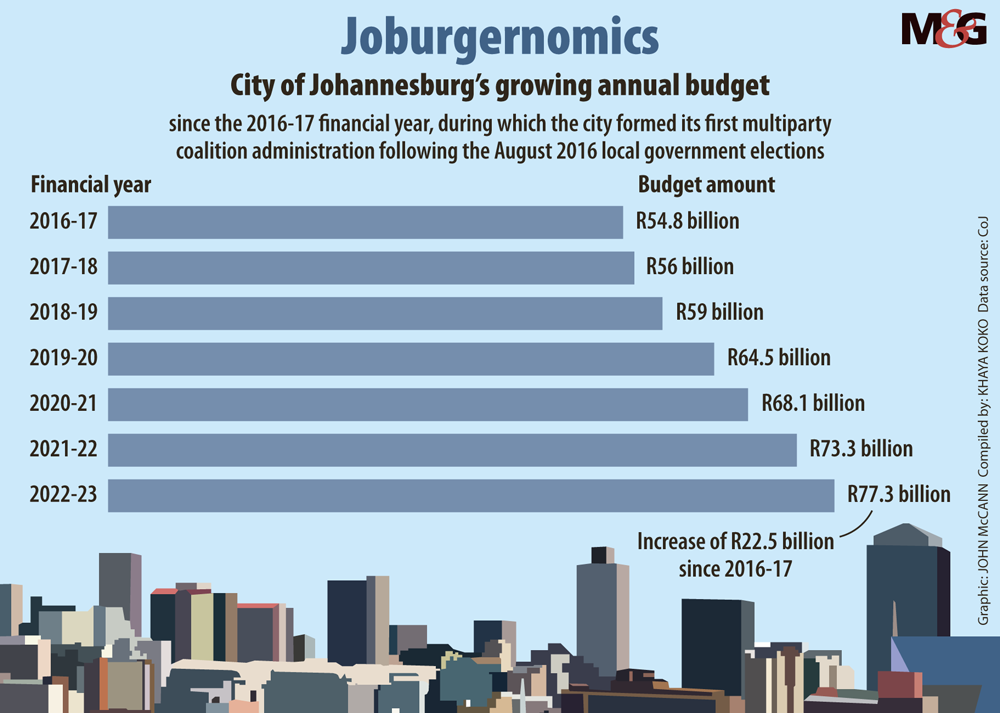
The city’s budget, which is consistently the biggest of any municipality in the country, grew from R54.8 billion in the 2016-17 financial year to R77.3 billion in the current 2022-23 reporting period, which ends in June.
 Wasteland: The city’s budget grew from R54.8 billion in the 2016-2017 financial year to R77.3 billion for the current period. Photo: Moeletsi Mabe
Meanwhile, in the land occupation saga, Moosa, responding this week, refuted allegations of having a hand in Mudogwa’s murder, saying he only acted to prevent “unlawful land invasion and the presence of unknown persons who had commenced construction of a dwelling”.
Moosa can be heard in a series of voice messages, sent by him on the day of the incident to a Lenasia social media group chat, calling on the CPF as well as local security companies to protect what the councillor referred to as “our land”.
“This is why our community activists, patrollers [and] CPF … need to get hold of some of the police members to understand exactly what our aim and objective is to protect the land in our [surroundings].
“We cannot allow flagrancy of the law in the way that it is taking place,” Moosa says in the voice messages.
“So we call upon all security firms, CPF [and] patrollers, let’s meet up together and let’s do something about it lest we lose our land.”
Mudogwa’s brother, Khaya Mudogwa, this week alleged that Moosa was a “powerful” person, who held sway with the city’s law enforcement officers because the councillor was able to “summon” JMPD officers in the dead of night to bulldoze houses.
Khaya said he and his brother had started erecting their house on the morning of 15 December, whereafter Moosa arrived with JMPD and police officers to “instruct” the brothers to stop their building.
 (John McCann/M&G)
The M&G has seen a video taken on the night of Mudogwa’s killing, where people held their hands in the air to show they were not looking for a fight, before they were shot at.
“Moosa kept returning with different JMPD officers throughout that day and into the night. How powerful can one man be to be able to arrange a [tractor-loader-backhoe] late at night?” Khaya Mudongwa asked.
Moosa confirmed that he had called for the removal of the structures, saying it was his duty as a councillor to do so.
“After much interaction during the day, the law enforcement authorities caused the land invaders to be removed and the unlawful structures to be demolished,” Moosa said. “The matter was only concluded late that evening.
“By the time that the land invaders were removed and the unlawful structures demolished, nobody had taken up residence on the land in question and nobody was evicted.”
But another resident, Themba Mabasa, disputed Moosa’s contention that no one had taken up residence, saying that his house, which is next to the land the Mudogwa brothers wanted to occupy, was also demolished in December.
“My wife and I had to squat at a friend’s house nearby after my house was destroyed.
“We have only recently moved back into our home, but I am still piecing together what was bulldozed after Moosa called for us to be removed,” Mabasa said, showing the M&G around his house.
“The JMPD and Moosa did not show me or anyone else a court order that I should be evicted and my house destroyed.”
Johannesburg spokesperson Nthatisi Modingoane said: “The operations to prevent illegal land invasion in [the Lenasia area] are undertaken by the JMPD on an ongoing basis, not by councillors.
“When a land grab is reported to the team responsible, they go out and deal with the matter.”
Gauteng police spokesperson Colonel Dimakatso Sello confirmed that Lenasia police were investigating a murder case.
*This article first mentioned the Johannesburg Housing Company instead of the Johannesburg Property Company. For this, we apologise. The mistake has been corrected