

/ 18 May 2023

Activists reject Lamola’s call to withdraw rape law challenge

Ed 443597
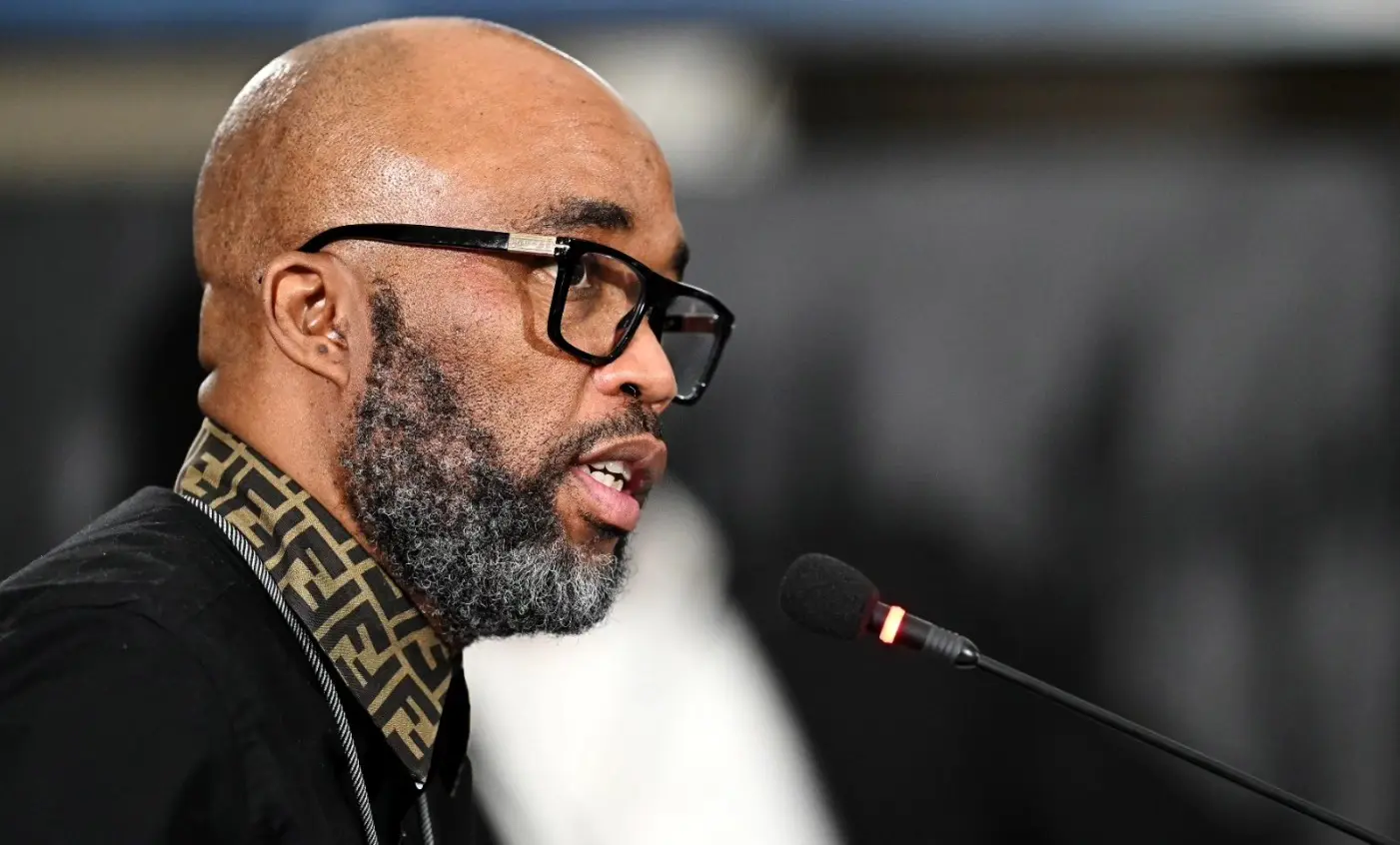
Justice Minister Ronald Lamola. (Brenton Geach/Gallo Images and Phill Magakoe/ Gallo Images)

The Embrace Project has a rejected a proposal by Justice Minister Ronald Minister Lamola to withdraw its constitutional challenge to the defence of mistaken belief in the law on rape and rather allow him to send the Sexual Offences and Related Matters Act back to the law commission for consideration.

Doing so would only delay the matter, the director of the NGO, Lee Ann Germanos, said in a replying affidavit filed to the Pretoria high court. She recalled that the commission received proposals more than 20 years ago to scrap the subjective test on consent in the law but these came to nought.

“The minister of justice and the legislature did nothing about it. If the Act is declared unconstitutional, the minister and the legislature will have an opportunity to consider how best to remedy the defect,” Germanos wrote.

Lamola made the offer after withdrawing parts of the ministry’s replying affidavit to the application which he deemed offensive, notably a paragraph suggesting that the applicants were motivated by negativity towards men.

The applicants said his supplementary affidavit did not go far enough in this regard.

It left intact a facetious comment that the applicants failed to communicate their viewpoint to the commission before it submitted its proposals for amending the Act in 2002. The Embrace Project was only founded in 2020 and the second applicant, Inge Holztrager, was still a child when the report was filed.

“These sarcastic comments (which have not been withdrawn) are unbecoming of the minister of justice, and are rejected with contempt.”

The applicants are asking the court to declare sections 3 to 9 and 11(a) of the Act unconstitutional.

They argue that these are against the constitutional rights of rape victims by recognising a defence of mistaken belief that there had been consent. 

The test hinges on the mindset of the accused at the time. In other words, if the state fails to prove beyond a reasonable doubt that it was not “reasonably possibly true” that the accused held this belief, acquittal must follow. 

The defence is not unique to South African law and neither is the debate about it. But in recent years other jurisdictions have replaced it with “an objectively reasonable” belief that the victim had consented.

The justice ministry has argued that it would be problematic to introduce an objective test because it would impose a single standard of acceptable sexual conduct in a diverse society.

“South Africa is a heterogeneous nation and this factor on its own will make the objective test difficult for the courts to adjudge consistently.”

The applicants said this objection, in effect, saw the ministry plead for the law to retain a provision that compelled courts to acquit rapists who raised a regressive mindset as a defence. 

It was understood that it intended to strike out this paragraph, but it has been retained and qualified with the assurance that consent was a “golden thread” running through every cultural context.

The applicants said this was “an astonishing submission”, and did not hold in fact or in law.

“It simply beggars belief that the minister of justice can contend that a reasonable person test cannot be applied in a ‘heterogeneous nation’,” they argued.

First, those jurisdictions that have adopted an objective test were diverse in terms of race, religion and culture. Second, it was routinely applied in criminal courts dealing with culpable homicide.

The applicants said the minister’s argument underscores why the law should be amended, because as it stood it opened the door for defendants to invoke rape myths in justifying their subjective belief that the complainant had consented to sex.

In its answering affidavit papers, the ministry said there “is nothing wrong with the defence of purely subjective belief”. It added that the applicants should be more measured in their arguments because a reasonable belief must be based on the facts and therefore a court must consider the full spectrum of evidence.

It argued that an objective test would reverse the burden of proof by compelling the accused to prove that there was consent and rob him of the presumption of innocence.

The ministry raised similar objections to the applicants’ argument that the law must at all times punish intercourse against the victims will, regardless of whether it was done intentionally or recklessly, through failure to establish consent.

“The relief sought by the applicants is to criminalise negligent conduct in sexual offences and convict the accused person of the full blown crime of rape.”

The ministry said it would be unfair because the burden of proof for negligence is lower.

This was wrong in law, the applicants countered in papers filed last week, adding that Lamola appeared to have misread their case. 

“Our case is, very simply, about outlawing an unreasonable perception of consent as a defence … It is correct that this has the effect of lowering the degree of fault for those sexual offences from intention (dolus) to negligence (culpa). But it has no impact on either the burden (onus) or the standard (quantum) of proof.”

Negligence is already criminalised in culpable homicide and in statutory rape, with no deviation from the standard of proof of guilt beyond a reasonable doubt, or prejudice to the constitutional rights of the accused the ministry inferred would arise if the law on rape were amended.

“It is only a question of whether the harm sought to be prevented and punished is sufficiently serious that a higher standard of conduct and care may be demanded of people,” the applicants said.

“The minister’s case must, therefore, be that the negligent violation of the dignity, equality, privacy, bodily and psychological integrity, as well as sexual autonomy of people in South Africa, especially women, is not sufficiently serious to warrant criminalisation. This case needs only to be stated to be rejected.”

Furthermore, the applicants said, international precedent favoured the criminalisation of negligent sexual violations.

“South Africa, with its transformative egalitarian constitution juxtaposed against its horrifying scourge of gender-based violence, should be taking the lead in this long-overdue evolution in the law. Instead, we are lagging behind.”

The contested defence fell under the spotlight a year and half ago when a rape conviction was overturned on appeal in S v Coko, with the court accepting that the accused could have held the genuine belief that his girlfriend had tacitly consented to intercourse.

At the time, a number of legal experts said the court could have upheld the conviction if it had applied the principle of dolus eventualis — a mindset of intention where the accused foresees that harm could follow and reconciles himself with it.

The ministry also raised this possibility of applying this principle, saying it should have been done in S v Amos, the rape case where Holztrager was the complainant that ended in acquittal of the accused.

“It was possible to convict the accused as dolus eventualis was proven, because he displayed no care for whether consent was given.”

But the applicants said the ministry’s thinking was hard to follow because its objections to negligence would also apply to dolus eventualis.

“The minister’s contention that an unreasonable belief that consent was present would necessarily amount to dolus eventualis is difficult to understand, as he elsewhere repeatedly complains that the relief we seek would lower the degree of fault to negligence. 

“This is an irreconcilable contradiction.”