Your cheque is in the mail: Finance Minister Enoch Godongwana has welcomed a court decision to place the South African Post Office in business rescue. Photo: Made Nagi/AFP
The South African Post Office (Sapo) has been placed under business rescue while the SABC is on the verge of going the same route, highlighting what business experts say are the governance and operational failures plaguing state entities, as well as their unwillingness to move with the times.
Finance Minister Enoch Godongwana, who is also the acting minister of communications and digital technologies, welcomed Tuesday’s decision by the Pretoria high court to place the post office under business rescue after an application by the government.
The post office had already been deemed commercially insolvent and illiquid and was placed in provisional liquidation in February, due to its failure to pay rent and other liabilities.
Godongwana said the court’s decision confirmed that the post office was a strategic government asset, which provides vital services throughout the country, especially in remote areas, where it is often the main link between residents and the outside world.
“This decision will give Sapo the much-needed time and space to restructure its affairs under supervision and implement the turnaround plan to fundamentally change its business model into a solvent and viable business with broad revenue streams that leads on modern services,” he said.
The SABC is also in extreme financial distress and could be forced to apply for business rescue. The Sunday Times reported that the public broadcaster looks set to announce a loss of more than R1 billion for the financial year ended March 2023.
Michael Sachs, a professor at the University of the Witwatersrand, noted that both the SABC and the post office have had “serious problems” with governance for a while.
“In the case of the SABC, in particular, they spent a very long time without a board.
“If you look at both the post office and the SABC, they are operating in spaces where there have been really deep changes in technology.
“In the post office, it goes back to the invention of email which, over time, undermined the whole business of post, globally,” Sachs said.
The public broadcaster went six months without a board after the term of the previous team came to an end in October.
Sachs said while governance was the number one problem, there was also the challenge of an unwillingness to confront the deep structural changes that are needed to make state institutions financially viable.
The end result was that the treasury had to keep bailing them out.
The office of the auditor general has warned that the post office would not make it through the year, noting that the entity had struggled to implement its turnaround plan because of funding constraints.
In an effort to help it implement the plan, the treasury granted the post office a R2.4 billion bailout in its 2023 budget, which was tabled in February. It also receives a R452 million subsidy from the treasury.
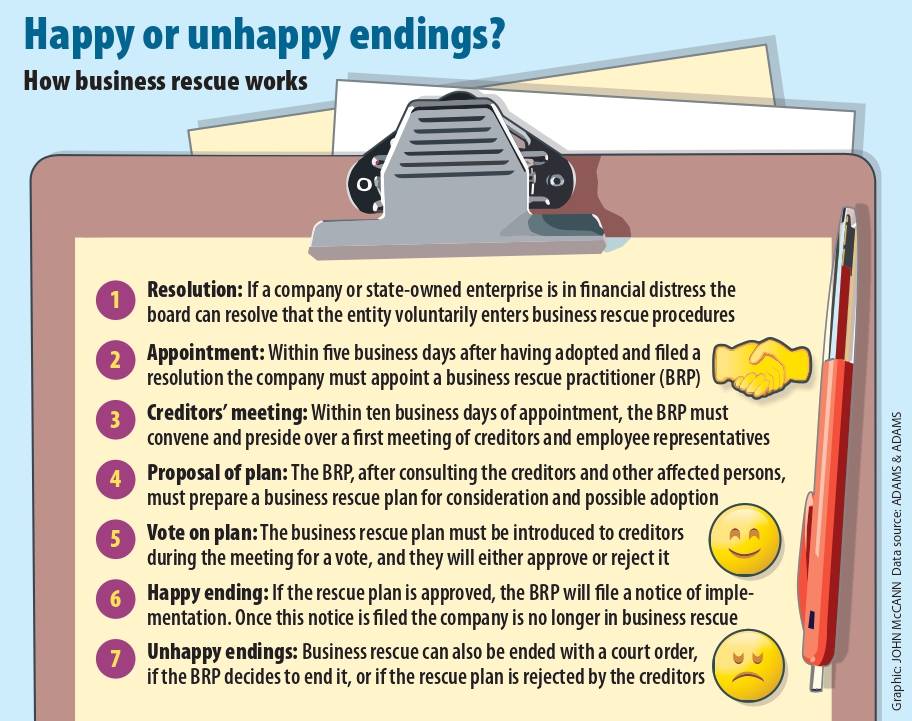 (John McCann/M&G)
But the cash injection came too late and was not sufficient to set the clock back on the financial battering the entity endured in the wake of yearly losses of R2 billion.
The post office is not the first state-owned enterprise to enter into business rescue, with SAA having led the way.
The national carrier was placed under business rescue in December 2019 and exited the process in April 2021. As part of SAA’s business rescue plan about 2 268 employees were axed.
“The example of SAA shows that the business rescue process is not an ideal process for a state company because it’s really designed to deal with a kind of private sector commercial operation,” Sachs said.
The key difference between a public company, such as the post office, and a private company, he explained, is that when a private company goes bankrupt creditors need to be dealt with and the potential closure of the business is on the cards.
In contrast, it would not be that straightforward to close down the post office or the SABC because these institutions perform public functions as stipulated by legislation.
“The business rescue process is not ideal for a state-owned entity but at least it is an acknowledgment that things cannot go on as they have been,” he said.
“It’s the only way to signal that something very fundamental has to change in the operating model of the institution.”
The business rescue process for a state-owned entity differs from that of a private corporation, according to Lara Kahn, an attorney at Webber Wentzel who specialises in business rescue, restructuring, as well as insolvency-related matters.
Chapter 6 of the Companies Act governs business rescue and has to be read together with the Public Finance Management Act, she said.
One of the fundamental differences is that, in a normal business rescue process, the practitioners are independent and, outside of them, the important stakeholders in decision-making are the creditors, Kahn explained.
The creditors will vote on a business rescue plan. The shareholder only gets a say if the business rescue plan impacts on their rights and this is often not the case.
With the business rescue of a state-owned entity the shareholder — being the state — usually has a lot more control.
“There is an uneasy tension and it doesn’t operate in the same way. It’s harder for a business rescue practitioner to run a rescue of a state-owned entity than it would be to run an ordinary commercial entity.
“You wouldn’t have to revert to the shareholder before making certain decisions,” Kahn said.
She added: “The rescue of so many SOEs is a failure in governance and, as much as rescue is better than liquidation, it would be far better to run these entities properly so they don’t have to go to rescue, or restructure them early enough, while they are still solvent.”
To return the post office to an operational entity, about 7 000 jobs would need to be cut. According to its 2022 annual report, it has 14 460 permanent employees.
“Certainly, trade unions are likely to have a problem with the loss of jobs that is likely to happen,” Sachs said.
“When a private company is bankrupt, it’s bankrupt and there’s not much anyone can do.
“With a public company that is operated in terms of a public mandate with some kind of legislation passed in parliament, the unions have recourse to the government.”
But unions say business rescue has made it easier to shed workers at state companies.
“We think that our government has found a new way, and the easiest way, to retrench employees. When they go into business rescue it makes it impossible to fight against retrenchments,” said Aubrey Tshabalala, general secretary of the Communication Workers’ Union.
Although SOEs are generally not meant to be run with the intention of making a profit, Tshabalala said SAA, SABC and the post office were prime examples of how South Africa’s badly run state companies were failing to fulfil even their basic public service mandates.
“Unfortunately, everyone who is employed in these institutions thinks they are being served lunch,” he said.
“They just come in and run it down the drain, make irrational decisions, and no one has been held accountable.
“The issues of corporate governance also play a role in all the institutions when the government is involved.”