Wheels are off: Minibuses were used to block roads and buses were burnt, leaving thousands of commuters without transport, after taxi operators went on strike this week. (Jaco Marais/Gallo Images)
The taxi strike in Cape Town over the impounding of vehicles found to be flouting laws has brought into focus the power struggle between the Democratic Alliance (DA) in the Western Cape and the ANC-led national government.
It has also highlighted the importance of an industry which is the only source of affordable transport for millions of commuters but has long been poorly regulated.
The low cost and point-to-point flexibility of taxis appeals to consumers, not just in the Western Cape, but across the country, when contrasted with the more rigid routes and timetables of buses, noted Craig Pederson, the head of private digital forensics firm TCG Forensics, who has been monitoring the strike.
“The taxi industry has always offered an affordable route to work for thousands of blue-collar workers in the Western Cape.
“The decline of rail services has also made workers more reliant on taxis and buses over the years,” Pederson told the Mail & Guardian.
“This week we have been reminded of their importance as a route to work for many people, he added, referring to the thousands of commuters and schoolchildren who have been left stranded.”
The economic effect of the strike has been widespread, Pederson said.
“Stores have run low on, or out of, essentials such as bread and milk which are reliant on daily deliveries and a free-flowing route to market.
“Many restaurants have closed as staff haven’t been able to reach work.
“We’ve seen hundreds of businesses closing early to ensure staff can get home.”
The knock-on effect has also highlighted South Africa’s lack of a reliable public transport system, said Genevieve Labuschagne, researcher at the Centre for Risk Analysis.
“Businesses have had to change operating hours or close operations, places are working on skeleton staff, and staff who work on hourly wages have lost serious income.
“Services, such as transporting stock, have been disrupted so stock is running low for retailers as well as hospitality. There is also the economic loss from damage to property, which will only later be calculated,” she said. “The industry provides employment and, by extension, it plays a role in the employment of multiple other industries.
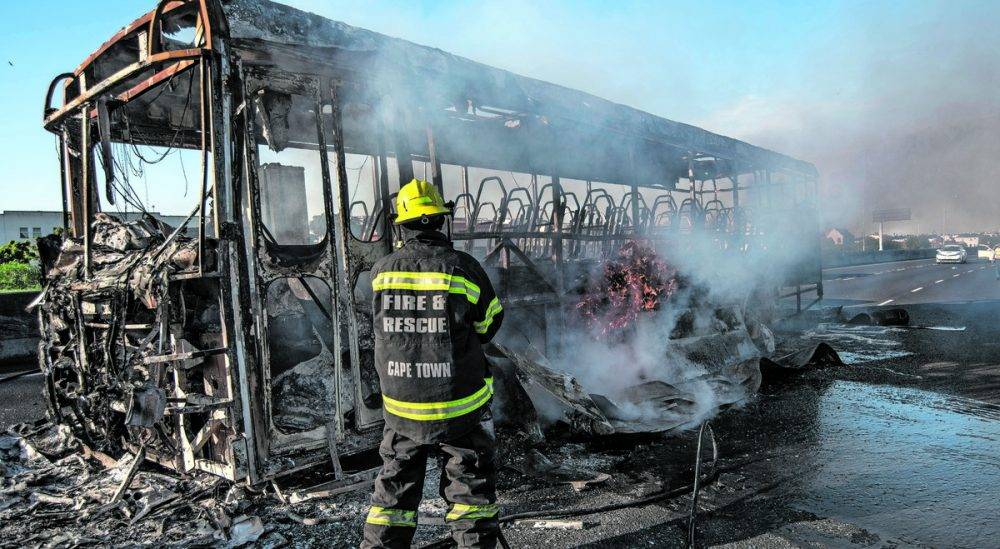 Busses were torched during the protests. (Brenton Geach/ Gallo Images)
“Logistics and transport are crucial to a country’s economy and taxis have filled a part of the transport gap that has resulted from bad governance, no maintenance of infrastructure and corruption in state institutions.”
The taxi industry has long been plagued by poor regulation, while an oversupply of vehicles has, over the years, resulted in carnage on South Africa’s roads as taxi drivers competing for passengers flout traffic rules, largely without legal punishment.
“The taxi bosses operate with impunity … outside of the rules of ‘normal’, legitimate businesses because it’s so hard to regulate.
“The taxi industry has been able to operate without roadworthiness; with unpaid fines and tickets; invalid [or no] licences and with no regard for the rules of the road because of the state of our traffic services and policing,” Labuschagne said.
“The taxi industry is a major political non-state actor. It has been allowed to get away with violence and strikes before and the failure of our government to react has placed them in a position where they are at the hands of the taxis.”
Taxi operators have increasingly become intolerant of competitors in the public transport sector and, during the strike, buses belonging to Golden Arrow have been torched.
“The Western Cape and Cape Town are areas where public transport does operate more reliably and adequately in comparison to the rest of the country — the Gautrain is too limited in routes and destinations and is expensive,” Labuschagne said.
“Golden Arrow buses present an option for commuters who don’t want to use taxis … buses are ‘threats’ to the taxi industry.”
Pederson weighed in: “We’ve seen similar dynamics at play with the sabotage of trains in Cape Town, where the undertone was that trains were being burned to disrupt their operations and force commuters to use taxis instead.
“As soon as the taxi industry goes on strike, they will target buses as this is the logical alternative to taxis.
“Taxi operators feel they should be entitled to the same subsidies paid to bus services. Bus services receive subsidies to reduce the cost of public transport. While buses are easy to regulate and control routes, the same can’t be said of taxis,” he added.
The taxi strike has brought to the fore the political power tussle between the DA government in the Western Cape and the ANC-led national government, which lost control of the province in 2009, political analyst Ralph Mathekga noted.
Earlier this week, Transport Minister Sindisiwe Chikunga slammed the City of Cape Town over its handling of the crisis, accusing it of being arrogant. She said the by-laws the city had used to impound taxi vehicles were “actually overreaching and extending the legislation that already exists”.
“What is at play here is the evolution of power from the national to regional government. The bigger thing at play is actually how the provincial government is testing what is legally possible at a provincial level and the national government, that is not running this province, asserting itself,” Mathekga told the M&G.
He said the debate was whether the DA was wielding its inherent provincial legislative powers rather than power ceded to it by virtue of legislation set by the national government.
“What has happened in Cape Town could have happened 15 or 20 years ago. Why didn’t it? Because the ANC didn’t have coherence.
“It is one of the most interesting tensions that is happening in the evolution of power from national to regional government as the government is decentralising,” he said.
“The DA realises it doesn’t need the vote of the people affected by these laws, so they can enforce it. The law is the same in other cities, although you might find deviations here and there, but it is the stand which the municipality executives take.
The DA has been criticised, not just by the government but by civic groups over its handling of the strike and the plight of stranded commuters and pupils, but Pederson applauded its hardline stance, saying it should be emulated elsewhere in the country to bring the sector to order.
It’s never going to be easy to control an industry that operates largely on a cash basis, he added.
 Thousands of commuters were left without transport.
“We’re talking about a business that generates millions in tax free revenue. I’ve never seen or heard of a taxi charging value-added tax, yet it’s possible for a single taxi to generate more than the R1.2 million per annum threshold for VAT registration.
“This type of business is going to attract some shady characters and some hard characters. With their influence and standing in their communities as employment generators and cash businesses, it stands to reason it’s a highly competitive business.
“That, in turn, has led to taxi associations which represent the interests of different groups and routes.
“Those associations wield substantial influence and authority. The only way to deal with this is through regulation of the taxi industry and the City of Cape Town’s approach of ‘no-permit, no taxi’ is perfectly correct and should enjoy every support from local and national government.”
Pederson said taxi associations have always been about money, not politics, but added: “They do get drawn into the political fray, with parties vying for their support. They’re seen as a representative body and powerful within the communities they serve, so obviously politicians would be drawn to having their support.”
A source, who asked not to be named, said nepotism and patronage are deeply rooted in the industry.
“The taxi bosses are well-connected politically and commercially. If you take a look at Chikunga’s remarks and how strongly she defends the taxi bosses — regardless of the laws and violence — it shows how much influence the taxi industry has in politics.”