South Africa is widely recognised as the most unequal society in the world, with a startling 71% of the country's wealth concentrated in the hands of a mere 10% elite
In 2009, Trevor Manuel — South Africa’s longest-serving finance minister — returned to the government to spearhead what would become the National Development Plan (NDP) alongside his right hand, Cyril Ramaphosa.
The 489-page plan was adopted three years later in 2012, setting out goals to be achieved by 2030.
At the time, South Africa’s economy was lumbering along despite the pain inflicted by the global financial crisis, thanks in part to the revival of the commodity supercycle.
But the economy would soon feel the full extent of the downturn, raising red flags over the country’s public finances and prompting the national treasury to administer fiscal consolidation.
In the decade that followed, the NDP’s targets slipped even further from the government’s reach. As the plan approaches its home stretch, the economy now looks set to endure even deeper austerity — a development that would cut an already limping NDP right at its knees.
Earlier this week, the National Planning Commission, an independent advisory body appointed by the president as the custodian of the economic plan, released its 10-year review of the NDP, which has the overarching goal of eradicating poverty and reducing inequality and unemployment by 2030.
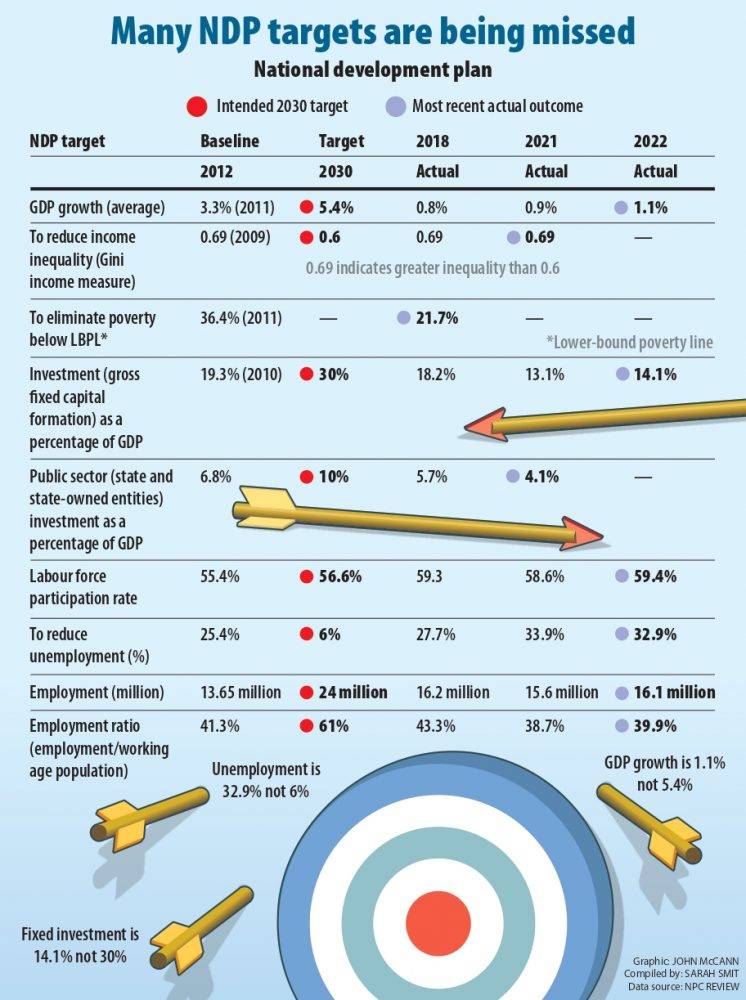
Attaining this would require the economy to achieve 5.4% GDP growth per year, a target it is tragically far from realising. As the review notes, South Africa’s growth has averaged 0.99% annually in the past decade, with GDP per capita growth negative in five of those years.
To achieve its lofty annual growth target, the NDP set the target of 30% investment as a percentage of GDP by 2030.
But, from 2012 to 2019, gross fixed capital formation as a percentage of GDP averaged 19.6% “largely as a result of a decline in private investment, a slowdown in general government spending and reduced capital spending from SOEs [state-owned entities]”.
 (Graphic: John McCann/M&G)
Investment fell even further from 2018 to 2021, averaging only 14.7% of GDP. Public sector investment fell from 6.8% of GDP in 2012 to only 4.1% in 2021. The 2030 target is 10%.
The NDP’s goals, the 10-year review notes, were conceived under the assumption that South Africa would achieve improved investor sentiment, educational and health outcomes and infrastructure — all of which would be enabled by a capable state.
“Given that much of this was not realised, the economy has not performed as expected during the period under review.”
The review highlighted several risks to South Africa’s constitutional democracy, including a weakened government, the blurred line between political and administrative functions, corruption and “severe and limiting fiscal constraints”.
South Africa’s woeful growth prospects and another commodity slowdown are behind a renewed push by the national treasury, led by Finance Minister Enoch Godongwana, to pare back public spending.
According to the South African Reserve Bank’s most recent estimates, GDP growth will average 0.7% in 2023, 1% in 2024 and 1.1% in 2025. Although the outlook has improved compared with earlier in the year, the central bank still sees growth failing to meet the February budget’s grim forecasts.
Meanwhile, South Africa’s terms of trade have deteriorated materially compared to last year. The country’s trade balance recorded a small surplus of R0.5 billion in the first half of 2023, compared to the R22.3 billion in the same period last year, as demand for commodities fell off.
The commodity tax windfall has buoyed South Africa’s public finances in recent years. But as it has started to tail off, and financial conditions have tightened, the prospect of even deeper austerity has materialised.
The treasury has already set out a number of cost-cutting measures ahead of Godongwana’s medium-term budget policy statement set for early November.
The NDP’s targets may have been a tall order in the first place, given the constraints on the economy that already existed in 2012.
But the impending budget cuts will render the NDP even more futile. “With the cuts, there is no way we are going to achieve any of the targets,” said Duma Gqubule, a research associate at the Social Policy Initiative.
Gqubule cited research by the University of the Witwatersrand’s Public Economy Projects (PEP) — led by the former head of treasury’s budget office, Michael Sachs — showing that the fiscal squeeze since 2012 has contributed to “a chronic deterioration in the capacity of the state, the quality of social services, and the outcomes they are intended to achieve”.
In the decade after 2012, there were significant reductions in real spending on basic education and criminal justice, while healthcare budgets have been under increasing pressure, the PEP found.
“There is no chance we will meet any of the targets with austerity policies. It’s completely impossible,” Gqubule added.
“Until we decide what to target. Currently we are targeting debt and inflation, so we are not targeting the National Development Plan … If you’ve got no macroeconomic policies that are directed towards those targets, then it is a complete waste of time.”
Hugo Pienaar, the chief economist at the Bureau for Economic Research, agreed that in the context of fiscal consolidation, the economic targets set out in the NDP could be exceedingly difficult to achieve.
“Even if we did not have fiscal consolidation, 5% growth would probably still not have been achievable. That 5% per annum growth was a very lofty goal to begin with,” Pienaar said, noting that that level of growth is required to bring down unemployment. The NDP had the goal of reducing the unemployment rate to 6% by 2030.
Fiscal consolidation could weigh on growth, Pienaar said. But it is not the main constraint on growth, which — even in the most optimistic forecasts — will reach nowhere near 5.4% in the coming years.
Like Gqubule, the Alternative Information & Development Centre’s Dominic Brown pointed to the enduring macroeconomic framework, of which fiscal consolidation is a cornerstone, as being the NDP’s death knell.
“The macroeconomic framework is not suitable,” Brown said. “It is not congruent with the plan and it hasn’t been since its adoption, effectively.”
Former statistician general and economist Pali Lehohla agreed.
He has criticised the NDP for its failure to put forward a coherent economic plan. “It was a document that was important, that was desirable and that people agreed to. But it couldn’t pass muster as a plan, because it is yet to deliver a plan itself,” he said in an interview with the Mail & Guardian this week.
“So when we say that it was never implemented — it was never planned.”
That said, it would be misguided to believe that the public sector is incapable of meeting bold economic targets, like those set out in the NDP, Lehohla said.
“But this idea of a small government doesn’t work … If we entrench austerity, it will be worse. Our policies cannot be anchored on free market fundamentalism, in which the private sector says government is a referee, not a player,” he said.
“Government is an interventionist in the system of development.”
The free market fundamentalism described by Lehohla is at odds with the ideal of a caring government set out in the NDP. This approach, he explained, was characterised by limited state intervention.
After 2009, state capture was added to the mix, having detrimental consequences. “Then we realised we were in a free-fall. And we have been in a free-fall since,” Lehohla added.
“We have an economic system that does not answer the fundamental questions of poverty, inequality and unemployment in South Africa. Instead, we are reinforcing everything that should perpetuate poverty, inequality and unemployment.”