Classic: Sean Summers returns
ANALYSIS
On a Sunday in August 2006, Sean Summers was caught driving his Ferrari at 186 km an hour in Johannesburg’s East Rand. Summers had a particular fondness for the luxury sports car, his office at Pick n Pay headquarters reportedly decked out with Ferrari memorabilia.
In the weeks that followed, it might have dawned on Summers that he would have to pack up the Ferrari jacket hanging behind his desk. The Pick n Pay lifer-turned-chief executive was on his way out.
But, in an unexpected twist, Pick n Pay has announced that the man the late Raymond Ackerman anointed as his successor would be back at the wheel — although Summers won’t be steering a speedster, but an old classic in dire need of a new engine.
The question is, will he endure any backseat driving from the family seen as sending Pick n Pay off course?
On Monday Pick n Pay announced that, after less than three years, Pieter Boone would be stepping down as chief executive. The Dutch national would be replaced with someone with far more intimate ties to Pick n Pay and the family behind the grocery retailer.
When Summers was appointed chief executive back in 1999, he had already worked for the group for more than half his life. His ascent to the top job marked a turning point for Pick n Pay; with Ackerman stepping down as an executive, the family signalled its willingness to relinquish some of its control — albeit only somewhat.
Announcing the 1999 leadership change, Ackerman, who would remain as Pick n Pay’s board chair, said: “Once we, as a family, understood that we had to separate the roles of family, ownership and management, the solution was straightforward. We had to appoint a CEO and we had to choose the very best person for the job.”
Looking back at Summers’ first tenure as chief executive, it’s easy to see why he is remembered as one of Pick n Pay’s best leaders.
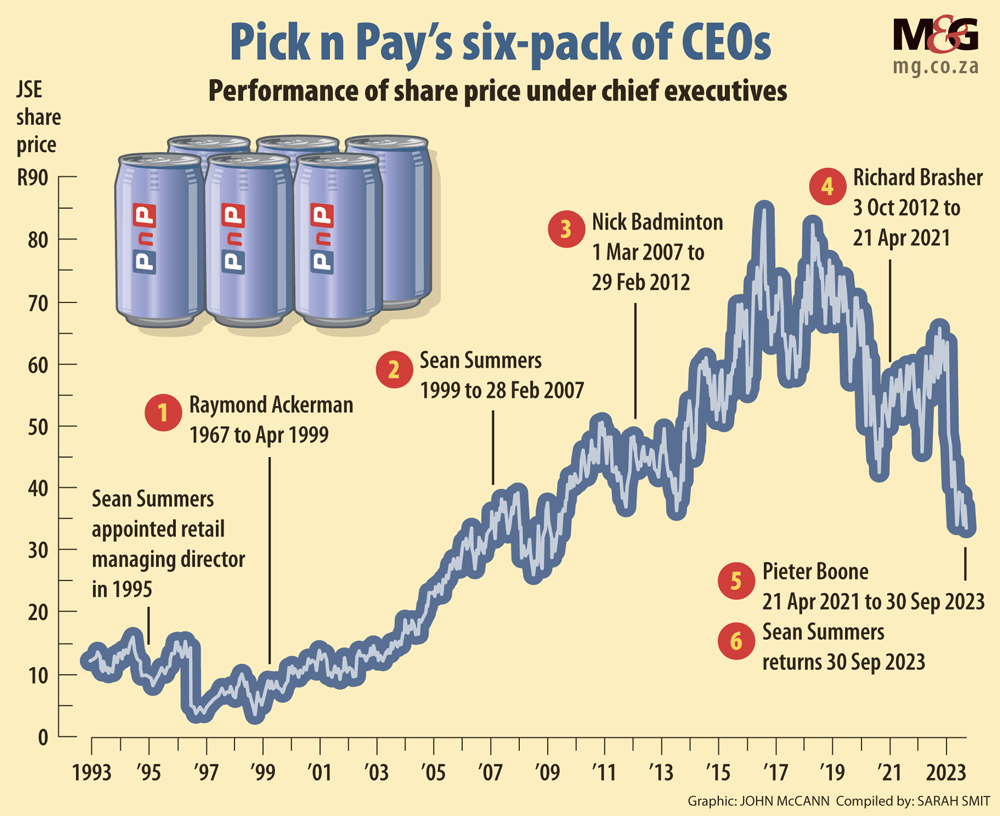
From 1999 to early 2007, Pick n Pay’s share price grew by about 333%, outpacing the retailer’s biggest rival, Shoprite. By the time Summers left, the stocks of the two retailers were trading at about the same rate, with Pick n Pay pulling ahead slightly, despite starting at a lower price.
In 2006, Pick n Pay also enjoyed the largest market share of the country’s grocery retailers, although Shoprite overtook the family-run business shortly thereafter. In the intervening years, Pick n Pay endured a brutal hammering, as Shoprite extended its streak and Woolworths became the competitor it is today.
The Ackermans brought in two outsiders — former Tesco chief executive Richard Brasher and, a while later, Boone — but Pick n Pay has struggled to regain ground. When Boone’s departure was announced this week, the retailer’s stocks were going for more-or-less the same price as they were when Summers left.
The news of Pick n Pay’s leadership change was attached to a particularly dire trading update from the group, which Summers’ return can’t exactly paper over.
Shareholders were alerted to the company’s struggles in July, when it advised that it expected to report a loss at the earnings, headline earnings and pro forma headline earnings levels for the first half of 2024. The trading statement further noted that the group did not expect to report a loss during the period excluding incremental abnormal costs, which we now know are expected to come in at R565 million.
But Monday’s trading update advised that the group now no longer expects to make a profit excluding these costs. Pick n Pay’s losses could now reach R1.50 a share. The group also reported net debt of R3.8 billion.
Speaking to the Mail & Guardian soon after the release of the trading update, FNB portfolio manager Wayne McCurrie said Pick n Pay was in deep trouble, noting that the group hadn’t grasped the true extent of its financial distress back in July. “They have been struggling to catch up to Checkers mainly, but also Woolworths to a lesser extent, for probably 25 years,” he said.
“So a change in management to bring Sean back might be a good thing. I don’t know whether he could fix it or not. His previous stay was quite successful … If the company has results like that, you’ve got to change the management.”
 (John McCann/M&G)
Pick n Pay was slow to adopt centralised distribution, which comes with considerable cost and efficiency benefits — a fact which is often cited as the reason for the group’s eventual loss of market share.
Shoprite kingpin Whitey Basson started rolling out centralised distribution at Pick n Pay’s rival in 1995. At the time, Summers was already being groomed by Ackerman to take over.
When he did eventually ascend to the top job, he had to contend with the family still being in control. When Summers was announced chief executive, so was the formation of the Ackerman Family Council, set up to give “a unified and organised voice to family ownership”. But the family’s patriarch assured that the company would be run on professional terms, not on family terms.
“The thinking at the time — and certainly the thinking post then as well — is that he wasn’t given free rein by the family,” trader and analyst Simon Brown noted.
“I’m thinking about free rein as him being able to spend money. And the one good example is distribution centres, which Shoprite had started doing. They came at a huge cost. The accusation has always been that he couldn’t, because the family wanted the dividend flow and therefore there wasn’t enough cash flow within Pick n Pay. How true that is, I honestly don’t know.”
Brown pointed out that it was during Summers’ first stint as chief executive that Shoprite began getting its claws into the food retail market. “It’s difficult to know how much that was Sean versus how much it was the family hindering him.”
Pick n Pay’s dividend policy came under scrutiny for many years and the company’s pyramid ownership structure was unpopular among investors for diluting shareholder rights.
Introduced in 1981 to prevent a hostile takeover, the pyramid structure gave the Ackermans interlocking shareholdings in Pick n Pay and meant that just over half the dividends paid by the company were channelled to the family’s trust. The Ackerman pyramid was also seen as a hurdle when Walmart approached the family to take Pick n Pay off their hands.
Another wealthy South African family also benefited from this type of ownership structure, the Oppenheimers, whose Anglo American-De Beers pyramid permitted them to expand their empire’s reach without diminishing their control.
In 2016, the Ackermans opted to collapse the pyramid structure. At the time the family announced the unbundling, Pick n Pay’s shares were valued at about R70. Shoprite’s were going for more than double that.
The years that followed, during which Pick n Pay was led by its first outside-hire in Brasher, were punctuated by three South African technical recessions. Unfortunately for Pick n Pay, Boone’s 2021 appointment didn’t exactly mark a new era of prosperity.
Commenting on Summers’ return, veteran retail analyst Syd Vianello said the new Pick n Pay chief executive is very much part of the family. “Yes, he left with a bit of bad blood between him and the family … But he has restored his relationship with the family, hence he was invited back.”
Crucially, however, the Ackermans — whose empire is now in serious jeopardy — probably need Summers more than he needs them.
Summers will also benefit from the fact that the Ackermans’ influence in the company has been greatly reduced. “This means that he has got free rein to do whatever he needs to do,” Vianello said.
That may be true, but Summers will be constrained by Pick n Pay’s financial position. “My biggest concern is, if they are going to do all these things, they are going to need capital. Pick n Pay already has a lot of debt on the balance sheet … They may have to raise capital,” Vianello said.
“That then has all sorts of conundrums attached to it — like would investors put more money into Pick n Pay if the family retains control? The answer would be ‘no’. That means, if you need capital, we will put the capital in and the family will lose control.”
If this comes to bear, Summers will be truly unfettered. “That then means that Pick n Pay really has a unique opportunity to do its own thing,” Vianello added.
The question then becomes whether Pick n Pay will again become the target of a takeover by a foreign retailer, considering its current share price. “I can’t help wondering if perhaps that isn’t back on the table,” Brown said.
“That said, you’re going to have to do a massive turnaround. It’s not going to be anyone local. It would have to be a foreigner. And they would have to be brave.”