EFF leader Julius Malema. Photo: Victoria O'Regan/Daily Maverick/Gallo Images via Getty Images)
“Don’t get us wrong, there is no way we won’t work with America, Europe and the UK,” was the assertion this week by the Economic Freedom Fighters leader, Julius Malema, whose party’s policies arguably pose a threat to Western interests in South Africa.
Malema, who has in the past been critical of rating agencies’ moves to downgrade South Africa, conceded that even if he was in charge, the country would have to submit to their scrutiny if it wanted to be globally competitive.
The EFF is hoping to take over control of government in general elections set for 29 May, with polls suggesting that the ANC’s support will probably dip below 50% for the first time.
Some polls have suggested that the EFF will surpass the Democratic Alliance (DA) as the main opposition party.
The EFF has, in the past, said that if it were in government, it would establish a state-controlled credit rating agency to provide independent assessments of the national economy and counteract bias from international rating agencies.
“We feel very strongly that the continent must have that [rating agency] itself,” Malema said this week.
“And there will be other rating agencies from progressive countries which will come and look at our policy and look at our infrastructure development, corruption and all of that money laundering and be in a position to say, ‘We think this economy — although socialist orientated — but it’s a relatively stable economy, where there is law and order, corruption is punishable and there is no money laundering.’”
He said an EFF-led government would have a bias towards pursuing economic and political ties with the East but would also work with the United States, Europe and the United Kingdom. “But our preferred choice will be the East, will be Russia and all those sorts of things.
“But if a good proposal is put forward, and it’s to benefit both countries, why not? We are in a country that doesn’t exist in isolation. That’s why we say we want the continent to be one. Because we believe with the unity of the continent, we are able to now earn our seat at a negotiating table.
“We can be able to say to the UN Security Council, ‘You were formed in this fashion before we decolonised ourselves and before we did away with oppression. Now we are independent and this development must be taken into consideration.’”
The aspirant president said the EFF wanted South Africa to renegotiate its trade agreements with the West and in particular to relook at the African Growth and Opportunity Act (Agoa) agreement with the US to better promote its interests.
The country should also seriously consider a build-operate-transfer model in its trade agreements with China, Malema added.
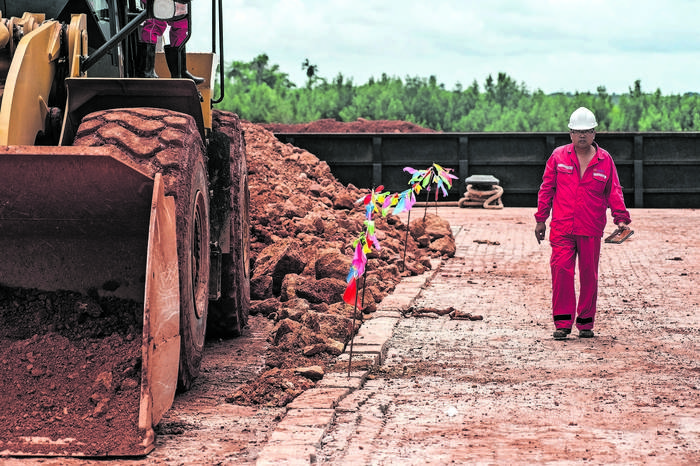 Trap: A Chinese employee works on a port in Guinea. Countries in Africa and elsewhere have had to forfeit their strategic assets to China to pay off their debt to that country. Photo: Waldo Swiegers/Getty Images
South Africa is in the third term of its Agoa trade agreement with the US and has been awaiting approval on its application for an early extension ahead of the 2025 expiry date. The pact provides duty-free access to American markets for 1 835 products across sub-Saharan Africa. The US has previously signalled that it wants a more reciprocal trading pact with South Africa that also benefits its own exporters.
“We have to protect our infant industry against such powerful agreements,” Malema said, also taking aim at South Africa’s trade agreements with Germany, which he said made it impossible for the country to manufacture its own vehicles.
“We finance … the assembling of cars instead of financing the manufacturing of cars because of those agreements. So we’re not going to perpetuate unreasonable trading agreements which are not to the best interest of our country, including the apartheid debt,” he said, referring to debt incurred under South Africa’s previous white minority government.
In September 2001, the treasury said South Africa had made its final repayment on billions of dollars of foreign debt dating back to a moratorium imposed during apartheid. This improved the state’s credit outlook at the time.
The $6.885 billion (then R56.85 billion) was made in August, the treasury said.
Malema said to grow South Africa’s economy, the country needed to invest in industrialisation. He added that the current political leadership lacked the vision to provide incentives for businesses to set up industries in existing special economic zones.
“There could be tax incentives, there could be incentives in water or electricity or anything of that sort, depending on how many people you employ. In that way, you decentralise the economy, you grow it, and you depopulate Gauteng because what is happening now here in Gauteng is unsustainable,” said, referring to the country’s economic hub.
“If we are not going to decentralise this economy and we concentrate it in Gauteng, we are going to become what that main city of Venezuela has become, where walking on foot is much better than driving. So we need to engage in industrialisation, and we need to protect the infant industries of South Africa against the big economies.”
He said it was nonsensical to argue that the nationalisation and expropriation of land — a policy the EFF has long championed — would repel investors.
“As we speak now, in all special economic zones where there is private investment, they are on state-owned land. They don’t own that land. So it’s not true that if we own the land, they will not come and invest,” Malema said.
The EFF leader said that the state must be first in line to invest in strategic mining ahead of the private sector.
“If it becomes costly for the state to do that, then we can consider private investment and direct foreign investment,” he said.
“We’re not fighting with anyone. We simply say, ‘You are going to invest in this country and you are going to do it through our own terms.’ The state must own strategic means of the economy. Anything strategic must be owned by the state.”
Despite criticism of China’s debt trap strategy where African countries have had to forfeit key strategic assets to pay off their debt, Malema said the Asian giant must be South Africa’s preferred trading partner.
“A lot of Chinese leaders have taken me into their confidence that ‘the reason why we end up owning the harbours and the railway lanes is because your African leaders come and use that as collateral, that if we can’t pay, you can take this’. So it’s not China coming to say we want a harbour, it’s us giving to China voluntarily. So we’re not giving China anything,” he said.
He said South Africa must consider entering into a build-operate-transfer model agreement with China, under which that country would build the infrastructure under a loan payable within 30 years.
“Had we done that in 1994, the Chinese or whoever had invested in our infrastructure would be going out now and handing it over back to us,” he said.
In January, the minister of electricity, Kgosientsho Ramokgopa, said the government was considering procuring new transmission capacity using the build-operate-transfer model.