ANC president Cyril Ramaphosa at the party's manifesto rally at Moses Mabhida Stadium. Photo: Supplied
South Africa is going into the 2024 general elections with an economy that is more broken than it has been in a long time.
The country’s real GDP per capita, which economists use to gauge living standards, is lower than it was in the 2009, 2014 and 2019 elections. Meanwhile, there are more unemployed people than there have been since at least 2009.
All this to say that when it comes to the economy, the stakes are exceptionally high — something the country’s three biggest political parties have sought to address in their 2024 election manifestos.
Some of the economic plans offered by the ANC, the Democratic Alliance (DA) and the Economic Freedom Fighters (EFF) might be described as “same-same, but different”. But each manifesto gives their distinctive spin on what it takes to create jobs, grow the economy and arrest the country’s lurch towards a fiscal crisis.
Perhaps where these three political parties differ the most is in their prognoses of South Africa’s unemployment crisis.
As can be expected, the ANC’s manifesto travels old ground on the job issue — underlining the party’s intention to expand public employment through various existing programmes, such as the Presidential Employment Stimulus (PES) and the National Youth Service.
The ANC’s most explicit job promise is to sustain 2.5 million work opportunities through these programmes.
According to the party, the PES has already created 1.8 million jobs and what it refers to as “livelihood opportunities”. The initiative provides support to beneficiaries through a combination of job creation, job retention and income and skills aid.
The 2024-25 budget, tabled last month, already sets aside R7.4 billion for the government’s public employment programmes in the current fiscal year. The lion’s share of that amount, about R4 billion, has been allocated to hiring more teacher assistants. The National Youth Service will receive R250 million.
The party also commits to increasing support for small enterprises, entrepreneurs and cooperatives, as well as working with the private sector on creating jobs.
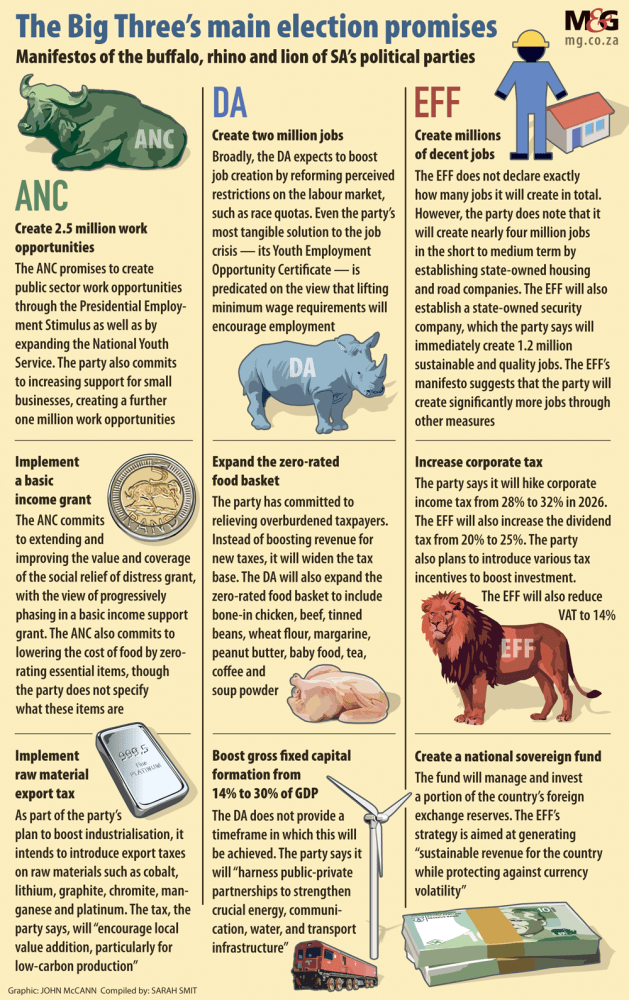 (Graphic: John McCann/M&G)
The DA’s plan — which promises to create two million jobs — is far more angled towards the private sector, insofar as it relies on loosening labour regulations to encourage employers to hire.
The official opposition’s flagship offering is the Youth Employment Opportunity Certificate, which will allow job seekers aged 18 to 35 to forgo receiving the minimum wage. The goal, according to the DA, is to make it easier for young people “to move from not having a job to having one by offering flexible employment terms”.
The party also commits to removing other perceived barriers to job creation, such as the racial targets enforced through the Employment Equity Act. Draft regulations setting out these sector-wide targets attracted considerable backlash from some quarters, including the DA, which accused the ANC of “race-based” meddling that the party said would ultimately hurt employment prospects.
The DA’s manifesto also sets out a new strike deterrent, promising to make trade unions pay a deposit before they can embark on industrial action. The deposit will be used to cover any destruction to property caused during the strike.
The EFF puts a far greater emphasis on public sector-led employment than its opponents, contending that a Red Beret-run government would create nearly four million jobs by establishing state-owned housing and roads companies. Other new state-owned companies — one to insource security personnel and another to provide landscaping services — could create more than two million jobs, according to the party.
The party also intends to boost job creation by declaring a number of special economic zones and offering incentives to investors who employ and sustain a minimum of 2 000 jobs per factory.
The EFF’s economic plans are far and away the most extensive, a fact which could be viewed as the party being overly ambitious.
Predictably the EFF’s manifesto flies in the face of the more conservative economic doctrines championed by its opponents, which, depending on what side of the aisle you stand on, will either be welcomed or inspire fear.
For example, whereas the DA views the minimum wage as an impediment to job creation, the EFF commits to raising it.
This divergence is especially stark in some of the EFF’s macroeconomic policies.
The ANC merely alludes to the party’s fiscal and monetary policies, noting that it will pursue a developmental macroeconomic framework, which will at times require expanded public spending. The DA’s policy proposals appear to align with some of those already being pursued by the current government, such as reining in public debt.
The DA does commit to no tax hikes, including through bracket creep, opting to grow revenue by increasing the tax base instead.
In an effort to lower the cost of living, the party also pledges to expand the basket of zero-rated food items, which will have a bearing on a DA-led government’s ability to raise revenue. The ANC also mentions exempting essential food items from VAT, but does not specify which — if any — will be added to the zero-rated list.
The only other revenue-related commitment the ANC makes in its manifesto is to implement export taxes on certain raw materials such as cobalt and platinum. Export taxes such as these are aimed at bringing down prices for local manufacturers, although questions have been raised about the extent to which they handicap local producers and hurt the economy.
While, like the DA, the EFF sets its sights on increasing revenue by expanding the tax base, the party also states it will hike corporate income tax from 28% to 32% in 2026. According to its manifesto, an EFF government will increase dividend, capital and inheritance gains tax.
These tax hikes will help fund the EFF’s spending commitments, including its promised social grant increases. The party has pledged to double existing social grants and introduce a new one for unemployed graduates.
The EFF’s other controversial promises, including nationalising the South African Reserve Bank, have seen the party cast as the least market-friendly of the three, which could imperil the country’s credit rating.
The party does, however, intend to establish a state-controlled credit rating agency, which could help counteract whatever pain Moody’s, S&P and Fitch inflict on an EFF-run economy.