Residents of Hammanskraal have to rely on infrequent tankers to supply them with clean drinking water.
Photo: Delwyn Verasamy
The water truck hooted persistently as it rumbled down a dusty road in Temba, Hammanskraal, north of Pretoria.
Like many of her neighbours, Patricia Ngubane* had already heard through the grapevine that the tanker was doing its rounds. It had been two anxious weeks since she last spotted a tanker in her area.
The 47-year-old stood patiently in the searing heat waiting for her turn to fill her collection of water containers, stashed on the pavement.
“We are struggling,” she said. “We can’t live without water but the water in the tap is brown and dirty.
“Even if you try to boil it, you are afraid to use it, to cook with it. But when there’s no money and the tankers do not come — maybe after three weeks — you are forced to go to the tap and pray that you and your family will be okay.”
The taps have been running dry, or dirty, in Hammanskraal — where residents have been consuming contaminated water — for nearly 20 years.
The large, semi-rural area was the epicentre of an outbreak of cholera in May 2023, in which the death toll eventually climbed to 31 people.
“The water crisis in Hammanskraal is even worse now,” said Ngubane, about the persistent lack of safe, potable water in taps. She said the government had promised residents that the water would be clean after the cholera outbreak.
“Even [President Cyril Ramaphosa] came here and saw the situation and made promises to us.
“But there’s no difference. We can’t trust the tap water and you can wait for two to three weeks for the takers to come and fill up the water.”
Her neighbour, 21-year-old Anna Rapodile*, agreed. Last week, she had to rush her one-year-old daughter to hospital when she fell ill after drinking the tap water. She was in hospital for three days.
“The truck hadn’t been here for a few weeks and we had no money to buy water,” Rapodile said, tears welling in her eyes.
“I was forced to give my daughter tap water because there was nothing else and she started vomiting and having a fever.
“She is better now but this water issue is a serious problem.”
In June, during his visit to Hammanskraal after the cholera epidemic, Ramaphosa acknowledged the government had failed its residents, who had been without quality water for many years.
“We are sorry we have not been able to provide you with the basic human right of clean water and that it has taken the lives of people,” he told them.
“We have not lived up to your expectation and we are now going to do things right.”
He said the maintenance and the expansion of the dysfunctionalRooiwal wastewater treatment works and the Temba water treatment plant would cost R4 billion and take three years to complete.
While this work was underway, the City of Tshwane would continue to provide tankered water.
He also announced the government had invited Magalies Water to Hammanskraal to “assist with the building of small water works.
“They [Magalies Water] would be able to complete the work in the next six months.”
The residents would carry on relying on tankers supplying clean water but it wouldn’t “go on for a long period”, he said.
But despite the promise, this plant seems to have been delayed.
“The City of Tshwane and the national department of water and sanitation have both made numerous public pronouncements on this,” said Selby Bokaba, the spokesperson for the City of Tshwane.
“The construction of a package plant by Magalies Water will soon commence, which will be done in five phases.”
A contractor had been appointed and the launch was imminent.
“The package plant will provide the people of Hammanskraal and surrounding areas with potable water while the refurbishments and upgrades at the Rooiwal wastewater treatment plant are underway.
“The construction of the plant, which is a short-term measure, will take about 12 months to construct and will produce 50 megalitres of water per day. The first phase will provide 10 megalitres of water per day, and increase by 10 megalitres for each phase, until the completion of the fifth and last phase.”
The details would be revealed at the launch, the date of which would be announced soon.
“There is a glimmer of hope for those residents,” Bokaba said. “The construction will move parallel with an audit of the meters to make sure that all the people that have to receive water do get water.
“They have to prepare themselves to start paying for receipt of clean and safe drinkable water, as Magalies Water will not be providing that water for free.”
At her home in Temba, near the Temba water purification works, an out-of-breath Annatjie Chauke*, 66, showed the Mail & Guardian her freshly filled stack of water containers, which she had spent the morning hauling from the roaming water tanker back home.
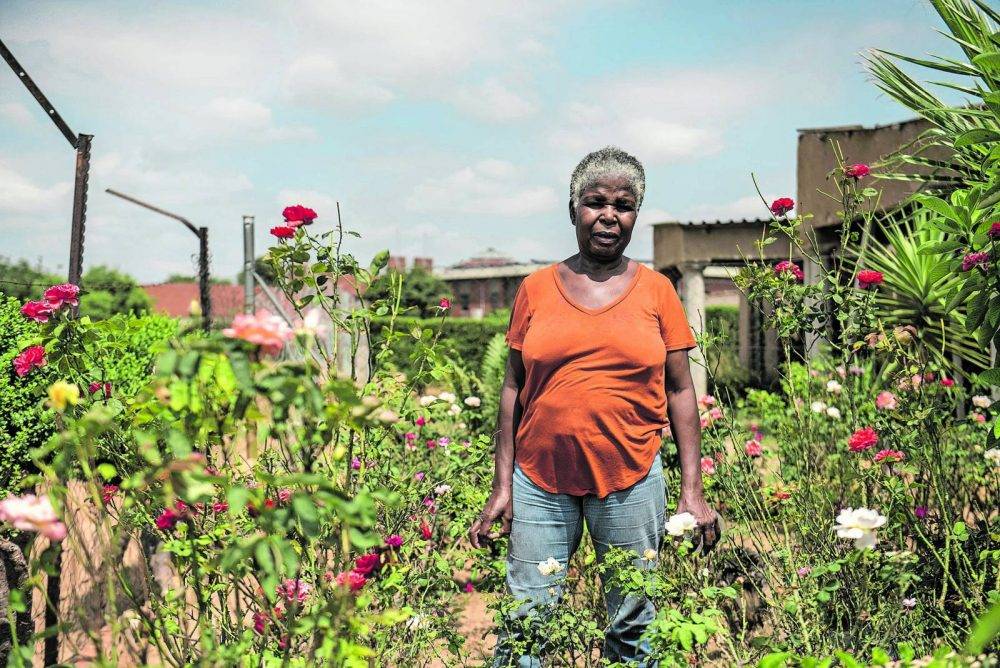 Annatjie Chauke (not her real name) says she only uses the ‘dirty’ water supplied by the municipality for washing clothes, bathing and watering her rose garden. Photo: Delwyn Verasamy
She only uses the municipal water for washing clothes, bathing and watering her cherished rose garden. “But you can’t drink this water,” she said, wrinkling her nose in disgust.
“It’s sleg [bad]. It’s vuil [dirty]. It’s always brown or yellow and it’s not alright for drinking or eating.
“After the cholera [outbreak], the president and the minister of water and sanitation [Senzo Mchunu] said they were going to make the water right but it’s still not right. It’s the same or worse …
“When the tanker doesn’t come, we are forced to spend money we don’t have to buy water and have learnt to survive on very little.
“Water is life — you can’t live without it.”
A few streets away, Maria Mokubela stepped through a trail in her back yard to show the brown water that comes from her tap.
“Nothing is improving in Hamm-anskraal. We are afraid to drink this water. Sometimes we get a runny stomach, especially the kids if they wash their hands and then forget and drink a little bit of this water.”
Tumelo Koitheng, the former chairperson of the Hammanskraal Residents Forum, whose aunt died of cholera last year, said the water crisis persisted.
“Nothing has changed. Instead it’s been worse with the [water] trucks — some areas can go even two weeks, three weeks without water, without a truck passing by. We still cannot drink water from the tap.”
The water quality, too, is not consistent.
“Sometimes it looks clean; sometimes it’s still brownish in colour.
“For those that cannot afford to buy water, it’s a problem when the trucks are not coming because they’re forced to drink the tap water.”
Last year, Mchunu blamed the poor water quality in Hammanskraal on the failure of Rooiwal, run by the City of Tshwane, to meet the desirable final effluent quality for discharge to the Apies River, which in turn, flows into the Leeukraal Dam. In 2011, the department declared the Apies River a disaster area.
Rooiwal is upstream of Hammanskraal and the discharge of untreated and partially treated sewage and sludge has polluted the Leeukraal Dam, where the Temba water treatment works abstracts water for treatment and distribution to Hammanskraal residents as potable drinking water.
Water tankers now supply potable water to affected areas that were initially supplied by the Temba plant.
“We have made it very clear in council meetings and various public statements that the Development Bank Southern Africa has been appointed as the implementing agent for the refurbishments and upgrading at the Rooiwal wastewater treatment plant,” said Bokaba, adding that the process would be undertaken in three phases.
“The first phase is 68% complete. External funding options are being explored to fast-track the upgrades at the plant.
“The water coming out of the taps, as we have stated many times, is not meant for consumption, hence the provision of water through tankers.”
The City of Tshwane has allocated R150 million a year for the next three years to upgrade Rooiwal.
“We hope this time they will be able to finish at Rooiwal because now the [Development Bank Southern Africa] will be the implementing agent, so at least there’s hope something will be done,” Koitheng added.
In 2021, a South African Human Rights Commission report found that the primary reason for the unacceptable levels of pollution in Tshwane’s water was its failure to manage and maintain wastewater treatment works.
Tshwane’s freshwater sources — the Apies, Tolwane, Pienaar and Hennops rivers and the Roodeplaat and Leeukraal dams — are being contaminated with untreated and partially treated sewage and sludge.
“People and animals who drink the water are vulnerable to illnesses such as bilharzia, cholera and hepatitis. Such exposure renders those most vulnerable, like the elderly, children, and those who are ill, even more at risk of adverse health conditions,” the report noted.
In September, Ramaphosa ordered the Special Investigating Unit to investigate allegations of maladministration and corruption at the city and its refurbishment project at the Rooiwal wastewater treatment works, valued at just over R290 million.
In November, public protector Kholeka Gcaleka found that Hammanskraal residents were not receiving water suitable for human consumption because of the dysfunctional state of Rooiwal.
Her report gave the city’s municipal manager 60 calendar days to develop an implementation plan setting out the measures, including prioritisation of capital funding within its available resources, to be undertaken to upgrade and refurbish Rooiwal to address ongoing water quality failures at the Temba water treatment works.
Bokaba said on 15 March that the City of Tshwane joined the public protector during her office’s inspection at the plant and “she acknowledged progress made by the city since the last time she issued the report”.
“A resident who is a complainant in the matter confirmed that water tankers are being provided. He mentioned this in the presence of the public protector. In fact, it was a question raised and we responded. He confirmed indeed, that water tankers are being provided consistently and reliably,” he said.
Anja du Plessis, an associate professor at Unisa’s College of Agriculture and Environmental Science, said: “There has clearly not been any progress because the people of Hammanskraal are still sitting with either tainted water or trust issues in terms of ‘can we really trust this water?’
“You can’t really blame them after how many of their community members have passed away during that time [of the cholera outbreak] and also falling sick after that.
“I know of a couple of kids that have fallen sick and I do know that some of the hospitals or clinics are doing tests now, to see whether it is just regular viral gastro or is it actually caused by E. coli, in other words, contaminated drinking water.”
Hammanskraal is a prime example of “what happens when the government fails you on all levels”, Du Plessis said.
“They don’t have an alternative — you are dependent on national, provincial and local government to do their job. I know the president said they are going to invest more in bulk water infrastructure, looking at building dams or reservoirs and so on.”
“While this is all good and well, it’s still not going to bring immediate relief for people.
“There has to be short-, medium- and long-term [relief] and, unfortunately, again with the case with Hammanskraal, you’re sitting with something where money is pumped in consistently and you’re not seeing any results, despite some in government positions saying that progress is being made.”
In the run-up to elections, political parties would use the people of Hammanskraal to win votes.
“The ANC is going to use them to show the failure of the [Democratic Alliance] and the DA is going to use them to show the ongoing failure of the ANC. It’s a joke…
“People not having any water coming out of their taps or having water that is of a very questionable standard, is just not acceptable and it’s a basic human right.”
Municipalities are constitutionally mandated to provide their communities with basic services, which includes provision of water of a reliable, suitable standard, she added.
Ngubane has lost faith in the government over the water problem.
“If we complain about the water, maybe for two weeks, you will see it comes out cleaner, but not perfect, and then it goes back to being dirty again,” she said, shaking her head.
The people of Hammanskraal had been forgotten.
“The politicians, where they live in townhouses, they are very happy; they have clean water and everything. They can’t complain. They are not standing on streets with buckets waiting for water … Now there’s elections and they want our vote.
“They [political parties] are asking us what our problems are. The people told them the number one complaint that we have is water. They say, ‘We will fix it’ but we’ll wait and wait until Jesus comes and saves us,” said Ngubane, with a bitter laugh.
*Not their real names