March past: A Cosatu demonstration in Johannesburg last year. Photo: Papi Morake/Gallo Images/Getty Images
During a January 1995 joint Cosatu and South African Communist Party meeting, Mbhazima Shilowa — then the labour federation’s general secretary — reportedly had this to say about the new political system: “The decisive election victory of the ANC has placed the demands and concerns of the working people firmly on the national agenda, but it is not the case that that victory alone will determine how those demands and concerns will be dealt with.”
Nelson Mandela’s government of national unity was the culmination of years of negotiations towards the end of apartheid, which was dealt a death blow by, among other things, a mighty trade union movement. The period was marked by fierce debate in the ANC-led tripartite alliance about how the transitional government would be formed.
Now, as the ANC comes to terms with its recent election battering, a new round of negotiations are under way. Although it is still not clear what a new government of national unity will look like, the likely inclusion of the Democratic Alliance (DA) has been met with scepticism in some quarters.
Cosatu, in particular, has reason to be perturbed, as the anointed representative of South Africa’s labour movement comes to grips with its own diminished position.
Cosatu and the DA came up against one another on a few occasions in the lead-up to the May general elections.
There is good reason for this enmity. Not only are the two effectively political opponents, given Cosatu’s alliance with the ANC, but they are also on opposite sides of the ideological aisle.
Their differences bear out in the DA’s election manifesto, which took aim at Cosatu and the ANC’s protection of its labour partner’s “vested interests”.
In the manifesto, the DA vowed to overhaul the Labour Relations Act, removing what it views as deterrents to job creation. The party has also promised to impose a new restriction on strikes, making trade unions pay deposits before embarking on industrial action.
While the proposed government of national unity effectively rules out the prospect of an ANC-DA-only coalition, which Cosatu has said it would reject, the arrangement will inevitably introduce certain ideological dilemmas for the majority party.
The inclusion of more conservative parties in the new government will be a learning curve for the federation, Cosatu parliamentary officer Matthew ParksMatthew Parks told the Mail & Guardian this week.
“We’ve already had difficulties at times with the ANC-led administration. It is going to become more complicated now when you have several parties — some of which have very hostile policies,” Parks said.
“That is going to be a real challenge. We’re going to emphasise the need to put in place clear principles of what we expect: parties that respect the Constitution, the rule of law and the fight against corruption. Equally sacrosanct for us are the labour laws and the transformation agenda.”
In its manifesto, the DA promised to remove racial equity targets set out in the Employment Equity Act and the Preferential Procurement Policy Framework Act.
Parks said he doesn’t believe there is need to panic about the DA being brought into the fold, given that it is still a minority party — a fact that limits its ability to repeal existing legislation.
But he added: “Nonetheless, we can’t take anything for granted. So not only are we going to put in those conditions to the ANC as an alliance partner, but also keeping a vigilant watch and engaging with other federations that share the same views as us … So yes, it’s going to be a watching brief.”
According to Parks, Cosatu will insist that key economic portfolios — employment and labour, trade and industry, public service and finance — in the new cabinet remain in the ANC’s hands. “We wouldn’t want to see those going to other parties. That would be an absolute disaster if they did,” he said.
Cosatu will also have to strengthen its unions, Parks said. “Because if you rely on friendship and promises, you will often be disappointed. But if you have strong unions on the ground, then people are required to listen to you.”
Reflecting on Cosatu’s position in the alliance and its seemingly diminished strength after a 15-year economic pummelling, he said the federation has regained some of its footing after it was gripped by infighting in 2014.
The clash culminated in the expulsion of the National Union of Metalworkers of South Africa (Numsa) — once the federation’s biggest affiliate — after its decision not to support the ANC in the elections that year. The following year Cosatu fired its general secretary, Zwelinzima Vavi, who went on to form the South African Federation of Trade Unions (Saftu) with Numsa as an affiliate.
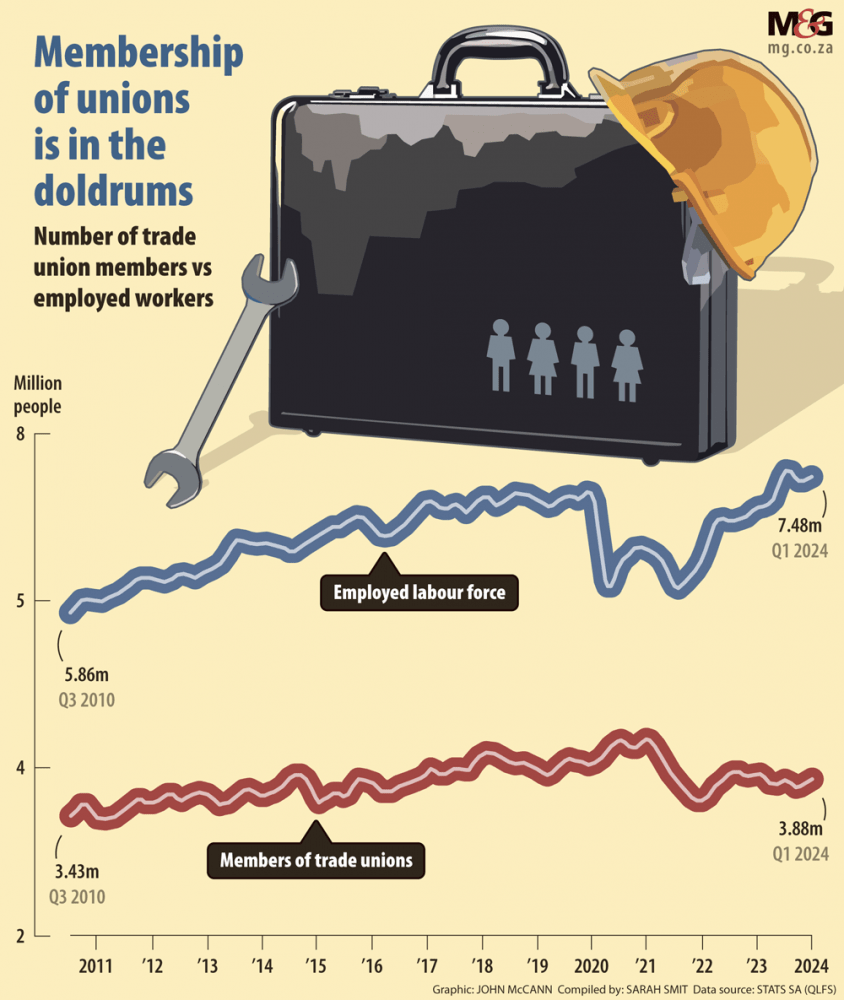 (Graphic: John McCann/M&G)
The episode had major consequences for Cosatu, knocking its influence in the private sector and seeing it become increasingly oriented towards its stronger public sector unions, which had been somewhat inoculated against the effects of South Africa’s economic decline. Some of Cosatu’s biggest clashes with the ANC-led government during Cyril Ramaphosa’s presidency have been over his administration’s efforts to rein in the public sector wage bill.
“Cosatu is much more united now. In fact in this past year it has been more united that it has been in a very long time,” Parks said.
He added that in the past five years the labour movement has seen some important victories, including the implementation of the minimum wage, the strengthening of the Employment Equity Act and the inclusion of domestic workers in the Compensation for Occupational Injuries and Diseases Act.
Saftu spokesperson Trevor Shaku agreed that unions have enjoyed some labour reform wins in recent years. But these are a cold comfort as they continue to endure an economic battering.
For Shaku, the more disturbing outcome of the government of national unity would be a continuation of the current macroeconomic policy programme, which Saftu views as having created the conditions for stagnant growth and ultra-high unemployment.
“Judging the parties by their election manifestos, we don’t see those organisations promising anything any different from what has been implemented before,” he said.
“The ANC and those organisations have more or less the same macroeconomic policies — to advocate for fiscal discipline and to maintain the independence of the central bank … So in essence, what they are going to do is merely sustain what the ANC is already doing.”
The transition to a government of national unity may change Cosatu’s belief that its influence and the wellbeing of its members relies on lobbying the state, said Steven Friedman, a research professor at the University of Johannesburg and a former trade unionist.
There is an implicit bargain between the ANC and Cosatu, through which the party gets to make macroeconomic policy as long as the federation has a veto on labour issues, Friedman noted.
“Cosatu has put trust in this implicit bargain despite the fact that the ANC has, albeit not massively, eroded the bargain in the sense that it has changed labour law in a way that is not favourable to unions.”
The legislation that introduced the national minimum wage in 2019 was passed alongside amendments to the Labour Relations Act, which many warned would effectively discourage strikes. The amendments, for example, require trade unions to hold secret ballots to decide on strikes.
Friedman said the DA’s presence may embolden those in the ANC who are already less sympathetic to labour. “But I think that this is all quite marginal. Because the issue is that a trade union in a functioning democracy really should be spending a great deal of time working out how to mobilise support, regardless of whether it is sitting in cabinet or not,” he added.
Anxiety over the new government’s permutations is indicative of the state of organised labour, which is significantly less influential than it was in the past, according to Friedman.
In June 1988, more than three million workers heeded Cosatu’s call for a three-day stayaway in protest of changes to the Labour Relations Act and restrictions on political organisations. Recent stayaways called by the federation have managed to only draw numbers in the thousands.
“For various reasons, unions are not well organised,” Friedman said.
“They have very limited capacity to mobilise their members. They are not particularly in charge of industrial relations … So there is a whole other agenda here which I think is far more important than whether some DA people get cabinet positions.”