Helen Zille. (Luba Lesolle/Gallo Images)
Negotiators from the ANC and the Democratic Alliance (DA) met on Thursday to try to ease tensions in the government of national unity (GNU) centred mainly on the division of cabinet posts.
A well-placed source close to the process said fresh talks had got under way late on Thursday to resolve the impasse between the ANC and the DA over the implementation of the coalition pact the parties signed last Friday.
At the same time, senior ANC members were sending a warning that President Cyril Ramaphosa’s unity government would remain on course even if the DA walked away.
The rub lies in the two biggest parties’ respective readings of clause 16, which speaks to how practically power will be shared in the president’s new executive.
It stipulates that the government shall be constituted in a manner that “reflects genuine inclusiveness of political parties” that have signed up, “broadly taking into account the number of seats parties have in the National Assembly and the need to advance the national interest”.
It then speaks to representation in the cabinet: “The president shall in constituting the executive, take into account the electoral outcomes.”
On the DA’s understanding, this translates into a sliding scale whereby the percentage of portfolios in the cabinet given to coalition partners reflects their relative ratio of seats in the National Assembly.
A chief negotiator for the party privately said this means the DA should get “roughly 30%” of portfolios in the cabinet, based on its calculation of the percentage of seats it holds relative to the combined tally of other parties who have agreed to the coalition pact.
The ANC holds a different view and believes Helen Zille, the chairperson of the DA’s federal council, crossed a red line by publicly stating her party’s position this week.
“This sabre rattling in public is not helpful,” said a senior ANC member close to negotiations.
It was simply not done to prescribe to the ANC how it should approach the new coalition when the party was a veteran of power-sharing, and has a history of working with the Inkatha Freedom Party (IFP) in the national interest, he said.
“Helen’s problem is that she wants the DA to be recognised as the founding partner in the GNU, with the IFP just tagging along. It does not work like that.”
Crucially, he added that the ANC considered the statement of intent a working document that would be fine-tuned as more parties signed up — either in writing or with an old-fashioned handshake — and was adamant that it cannot supplant the provisions of the Constitution.
“Appointing the cabinet is the president’s prerogative,” he said.
“He will consult, as he always does with members of the ANC. This time he will consult with the other parties in the government of national unity. But there is no quota, absolutely not.”
Although saying it was uncouth of Zille to make her stance known in public, members of the ANC were also clearly sending a message to the DA through the media that it would not back down on an issue she has flagged as a possible deal-breaker.
The wording of clause 16 was the subject of intense last-minute wrangling that continued beyond the start of the first sitting of the National Assembly last week. Agreement was crucial because the parties needed to elect the president, as well as consensus candidates for the posts of speaker and deputy speaker.
It came around noon and when Zille shared the statement of intent, she told journalists that the delay had been caused by the ANC sending through a version where the reference to the cabinet being “broadly” representative of the election result had been removed. She demanded it be reinserted and, in the same conversation, likened the document to an antenuptial agreement.
“She was jumping up and down about it, but it does not matter,” a senior ANC source said on Thursday of the wording in question.
“This statement of intent does not hold the same legal weight as an antenuptial contract.”
In an editorial this week, DA founder and negotiator Tony Leon said the coalition pact was not a contract that any party could take to court “to obtain enforcement”.
“The success or failure of the brave new world, which South Africa has now entered with its promises and its pitfalls, does not rest on a document, however difficult it was to obtain.”
The road ahead, Leon stressed, was one that required leadership and compromise.
On Wednesday, after he was sworn in for another term, Ramaphosa expressed a similar sentiment. And as much as ANC sources may at the moment claim that the party can default to the Economic Freedom Fighters and the uMkhonto weSizwe party should things fall apart with the DA, Ramaphosa’s clear wish is for a centrist coalition.
“The people of South Africa have stressed that they are impatient with political bickering and the endless blame game among politicians and political parties,” he said.
“They want us to put their needs and aspirations first and they want us to work together for the sake of our country … I will work with everyone to reach out and work with every political party and sector that is willing to contribute to finding solutions to the challenges our country faces as we transition to a new decade of freedom.”
His spokesperson, Vincent Magwenya, has confirmed that the president will give ministries to members of the ANC’s new coalition partners, but understandably refused to be drawn on the tussle over percentages.
ANC secretary general Fikile Mbalula said on social media on Thursday afternoon that the unity government agreement was structured such that “no single party, whether the DA, IFP or others, can hold our national agenda hostage”.
“The modalities of the GNU ensure representation and decision-making by all participating parties, safeguarding consensus-building and conflict-resolution mechanisms,” Mbalula said.
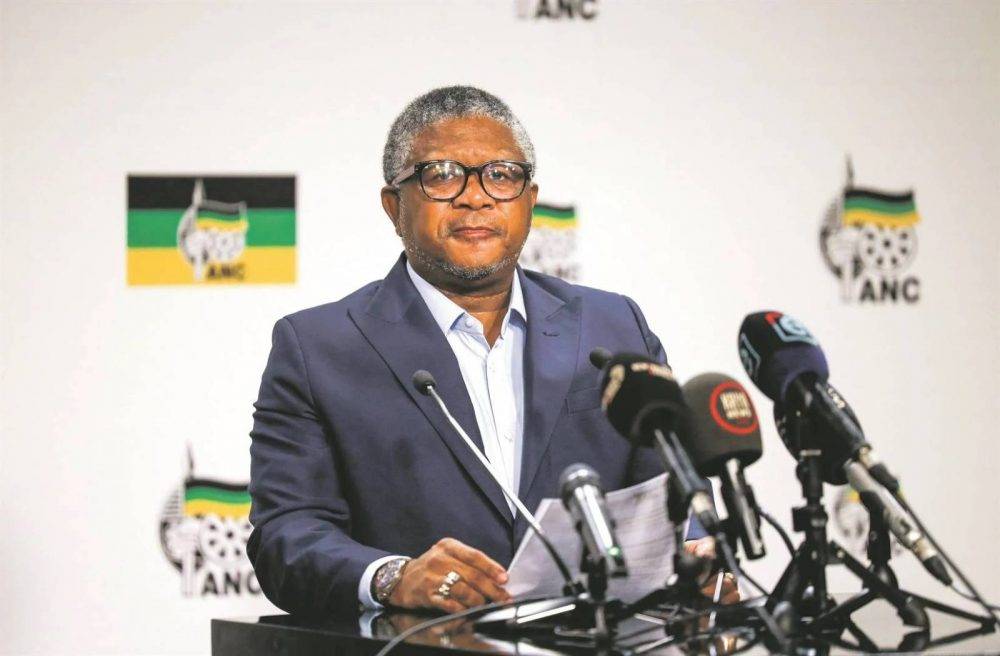 ANC secretary general Fikile Mbalula has said no party should hold the national unity agenda hostage. (Nigel Sibanda)
Gauteng
The bickering in the national negotiations has also filtered to Gauteng, where there was a delay in swearing in the premier on Tuesday because of disagreements in the legislature, where the ANC has a governing agreement with the DA and the IFP.
Re-elected Premier Panyaza Lesufi’s spokesperson, Sizwe Pamla, said the province had had to postpone Tuesday’s sitting, when he was to be sworn in, to Friday because the parties had not yet concluded their consultative processes on the election of the Gauteng executive.
Sources in the legislature said Lesufi was waiting for the go-ahead nationally on how to negotiate for positions.
“[All the partners] want positions in the provincial leadership and if we are smart we need to accommodate them all, including ANC factions, because if we don’t everything falls apart. So we were waiting for national advice, which makes Thursday’s meeting with the GNU partners important,” one source said.
Another ANC Gauteng source said the delay had been caused partially by talks about how to accommodate the IFP, which had a single member of the provincial legislature but still wanted to be in the national cabinet. The source said the ANC aimed to retain seven of the 10 provincial portfolios and give two to the DA and one to the IFP.
“There is an agreement in place in line with the national framework. What they have been busy with is the detail of how they balance all of this,” the ANC source said.
KwaZulu-Natal
The province’s new premier, Thami Ntuli, named his unity cabinet on Tuesday and appointed his MECs from the ANC, the DA and the National Freedom Party (NFP), whose single seat carried the vote in the legislature last week.
Ntuli appointed provincial ANC chair Siboniso Duma as public works and transport MEC, while his DA counterpart, Francois Rodgers, took on the finance MEC position. The NFP’s Mbali Shinga was appointed as social development MEC.