Radiating: The Koeberg nuclear power station 30km north of Cape Town is the only one on the entire African continent, but Russia plans to change this. Photo: Misha Jordaan/Gallo Images
A court challenge to the government’s plans to ramp up the country’s nuclear power to help resolve its energy crisis has rekindled the debate about whether it is a cost-effective and environmentally viable option.
The role of Russia in future nuclear plans has returned to the fore, seven years after eco-justice organisations were instrumental in halting a Gupta-linked R1 trillion deal for 9 600 megawatts of nuclear power with that country under former president Jacob Zuma.
Russian environmentalist Vladimir Slivyak recently warned that President Vladimir Putin was looking to sign costly contracts with African nations for nuclear energy which would tie them to his country for “at least 100 years”.
South Africa has the only nuclear power station on the continent, Koeberg.
Slivyak and other environmental groupings have received push-back from proponents of nuclear energy, who argue that it is a clean and cheap source of electricity.
In October, the Pretoria high court is set to hear the case between Minister of Electricity and Energy Kgosientsho Ramokgopa and the Southern African Faith Communities’ Environment Institute (Safcei) and Earthlife Africa, which are challenging the government’s decision to build 2 500MW of new nuclear energy capacity through a new Koeberg-type reactor of 2 400MW, plus 100MW allocated for a small modular reactor (SMR).
The minister of mineral and petroleum resources (previously mineral resources and energy), the National Energy Regulator of South Africa (Nersa) and Eskom are listed among the seven respondents in the matter.
Parallel to the eco-justice organisations’ case, the Democratic Alliance has also filed court papers challenging Nersa’s decision to concur with the procurement of new nuclear power on the grounds of “procedural irregularity and irrationality”.
In court papers, the environmental organisations have asked the court to review and set aside the government’s intention to procure 2 500MW of new nuclear energy capacity announced by Ramokgopa in December 2023. This was in line with the government’s now outdated Integrated Resource Plan (IRP) 2019 for 2 500MW of new nuclear power by 2030.
Energy experts have estimated this would cost as much as R330 billion to R400 billion.
According to court papers, Nersa concurred with the draft nuclear determination in September 2021, subject to a number of suspensive conditions.
These required the energy minister to provide further information showing the build was affordable, that technological developments had been considered and that 2 500MW of new nuclear electricity generation capacity was rational.
This required an energy demand analysis to inform the energy mix required and determine the capacity and scale of nuclear procurement.
In their court papers, Safcei and Earthlife said the then department of mineral resources and energy submitted a report to satisfy the suspensive conditions in July 2023, which Nersa accepted. But, they said, Nersa had refused to provide the organisations with this information or an opportunity to make further representations.
They argued that the determination is “unlawful and unconstitutional” because the process was procedurally unfair and must be set aside.
They also raised concerns about the high costs compared with renewable energy.
A third issue is the environmental risks of the disposal of highly radioactive waste and of accidents that could harm the natural environment and humans.
 (Graphic: John McCann/M&G)
Safcei and Earthlife, which were responsible for halting Zuma’s Russia nuclear deal, recently embarked on a campaign to warn the public about the dangers of nuclear and garner support for their legal battle, along with Slivyak.
Safcei’s Francesca de Gasparis said the high cost and time it takes to build nuclear power plants — usually at least a decade — would divert funds away from healthcare, education, housing and infrastructure development, while not mitigating the urgent climate crisis.
“South Africans are already having to deal with double digit annual increases in the cost of electricity. It makes no sense to pour hundreds of billions of rands into new nuclear energy that will do nothing to address our current energy crisis while other, more affordable and quicker to install energy solutions are available,” Gasparis said.
Slivyak told a recent public meeting in Cape Town that a new nuclear build would cost far more than politicians promised, take longer to build and make South Africa beholden to Russia for supplying the technology, both in terms of debt and politically.
He said that because many developed countries such as Germany, Switzerland and Spain were adopting policies in favour of renewable energy and aiming to phase out nuclear power, nuclear corporations were seeking new markets in Africa.
“It’s a really historic moment for Africa, where it will decide whether it will do as the West [did] and experiment with nuclear power and learn all the bad things that go with it, like the waste that will be dangerous for many thousands of years and nuclear accidents,” he said.
“Africa is becoming the big hotspot for this geopolitical game — Vladimir Putin is proposing to as many countries as he can to build nuclear power plants, and also proposing to extract loans from the Russian state budget to those countries willing to adopt the technology of Russian nuclear reactors on their territory. It’s a scheme to organise economic, and also political dependence of certain countries on Russia.”
Hartmut Winkler, a University of Johannesburg professor of physics and co-author of the World Nuclear Industry Status Report 2023, said Russia has signed agreements with more than 20 African countries, including Egypt, Mali, Burkina Faso, Kenya, Uganda, Tanzania and Ethiopia, for the provision of nuclear power, although it is not certain these would lead to action.
At the Africa Energy Indaba in March, then minister of mineral resources and energy minister Gwede Mantashe, whose portfolio is now mineral and petroleum resources, said the country would proceed with the development of new power plants to add new generation capacity alongside Koeberg.
In the recent energy discussion, Slivyak said building nuclear plants was more expensive than developing wind and solar energy ones.
Earthlife Africa representative Makoma Lekalakala told the meeting that the Integrated Resource Plan 2019 had included only a “policy decision” to commence preparations for a 2 500MW nuclear programme at “an affordable pace and scale”.
“It did not include new nuclear capacity as part of the least-cost electricity generation mix for the 2030 planning horizon,” she said, noting that the recently gazetted draft IRP2023 proposes 14 500MW of nuclear capacity by 2050, surpassing Zuma’s 9 600MW nuclear build programme that she had helped thwart.
Eskom said the safe operation of Koeberg and establishment of other nuclear institutions had established “a good base” upon which to expand the nuclear programme.
“Renewable energy and nuclear power should not be seen as competitors as they offer complementing benefits for South Africa as low-carbon energy sources. Nuclear and wind power have almost comparable life cycle greenhouse gas emissions [GHG] with solar having marginally more GHG emissions,” the utility said. “Ultimately, an energy mix that includes various technologies is needed.”
Asked where future nuclear plants might be located, Eskom said it has been involved in siting activities for more than a decade in Thyspunt, 12km from Cape Saint Francis in the Eastern Cape, and Duynefontein, 2km from Koeberg, with the intention of having the sites authorised as possible future nuclear sites.
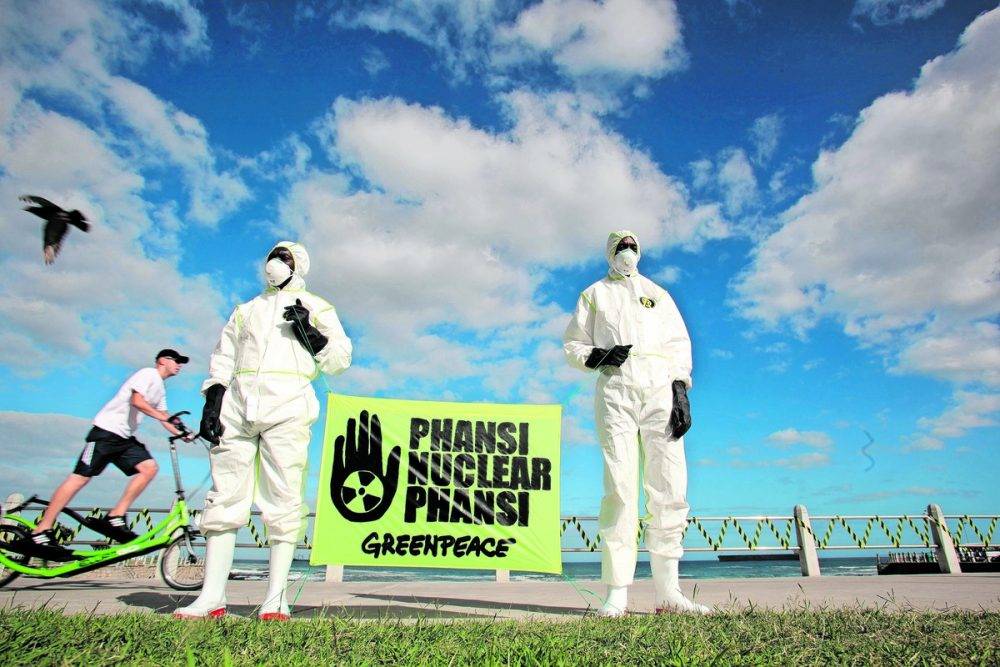 Challenge: Greenpeace protests in Cape Town. Earthlife Africa and the Southern African Faith Communities’ Environment Institute are taking the electricity minister to court over nuclear. Photo: Shelley Christians/Gallo Images
“Eskom has performed an environmental assessment of the Duynefontein site next to Koeberg, and the Thyspunt site in the Eastern Cape, and is awaiting the minister of DFFE [department of forestry, fisheries and the environment] to confirm the outcome,” the power utility said.
“According to the work that has been performed, neither site has any fatal flaws. In the future, any expansion in nuclear capacity will in all likelihood involve both of these sites.”
Eskom said Koeberg undergoes regular re-assessments by international bodies including the World Association of Nuclear Operators, the Institute of Nuclear Operations, Électricité de France and the Electric Power Research Institute.
“Starting already in the 1990s, many plant upgrades have been implemented following PSA [probabilistic safety assessment] insights to enhance fire protection, spent fuel pool cooling, reactor primary pump seal upgrades, strengthening of electrical supplies and many more,” Eskom said.
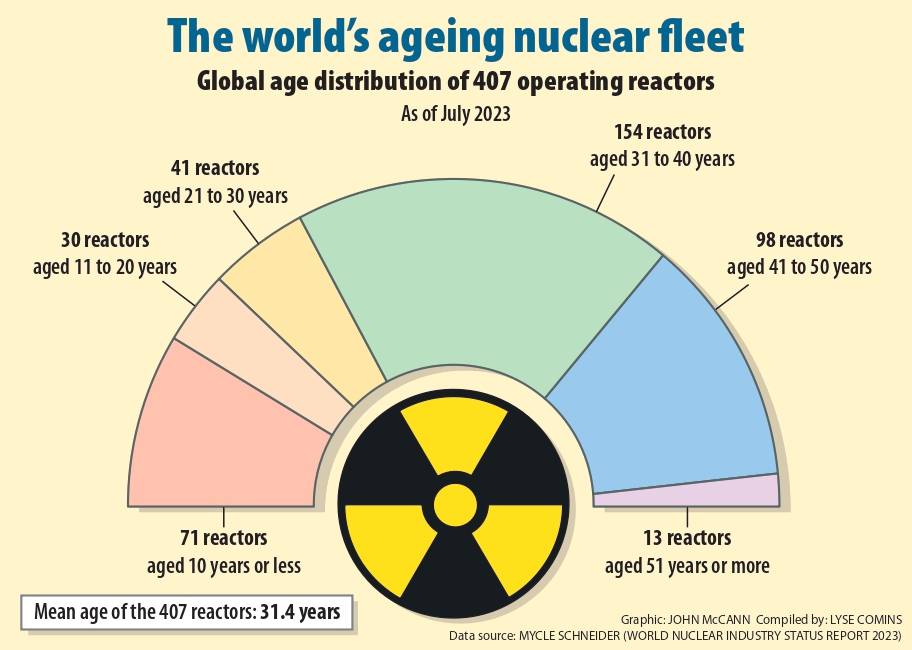
“There are around 120 reactors that have safely extended operation beyond their initial 40-year life and some of these have even obtained a further 20-year life extension to 80 years. This number is expected to increase as more plants like Koeberg join the group.”
While the IRP2023 proposes a delay in decommissioning coal-fired power stations, the adoption of clean technologies such as solar power, the addition of further coal-fired power stations and the more than 14 000MW of nuclear power, the issue of the cost of technologies is at the heart of the debate.
The University of Johannesburg’s Winkler said the plan, which focuses on several scenarios, is flawed, especially regarding costing.
The first scenario is a “reference case” proposal that all additional electricity be generated half by gas (about 6 000MW) and half by wind and solar power.
The second is a “renewable energy” scenario, where no new coal, nuclear and gas plants are built and one third of new solar power investment would be in the form of photovoltaic technology. The bulk of new solar capacity would be provided by concentrated solar power, which is far more expensive and rarely considered globally.
The third is “renewable plus nuclear”, where about 15 000MW of new nuclear builds would provide the electricity attributed to concentrated solar power under the former renewable scenario.
Under the fourth option, a “delayed shutdown” scenario, the life of coal plants would be extended beyond the projected closure dates, while under the “renewable plus coal” scenario new gas and coal plants would replace capacity of concentrated solar power or nuclear power in the other scenarios.
According to the IRP2023, the costs range from R5.9 trillion to R8.4 trillion, with the reference case being touted as the cheapest path, followed by R6.3 trillion for the plan that introduces new nuclear power and R8.4 trillion for the renewable energy scenario.
Winkler raised concerns that these cost calculations are incorrect.
He said the government claimed to have used the April 2023 Lazard Levelised Costs of Energy report to calculate price but an analysis of the costs contradicted the government’s costing and showed that renewable energy is cheapest.
He said Lazard sets out costs per megawatt hour of electricity as follows: utility scale solar photovoltaic, $24-$96 per MWh; utility scale solar photovoltaic plus storage, $46-$102 per MWh; onshore wind, $24-$75 per MWh; coal, $68-$166 per MWh for coal from a newly built coal plant and $29-$74 per MWh for coal from an existing plant; and nuclear, $141-$221 per MWh for new build and $29-$34 per MWh for an existing plant.
Winkler said the main concern about the introduction of new nuclear builds is the cost factor, not the risks of accidents. Furthermore, the cost of handling nuclear waste was usually not calculated into the costs.
“The big issue is the cost, accidents can happen and, if it does, it will be quite disastrous when one looks at Fukushima in Japan or even Chernobyl,” he said.
“But any new plants would be more advanced than both Chernobyl and Fukushima, so they wouldn’t experience the exact same type of accident. The risk of an accident is low, but it’s not non-existent. But that’s not so much the issue — the main argument against nuclear power is the economic one.”
University of Cape Town political economist and environmental sociologist David Fig said nuclear power should be rejected because “it hides behind a cloud of secrecy, poor governance, and misapplication of scarce energy resources”.
“It harms our democratic future. It carries huge risks, and creates expensive problems like the safe management of radioactive waste. It has become one of the most expensive forms of energy, thus placing a huge burden on its users. We would rely on foreign companies to build any new reactors, and become dependent on their personnel, technology and capital,” he said.
“Eskom and other parts of the establishment have only spread pro-nuclear propaganda, so the public is seldom shown the more valid critique of nuclear energy. The case posed by activists has been around for a long time, but not given enough exposure.”
He said many countries, including Germany, Italy, Austria and Switzerland, have said no to nuclear expansion, while others, such as France, are cutting down.
But Stratek chief executive and nuclear physicist Kelvin Kemm — whose company is developing small nuclear reactor systems — believes introducing new nuclear capacity is an “excellent move” that is “long overdue”.
“Nuclear power is the cleanest, greenest, safest, cheapest, electricity that exists. Over half a century of nuclear power in the world has proven that. Here at home Koeberg has clearly proven that, as it celebrates its fortieth anniversary,” Kemm said.
“Most claims of extreme environmentalists are ridiculous, and clearly illustrate their lack of understanding of the real science of nuclear power and nuclear processes. In 2022, the European Union declared nuclear power to be green, thereby opening up various funding routes and getting onto the national planning agendas of EU countries. During operation, a nuclear plant emits no CO2 whatsoever.
“If the anti-nuclear activists want to include mining activities for uranium as sources of CO2 then obviously mining does produce CO2. But of course then the ‘Sandal Brigade’ must include the CO2 produced in the mining activities for solar panels and batteries,” the nuclear scientist and business person said.
“For example, the silicon, the cobalt, the lithium, the aluminium, used to produce the solar panels. Plus, in the case of wind power, the massive amounts of concrete used. The CO2 that comes from that is huge. It really is time that the ‘Sandal Brigade’ pulled their socks up.”
He said nuclear power is cheaper than renewable energy when the huge cost of building transmission lines from the Northern Cape is factored in, which will add to Eskom’s costs and consumers’ bills.
“France is 70% nuclear. But by comparison, Germany carried out the largest wind and solar experiment in the world. After decades, the German electricity price is way higher than the French price. Plus, ironically, the German production of CO2 is way higher than the French CO2 emissions. The evidence is clear,” he said.
“We need to go for 14 500MW, in fact it should be more. This should be composed of new Koebergs on the coastlines of the Eastern Cape, Western Cape and Northern Cape, plus an array of SMRs across the country. Sites on all three Cape coasts have already been purchased by Eskom. SMRs are small modular reactors, about 5% or 10% the size of Koeberg. They can be placed anywhere inland, and don’t need the ocean for cooling purposes.”
Kemm added that he and his colleagues have been attacked for their views on nuclear.
Ramokgopa and the department of mineral resources and energy had not responded to questions at the time of publication.