The Special Investigating Unit traced financial gains of more than R181 million linked to beneficiaries of fraudulent visa applications that were supported by fake documentation
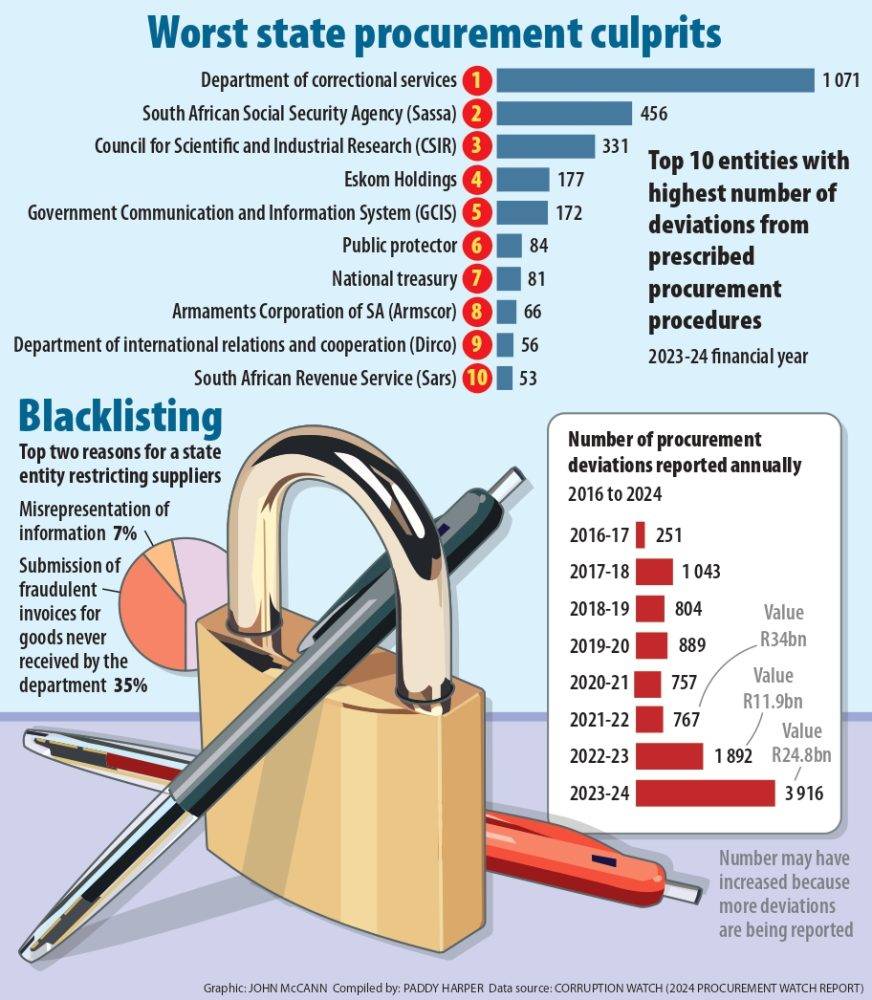
The vast majority of state organs have failed to blacklist companies and individuals engaged in tender corruption and fraud, allowing them to continue doing business with the government, despite being unfit to do so.
Only 30 out of a possible 584 organs of state — national and provincial departments, municipalities, state entities and boards — have submitted requests to the treasury for debarment.
In terms of existing regulations, unless they do so, the treasury has no power to bar companies implicated in fraud or corruption from continuing to receive payments from the public purse.
This is being exploited by both companies implicated in malfeasance, and their enablers within the state, to allow them to continue to operate at various levels of government.
This shockingly low rate of follow-up — 5.1% — on the part of government entities is among the reasons for the inability of the treasury to blacklist errant companies that were identified in a report released last week by Procurement Watch, an initiative of anti-graft watchdog Corruption Watch.
According to the report, only three out of 103 provincial departments, five of a possible 40 national departments, 10 municipalities out of 278 and 12 of 154 public entities had submitted names for blacklisting.
The appalling compliance failure had resulted in only 183 companies having been placed on the list by the end of June this year — 50 of them since the end of 2020 — and highlights one of the most serious weaknesses in the state procurement system.
According to Procurement Watch, the failure to pursue consequence management against offending companies did not end there, as not a single supplier had been placed on the Register for Tender Defaulters, which is also curated by treasury.
In terms of the Prevention and Combating of Corrupt Activities Act, companies can be blacklisted and placed on the defaulters list for up to 10 years by a court, but only if the aggrieved state entity makes a request for this in its court papers.
This means not a single state entity has successfully taken this route in ensuring not only that offenders are convicted, but that they are also prevented from milking the system further for the next 10 years.
In response to questions in parliament earlier this year regarding the failure to blacklist companies implicated in state capture, deputy finance minister David Masondo said it was the responsibility of the client department or entity to initiate the process.
In terms of Municipal Finance Management Act circular 43, municipalities had to first allow the company to make representations as to why they should not be restricted before making the request and submitting evidence that due process had been followed.
“Based on the proof that due process was followed, the national treasury would then assess the submission and include those suppliers in the list of restricted suppliers database,” Masondo said. “It is the responsibility of the individual organ of state to take appropriate legal steps and to recover such monies.”
The Special Investigating Unit (SIU) has also raised red flags over the failure of client entities to initiate a blacklisting process against tender fraudsters, including those who were sanctioned for protective personal equipment corruption during the Covid-19 pandemic.
 (Graphic: John McCann/M&G)
In February, SIU head Andy Mothibi told parliament’s Standing Committee on Public Accounts they had recommended that 91 directors and 297 companies be restricted from doing business with the government from 2021.
Not one of them had been placed on the restricted companies registers because the departments involved had failed to implement the SIU’s recommendations, Mothibi said.
“The poor response to restricting suppliers highlights the need for reforms,” he said.
They were hopeful that the new Public Procurement Act, signed by president Cyril Ramaphosa in July, would assist as it simplified and centralised the blacklisting and debarment process.
The date of the implementation of the Act — and the enabling regulations necessary for it to work — are still to be announced by the presidency.
While a lack of political will to enforce blacklisting has been particularly apparent at municipal level, there does seem to be a shift on the part of some local governments to finally act.
In eThekwini, new mayor Cyril Xaba and a management team, which has been supplemented through a section 154 intervention by the province, appear to have nudged the city into action.
The municipality recently blacklisted eight companies for corruption, fraud, collusive tendering or other offences, bringing the total number of entities it has banned from trading to 32.
City manager Musa Mbhele said those companies were listed on the city’s website and would be banned for five to 10 years — and that any other contracts they held with eThekwini would be reviewed.
He said the city would approach the treasury to have their names added to the central register to prevent them doing business with other municipalities or government departments.
“A zero-tolerance approach has been adopted by the municipality in implementing the blacklisting policy to freeze out dodgy suppliers and ensure that ratepayers receive expedited and effective service delivery,” Mbhele said.