Urban drought: The persistent water shortages in Johannesburg, often making it necessary for residents to collect water from tankers for daily use. (Louw/Volksblad/Gallo Images/Getty Images)
The deaths of a mother and her eight-month-old baby in a house fire in Mayfair West, west of Johannesburg, this week starkly illustrates the dire levels that the water crisis across large swathes of the city has reached.
Marhooma Raeesah Bulbulia Moesa and her eight-month-old daughter, Ayesha Suliman, died in the blaze in the early hours of Monday morning. They were buried at Westpark Cemetery that evening.
At the time of the fire, the area’s water supply was being throttled by Johannesburg Water, to reduce pressure and flow to curb rising consumption and protect reservoir levels.
“The house burned and the neighbours couldn’t even put their hosepipes on,” said Ferrial Adam, the executive manager of civil society organisation WaterCAN. “They had to take [containers with] five litres of water from their houses to help until the fire brigade came.”
The tragic fire, which took two lives and left others injured, is yet another devastating reminder of the risks communities face when basic services fail, she said.
“The lack of water at the time — due to nighttime throttling — meant that residents had no way to respond effectively. This should never happen.
“We are seeing the same potential disasters in many parts of Johannesburg, like Claremont, where people have lived with intermittent water supply for over 10 years.
“We cannot ignore the cumulative impact of poor service delivery. It’s putting lives at risk. The city burns while politicians fiddle.”
Nana Radebe-Kgiba, a spokesperson for the City of Johannesburg’s Emergency Management Services (EMS), told the Mail & Guardian that there was no water in the area when its fire engine arrived.
“We responded with a fire engine with a water tanker [from Brixton]. In all cases we do that,” she said.
“Remember, when we go to informal settlements, there are no fire hydrants around so we definitely have to rely on the water tanker …
“It does not stop any fire-fighting and it [the fire] was closer to Brixton. The water tanker was from the Brixton Fire Station, so they did not struggle with water.”
EMS, which is investigating the cause of the fire, said that four people — including two children — were hospitalised with smoke inhalation and burns.
“All I heard is they [the mother and child] died of smoke inhalation but I don’t know what caused the fire; they said they were trapped inside the house. Obviously, if there was water, maybe they would have been able to put out the fire and the smoke wouldn’t have gotten to them,” Mayfair resident Isthiaq Sattor said.
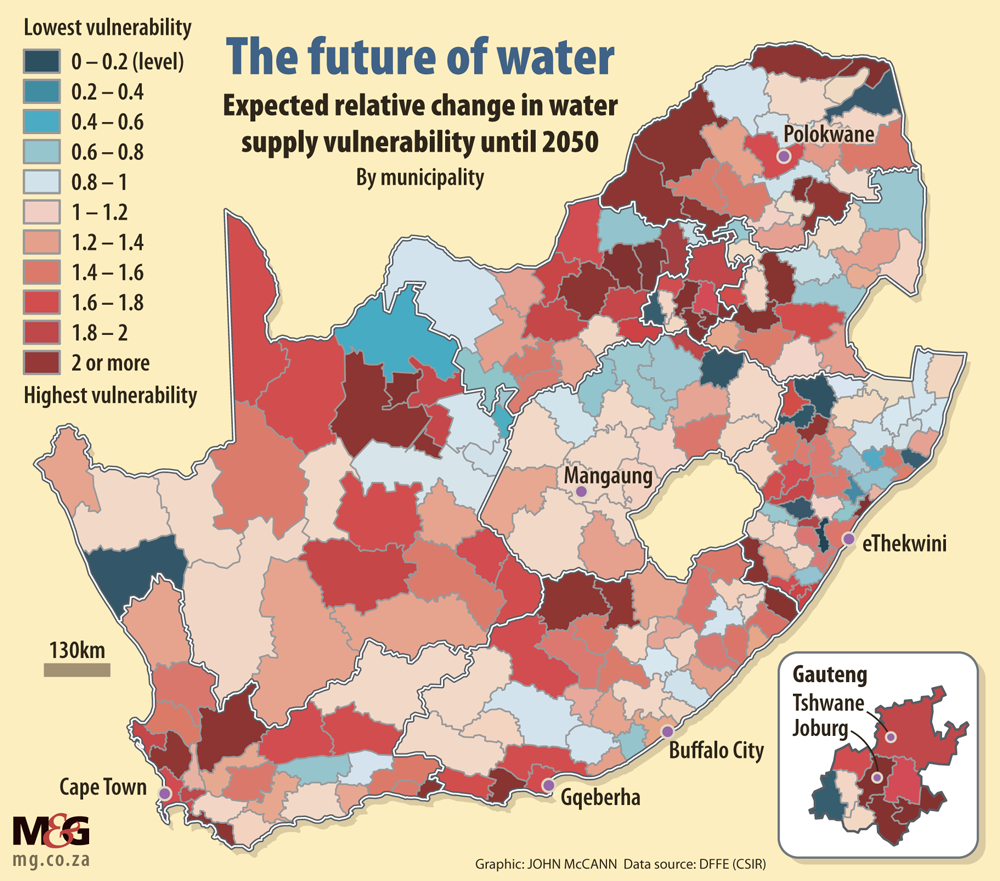 (Graphic: John McCann/M&G)
Fragile water system
Johannesburg’s water infrastructure is incredibly fragile, Adam noted.
“And that is something that we need to bang into our heads.
“That’s why every time we have these water outages people think that when they get water, it’s done and it’s fine. No, it’s not.”
“For as long as we do not start fixing our reservoirs and fixing our pipe bursts, this is going to be an issue … This system that they’re using of throttling and of switching off at night is not sustainable for the fragile system we have and if they keep doing this, it’s going to get worse.
“The reality is that our infrastructure is ageing, our reservoirs are leaking, and for as long as that doesn’t get fixed, we’re going to be in this gemors [mess],” she said.
There are different water crises playing out in Johannesburg and eThekwini, pointed out Mike Muller, a visiting adjunct professor at the Wits School of Governance and former director general of the department of water affairs and forestry.
The Ethekwini water problem is due to a failure to establish control over use in many parts of the city. This has aggravated the problem caused by flood damage, he said.
“The delay in implementing the Mkhomazi Water project means that growing demand has to be met without an increase in supply.”
The Gauteng crisis has similar roots, he said.
“The delay in implementing Lesotho Highlands Phase 2 means that growing demand must be met without additional supply.
“Johannesburg Water has tried ‘throttling’ the system — turning supplies on and off. This on-off cycle is making the leakage problem worse. It is leaving large areas cut off for days. It is also further damaging the old infrastructure,” Muller said.
Throttling is damaging the network and poor management of the networks is aggravating local shortages.
“Quite often, the field teams can’t find the valve and don’t know if they’re on or off.”
Ageing infrastructure is an “old excuse”, he said. “But, in the last 10 to 15 years, it has aged further and is now a real crisis. There has been no substantial replacement of pipe infrastructure.
“Water utilities in the city must be allowed to spend money paid for water to replace old infrastructure but they must spend it on pipes to reduce water losses, not new reservoirs, which can’t be filled because there is not enough water.”
There are no quick fixes.
“The cities have to improve their management. They must replace and stop damaging old pipes. They must control uncontrolled consumption in unmetered areas.
“In the meantime, to avoid further damage, demand must be reduced.
“Voluntary measures are not enough. The national department [of water and sanitation] should demand that municipalities implement formal restrictions to reduce demand. That’s the only way to stop the shortage from spiralling across the city.”
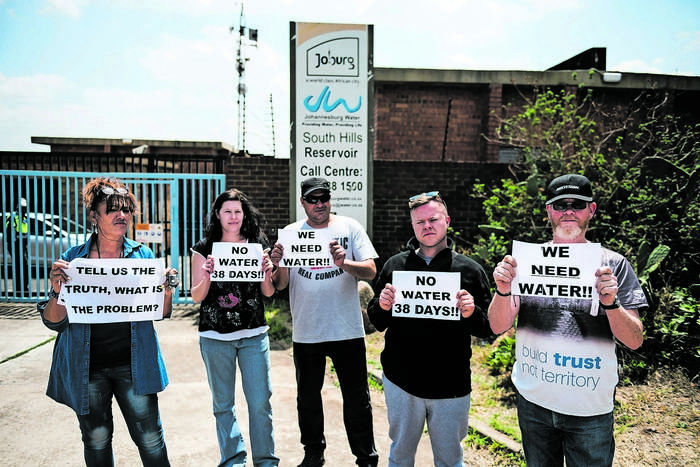 Water shortages has raised the ire of many community members and led to protests. (Delwyn Verasamy/M&G)
‘Fight for survival’
In the east of the city, Kensington resident Monica Singh has battled for more than three weeks without any water.
“We haven’t had water since 19 May … On 2 June, was the last time we had water for an afternoon to the evening and, ever since then, there has not been a drop,” she told the M&G.
Singh lives on the border of Malvern and Kensington, which is fed by the Alexander Park reservoir.
“I’ve been pretty understanding that I live right on the peak of the hill and, in terms of science, the water is going to reach me last and it’s going to leave me first.
“I can deal with that but not having water chronically for three weeks plus is ridiculous.
“Nobody is saying, ‘There’s this problem and we’re doing one, two, three to fix it, and one and two have worked, three hasn’t worked, so there’s going to be a delay.
“I think that’s the frustration. If people knew, they would be more understanding and prepared to wait,” Singh said.
Johannesburg Water has placed a tank outside her house, and keeps it filled, which is “fantastic”, she said.
She uses this water for bathing, flushing toilets and washing up while she has to buy water to cook with and to use for drinking.
“Not everybody can afford that.
“I’m not even going to talk about laundry and serious house cleaning; it’s really bad …
“The water tankers just pitch up with no announcement, so the expectation is from their side that we just sit around and stare at traffic and wait for the tank and, quite literally, a lot of people are doing that.
“Standing in the queue in the cold, carrying a bucket of water to whatever the distance is between your house and that tank; it’s very taxing.
“Not everybody is built for living as if you’re on a survivor show. I just feel absolute sympathy for those who have to walk longer distances to collect water, carrying buckets.
“Some people on the street were talking and they said, ‘We moved out of the villages to come to the suburbs, only to be living in the same fashion as in the village where you have to go collect water from the river.’”
Johannesburg Water did not respond to the M&G’s enquiries. However, in a statement this week, the utility said it remained committed to ensuring reliable water delivery across the city.
“One area currently under significant strain is the Alexander Park reservoir, which continues to experience critically low water levels due to demand consistently exceeding available supply,” it said.
As part of its short-term interventions, the reservoir outlet was closed daily to build capacity.
“The reservoir builds capacity overnight but loses it during the day due to demand exceeding the available supply. Therefore, customers in low-lying areas will receive supply most of the time, while high-lying areas will experience poor pressure to no water.”
Part of its long-term interventions require the rehabilitation of reservoirs to maximise storage. These are affected by a decline in incoming supply, linked to increased consumption on all its systems, it said.
“Our technical teams continue to monitor and implement necessary interventions to build capacity in the reservoir and have therefore implemented a revised reservoir configuration protocol to address some of the risks … this involves regulating the operation of the reservoir between 20% and 50% of its capacity.”
Kensington resident Tanya Bekker said answers are not provided.
“When and if there is water, very often the pressure isn’t sufficient to reach the higher-level homes. We’ve been without water for 28 days.
“Others may have had a couple of days, a couple of hours with water … It’s very, very difficult.
“We keep getting the response that Alexander Park reservoir was critically low; we understand that it was critically low. For at least the last year, we have had almost nightly throttling, so our water has been off at night, but at least it’s come back in the morning and you’ve had water during the day.”
During most of last month, the taps were completely dry.
“They are bringing water tankers as and when and you try to chase water tankers around to try to fill containers with water.”
Like most of her neighbours, Bekker relies on bottled water.
“As a single woman, it’s difficult to go to some random tanker, on some random corner, and try to fill lots of containers and bring them home.
“I’m washing underwear in bottled water and trying to fill a bucket and boil the kettle to pour a little warm in it to try and wash, and imposing on the good-heartedness of friends who live outside the area. You can’t wash your clothes, you can’t wash your dishes, I haven’t had a bath or a shower in my own home for 28 days.”
The national department of water and sanitation (DWS) said it has established a water partnerships office to assist municipalities to mobilise private sector finance and expertise.
“The water partnerships office is currently supporting the eThekwini, Mangaung, Buffalo City, Nelson Mandela Bay and Tshwane municipalities to enter into performance-based public-private partnerships for the reduction of non-revenue water, including replacement of aged leaking municipal water distribution pipes,” it said in response to questions from the M&G.
Through the department, uMngeni-uThukela Water is working with eThekwini to address the challenge of non-revenue water and high water losses, “which impact the water use efficiency and reliability”.
The new Polihali Dam, part of phase 2 of the Lesotho Highlands Water Project, is under construction and will add to the storage by 2029.
Rand Water has a R35 billion capital investment programme, timed to result in additional treatment and storage capacity becoming available when phase 2 comes online.
The department is implementing the Lower uMkhomazi Water Project and construction on the R27 billion Upper uMkhomazi project is planned to start in 2027. Together, these projects will address long-standing supply challenges in eThekwini and surrounding areas.
The department launched the Platform for a Water Secure Gauteng in June last year and the Platform for a Water Secure eThekwini soon after, with support from the World Bank’s 2030 Water Resources Group.
“The platforms bring together government, business, civil society, and experts to reduce water demand by 10% (400 million litres/day) and promote long-term resilience.
“Key focus areas include demand reduction, innovative financing, transparent information sharing and public awareness.”
Infrastructure failures are the most significant contributor to the water problems in Johannesburg and eThekwini, “not only due to failures, but also due to physical losses through leakages being at unsustainably high levels”.
“DWS must restrict the abstraction from the water resources to sustainable levels, but due to the high losses, the demand exceeds the available supply. But the interruptions experienced in Gauteng have not been caused by the unavailability of water resources.”
Muller said the solution must be to professionalise water management and take it out of the hands of politicians.
“This needs fundamental reform. The municipalities are the water authorities but they must appoint component service providers or move aside and let others do the job, whoever does the work. The money paid for water should be spent on water,” he said.
For Adam, while the good stories about water are few and far between, she draws hope from efforts on the ground, led by communities and ordinary people.
“During these times, they are the ones asking where the water tanks are and, ‘So and so doesn’t have a tank, let’s get water to them.’
“There’s this kind of organising happening to get tankers to people and water to people. Last week in the Kensington, Berea, Bruma area, the tankers were actually reversing to help people so they would go to where they see older people. There was a little bit of humanity there.”