Mess: Comparisons are often drawn between Midvaal and the badly run Emfuleni municipality next door. Photos: Delwyn Verasamy
Unlike their neighbours in Democratic Alliance-run Midvaal, life for residents of the Emfuleni municipality south of Johannesburg, governed by the ANC, is a daily grind of endless service delivery failings which they blame on the party.
But ahead of next year’s local government elections, where service delivery is again going to be a key campaign point for political parties, the embattled municipality is not taking full responsibility for the state of affairs here, instead accusing some of its customers of being selfish and not paying their rates.
“There are also people who are selfish in the communities who have the money to pay, who are working and have the money to pay, but they don’t pay,” Emfuleni municipal spokesperson Makhosonke Sangweni told the Mail & Guardian, saying this was a widespread phenomenon around the country.
“If you look at them, they have DSTV that they pay monthly, they pay clothing accounts monthly, they are drinking expensive alcohol- and that is not a conspiracy theory, it’s the truth.
“We do our best to make sure we are collecting revenue. People receive letters, warnings and all of those things, but because we are the government of the people, by the people, for the people so therefore it means that in our actions, we will not be arbitrary.
“We can’t behave like some apartheid government and wake up in the morning and switch off electricity and say those who are not paying, we are switching off, we don’t do that, we persuade them and I think that is where the problem is with our democracy that sometimes being patient and caring can be confused as weakness.”
The municipality has been battling service delivery challenges for many years. Last September, Gauteng finance MEC Lebohang Maile warned that its ongoing financial troubles could lead to a full blown service delivery collapse.
The municipality has had to operate with an unfunded budget for three consecutive years and in the 2023/2024 financial year it posted a R987 million loss. In 2018, the municipality was put under administration, but little to nothing came of it and political parties have been calling for it to be under administration again.
Last week the M&G visited the Vereinaging central business district and townships which are governed by the municipality. Here, roads are riddled with potholes, and piles of uncollected rubbish are the order of the day, with some streets filled with sewer.
The roads are so bad that cars have to share the side pavement with pedestrians.
In the township of Graceland, most of the houses have cracks, with sewer running through the yards. Residents have resorted to digging holes in their walls for the sewer to escape their yards.
Most residents completely remove their water taps or cover drain openings in their yards. To avoid sewer spillage in their yards when water is restored after an outage. In fact, some residents appeared to prefer not to have their water supply restored, as this would mean having to deal with the sewer.
“The reason we closed the drains and cut off the water pipe is that every time the municipality decides to give us water, all the pressure from the sewer comes through these taps and drainage, even the toilet,” one resident said.
“My yard smells so bad and now that we are going into summer, it’s going to be worse. At this point, I just wish the water would not come back because it causes more problems for me.”
Another resident said the municipality had a culture of employees who are not interested in doing their work, citing an example of his neighbour who works for the council.
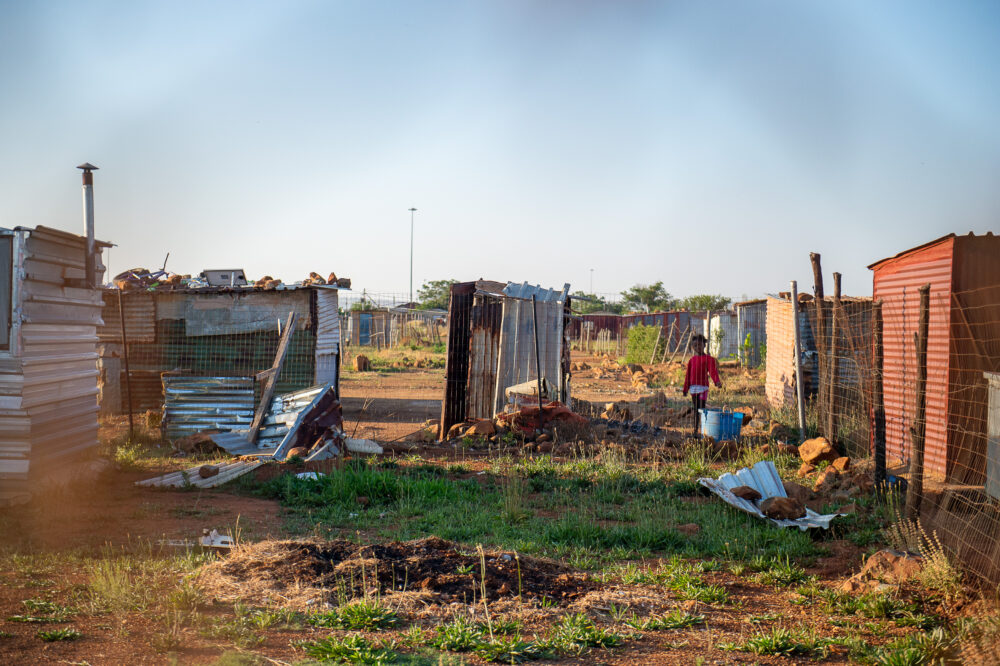 Shrug: The ANC is not taking full responsibility for the state of affairs in Emfuleni. Photo: Delwyn Verasamy
“He drives trucks that collect rubbish at the municipality, he leaves the house at 9am and he’ll be back home by 12 in the afternoon. We have not seen a truck that collects rubbish here for more than four years and he is comfortable and living like what is happening is normal,” the resident said.
Asked whether residents had relayed some of these grievances to the mayor, he laughed cynically. “I don’t even know there’s a mayor. There’s a mayor in Emfuleni?”
An elderly woman described how she and her husband have to rely on residents from the nearby squatter camp for water, paying R2 for two litres. The couple moved to the area in 1994 after buying what they thought would be their dream home.
“For 31 years since we moved here, we have been having problems with water and sewage and we have called the municipality so many times that we don’t bother anymore,” she said.
“We have to pay R700 a month for people to come and unblock the drains for us because we can’t do it alone. You can’t even sell the house because who in their right mind would buy here? So we are stuck.”
In a statement last week, the DA’s Emfuleni north constituency head Kingsol Chabalala said the municipality lost 16.4 million kilolitres of clean water in the 2024/2025 financial year, valued at over R880 million, despite saying it had paid 11 service providers R57 million to fix leaks.
“The gravity of the crisis is exacerbated by the fact that Emfuleni senselessly returned R636 million of its Municipal Infrastructure Grant funds in the past five financial years, which were urgently needed for critical infrastructure such as water, sanitation, and roads,” Chabalala said.
“Additionally, this municipality has spent R561 million on unnecessary overtime between 2019/2020 and 2023/2024, without any improvement in service delivery, which strongly indicates mismanagement, financial recklessness, or deeply entrenched corruption.”
Chabalala said his party has requested the South African Human Rights Commission to investigate Emfuleni for violating residents’ constitutional right to access to water and sanitation services and they were currently awaiting the outcome.
Responding to this, municipal spokesperson Sangweni said the challenges of the municipality also stem from the 55% of people who are unemployed and are not able to pay for their municipal bills saying the primary income for municipalities are rates and taxes.
He added: “There are businesses that are owned by many people who do not want to pay. Some of them, at some point, went to court to fight us about the rates they needed to pay. They wanted to pay the rates of apartheid, for example and if you tell them no, then they threaten that they are leaving and withdrawing all their investment.”
Sangweni said he was not aware of any communities going without water, saying whenever outages were reported, “We always find water tankers and we attend to the situation”.
He said the challenges in the municipality would take time to be resolved.
“We can not say that in the next five years we will resolve it; it will take time.”
Asked to comment on how Midvaal, next door, seems to have its house in order, he responded: “You can’t compare a Polo and an X5 in terms of performance and expect that the Polo will consume more petrol than an X5. The first is that numbers matter in a municipality and governance, how many people are in Midvaal, how many wards are in Midvaal, there are not even 10 wards.”
“We are leading 45 wards and these 45 wards of how many people. So you are comparing people who are less than 100 000, with people who are more than 900 000. Sixty percent of the 100 000 are white people, therefore meaning that it’s people who can afford to pay,” he said.
“People there when they don’t pay, they don’t receive services, it’s non-negotiable and those who can’t pay are black people. Midvaal is doing well in terms of compliance but in terms of changing the lives of the people, which the government should be about, they can never be better than Emfuleni.”