Home: Rivers such as the Nuwejaars in the Western Cape, part of the Heuningnes River system, where the newly named redfin species is found, need to be conserved to protect them.
Photo: Supplied
A small freshwater fish species has been slowly evolving — nameless and unknown — in the rivers at Africa’s southernmost tip. Now, at last, the only redfin living in this region not only has a name but has been formally described.
The redfins found in the Heuningnes River system, including the Nuwejaars River and its tributaries around the towns of Bredasdorp, Elim and Agulhas, have now been officially named Pseudobarbus agulhas — the Agulhas redfin.
Scientists had already discovered that these fish formed their own distinct lineage but, until recently, they were only referred to informally as the Heuningnes redfin (Pseudobarbus sp. ‘Heuningnes’).
The species’ official recognition was confirmed in a newly published scientific paper, authored by Fatah Zarei, Melissa Martin, Paul Skelton and Albert Chakona, from the NRF–South African Institute for Aquatic Biodiversity (Saiab).
“We confirmed that the Agulhas redfin (Pseudobarbus agulhas) is a distinct species based on three independent lines of evidence: genetics, morphology and distribution,” Zarei said.
Genetically, all individuals and populations of this species form a single, well-supported lineage that is clearly distinct from all other redfins: “Morphologically, it can be distinguished from the other 14 known redfin species by a unique combination of traits,” he said.
“These include two pairs of slender barbels near the mouth, absence of linear body speckles, a relatively narrow head, specific scale counts, a characteristic pattern of small tubercles on the heads of breeding males and usually a single tooth in the outer row of the throat teeth.”
Finally, this species is found only in the Heuningnes and the upper reaches of the Klein River systems, with no distributional overlap with other redfins. “Its restricted distribution reflects a distinct evolutionary history in this part of the Cape region,” Zarei said.
Formally describing and naming it as a valid species, Pseudobarbus agulhas, is an important step because it gives the species official recognition, allowing it to be considered under conservation laws and management plans. Without a scientific name, it would remain invisible to policy and conservation action, he pointed out.
On the brink
The name draws attention to the species’ extremely limited range — and its conservation status of endangered, the authors said.
Its small, isolated populations are threatened by water extraction for farming and domestic use, as well as by invasive species such as spotted bass and bluegill sunfish. These alien fish feed on the small indigenous freshwater species and compete for food. The juveniles of the indigenous species are particularly at risk.
Climate change is another threat. “We’ve seen two floods in the past two years,” noted Erica Brink, the conservation manager of the Nuwejaars River Nature Reserve.
“These floods have affected the habitat of our fynbos fish, often impacting the deep pools where these small fish can hide, creating erosion and degradation of the river and riparian zones.”
This new description adds to a growing list of discoveries. There are now 15 recognised redfin species, compared with only seven in 2001.
The Agulhas redfin itself has two sub-lineages — one in the Heuningnes River system, believed to be its evolutionary stronghold, and another in the Karingmelks River, part of the Klein River system around Stanford and Teslaarsdal.
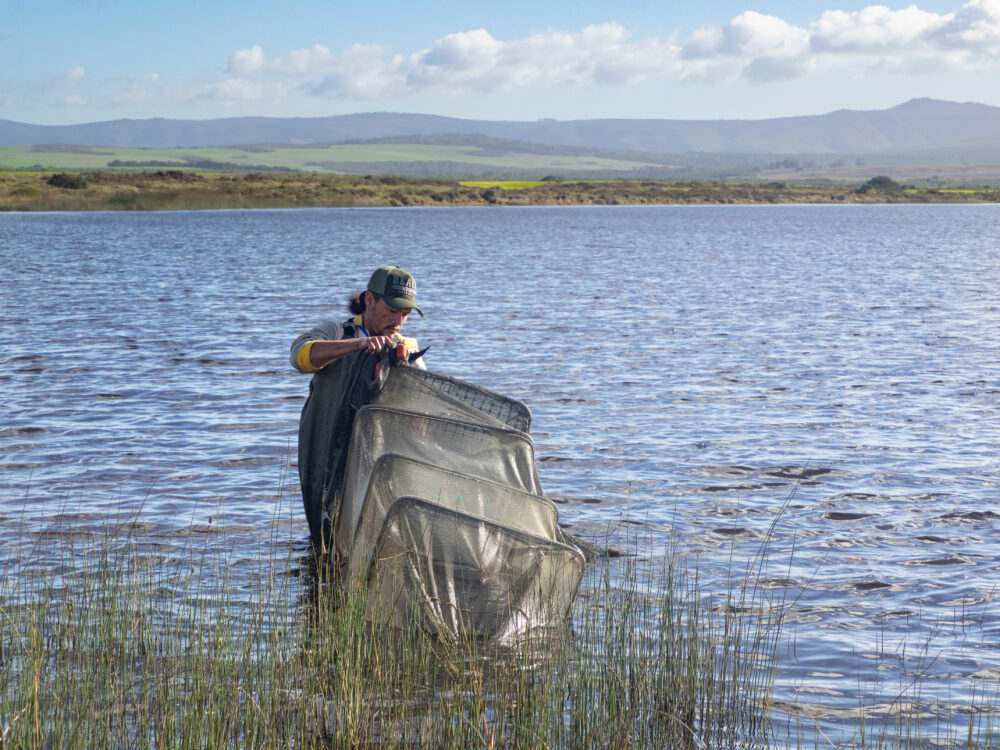 Net value: Environmental worker Breyton Murtz does research in the Nuwejaars River in the Western Cape. Photo: Supplied
A hidden history
Along South Africa’s southern coast, rivers tell an extraordinary story of survival, isolation and adaptation. The Agulhas redfin belongs to a group of closely related species known as the Pseudobarbus burchelli complex, which includes P. burchelli and P. vulneratus.
The evolutionary split within this group is striking, the authors said. “P. burchelli in the Tradouw catchment of the Breede River system diverged from the ancestral population of the other two species nearly 1.7 million years ago, during a time when high sea levels fragmented rivers and isolated freshwater populations,” Zarei explained.
The ancestral population that later gave rise to P. vulneratus and P. agulhas spread across several river systems — the Breede, Duiwenhoks, Goukou and Heuningnes — sometimes aided by natural events such as river captures.
Genetic studies show P. vulneratus and its close relative P. agulhas then split about 800 000 years ago, well before the last glacial period.
“The populations that remained in the Breede, Duiwenhoks and Goukou rivers eventually evolved into P. vulneratus, while the population that colonised the Heuningnes River became P. agulhas,” Zarei said.
The Agulhas redfin has since remained largely isolated in the Heuningnes system, where unique environmental conditions have shaped its evolution.
The river is more turbid, has higher conductivity and flows with gentler gradients than neighbouring systems. These factors probably reinforced the separation of this species and allowed it to follow its own evolutionary path.
A relatively recent river capture probably linked the Heuningnes and Klein rivers, enabling the Agulhas redfin to naturally colonise the upper reaches of the Karingmelks River in the Klein system.
The species inhabits pools and streams in the Heuningnes and Klein river systems — the only redfin found in this region.
Omnivorous, it feeds on algae and small invertebrates. Breeding takes place in summer, with spawning occurring in riffles above the pools.
Zarei said this discovery further highlights the remarkable diversity of freshwater fish in South Africa’s Cape Fold Ecoregion, a well-known centre of endemism.
“Many species from groups such as Pseudobarbus, Galaxias, Enteromius and Sandelia, which were once thought to be widespread across the region and are now known to comprise multiple range-restricted species and lineages, each with its own evolutionary history and unique distribution.”
“These findings reveal the hidden complexity of freshwater evolution in the area and emphasise the importance of protecting these rivers, as they are not only habitats “but also living records of South Africa’s evolutionary past”.
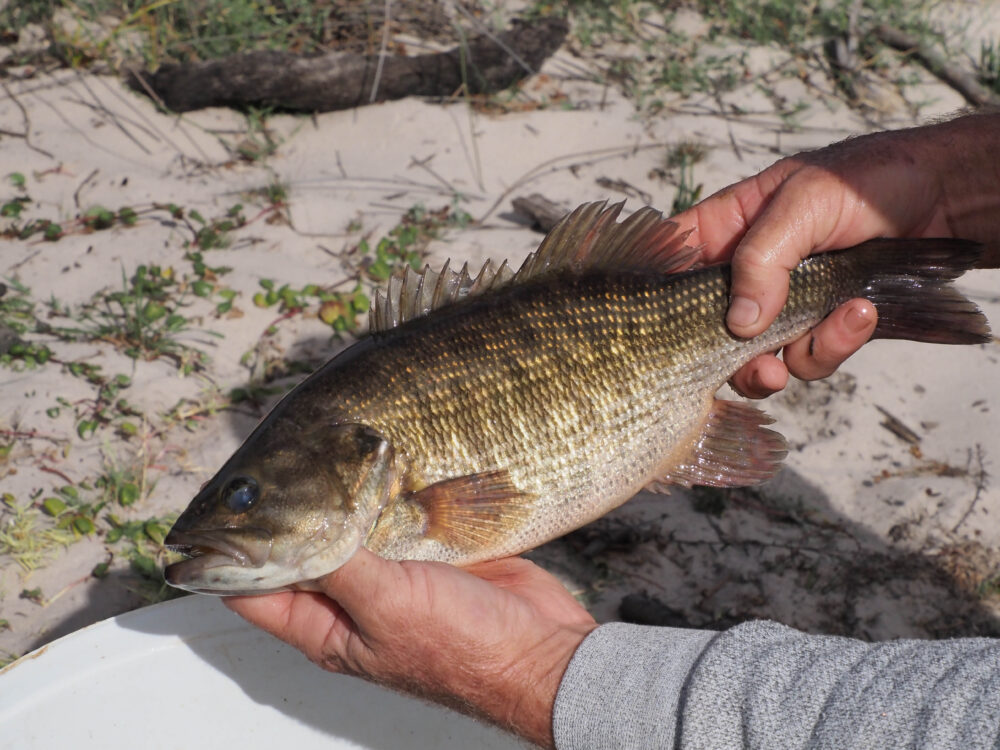 Body of research: Bass are among the invasive fish which threaten indigenous species. Photo: Supplied
Protecting the redfin
Now that the Agulhas redfin has been formally named and described, the next step is to protect it, Brink said.
The Nuwejaars River Nature Reserve is a non-profit company managing the 47 000 hectare Nuwejaars Wetlands Special Management Area between Bredasdorp and Elim.
This vast conservation landscape is home to one of South Africa’s largest wetland systems, as well as unique and threatened wildlife and fynbos habitats. The Agulhas redfin is among the species of conservation concern protected here.
With support from the Mohamed bin Zayed Species Conservation Fund and CapeNature permits, individual redfins have been relocated from various sites to two fish sanctuaries in the Nuwejaars Wetlands Special Management Area. In these safe, predator-free waters, they are expected to breed successfully.
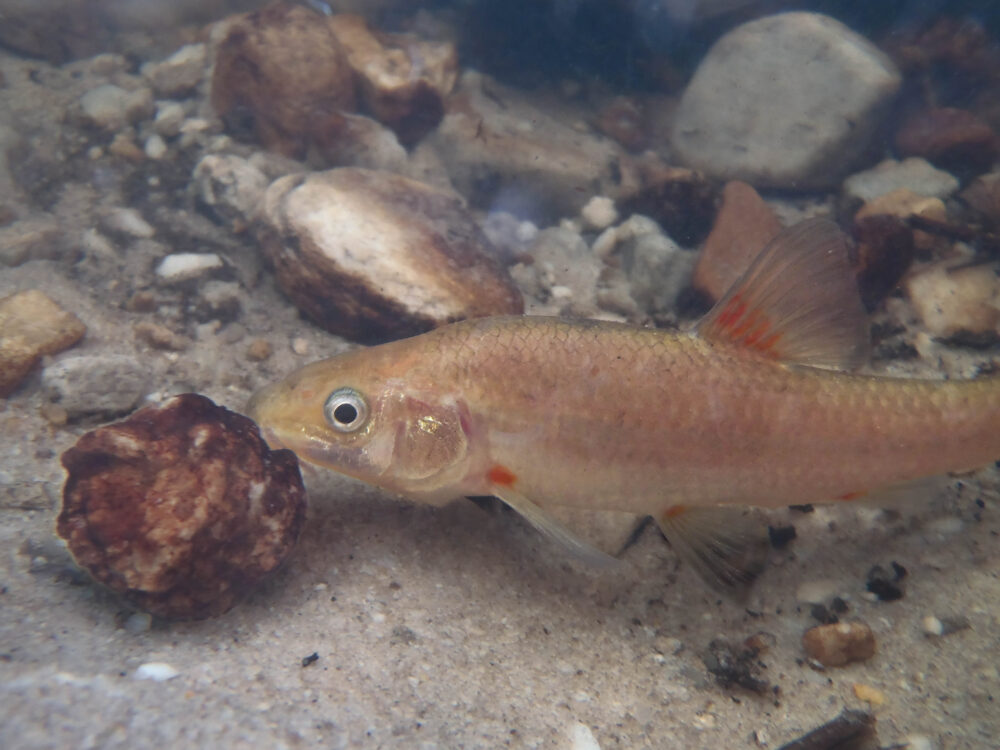 Red-letter day: The newly formally named and described Pseudobarbus agulhas — Agulhas redfin. Photo: Supplied
A long-term mission
In time, the fish will be reintroduced into conserved areas within their historical range along the Nuwejaars River and its tributaries, including pools and streams where they will remain protected.
“For now, some of the fish have been moved to off-stream dams as a temporary safeguard,” Brink said. “These dams bring together individuals from the four different sub-populations in the area, creating a safe space for them to breed.”
The offspring will later be translocated to a dedicated fish sanctuary, which is in the planning phase. Establishing this will depend on securing sufficient funding.
“It’s a costly exercise and a first for Agulhas redfins. However, similar projects elsewhere have shown great success, proving that this is a critical conservation tool if we’re to ensure the long-term survival of the redfin in its natural habitat.”
Safeguarding freshwater fish — the second-most threatened group of animals in South Africa after sharks — is a formidable and costly challenge.
Experts from the South African National Biodiversity Institute (Sanbi) estimate recovering and protecting 30 of the country’s most threatened freshwater fish species will require R168 million over the next five years, compared with only R18 million spent in the previous five.
Freshwater conservation challenges
Freshwater fish conservation in South Africa faces a complex array of challenges, Chakona noted.
Many catchments have been transformed for agriculture and rivers impounded to provide reliable water for domestic and industrial use. This has disrupted natural habitats and flow regimes, fragmenting fish populations and limiting genetic mixing between isolated groups, he said.
Conflict species — those with socio-economic value but significant ecological impact — further complicate conservation efforts.
“Climate change worsens these pressures through rising temperatures and declining water availability. Limited resources, low public awareness and slow taxonomic progress caused by insufficient capacity and funding also hinder protection efforts.”
Nonetheless, promising initiatives are underway such as the Freshwater Research Centre’s Fynbos Fish Revival Programme, with the Saving Sandfish Programme one of the most popularly known, as well as the Nuwejaars Wetlands Special Management Area’s ongoing work in the Overberg area.
Then, there’s the efforts of the Grootvadersbosch Conservancy in the Breede catchment, efforts by the Gouritz Cluster Biosphere Reserve in the Gouritz and Goukou catchments, the NRF-SAIAB and Mpumalanga Tourism and Parks Agency’s Chetia project and the Tilapia Mapping Programme of Saiab, Sanbi and the department of forestry, fisheries and the environment.
Chakona said that all these initiatives “signal a growing commitment to protect these highly threatened species”.
Achieving meaningful progress, he said, will require collaborative action from landowners, communities, scientists, citizen scientists, policy-makers, industry and government agencies as well as prioritisation of funding for foundational biodiversity research — including taxonomy, ecology and biology of species — “the backbone of biodiversity conservation and management”.
“Most importantly, to achieve meaningful biodiversity conservation, it is essential to clearly communicate the immense value of biodiversity and the ecosystem services it provides to humanity, from securing food security, driving pharmaceutical breakthroughs, safeguarding lives and livelihoods through eco-tourism, and ensuring our resilience to global environmental changes,” Chakona added.
Flagship species
The Agulhas redfins are a true flagship species for the Nuwejaars Wetlands Special Management Area — theirs is a story of survival and adaptation spanning millions of years, Brink said.
These fish have endured in the Cape Fold Ecoregion for what experts believe to be close to 20 million years, evolving and adapting through countless environmental changes. “And yet, after all this time, their greatest challenge comes now — from us.”
Their looming extinction is not an isolated tragedy, she said, rather, “it’s a symptom of the wider biodiversity crisis unfolding across the world.
“It forces us to confront the role we’re playing in driving nature’s decline and to ask ourselves what role we should be playing. For such an ancient, resilient and extraordinary species, our responsibility should be one of hope.”
Protecting them is about protecting an entire ecosystem. “And we’ve seen the importance of this ecosystem in supporting water security for farming communities and local towns, pollination services, climate resilience and so much more that we as humans cannot survive without.
“Redfins are indicators of healthy rivers. If we lose them, it’ll be a very serious and very distressing symbol that we’re losing the very natural balance that we all rely on.”
The ecosystem of the Nuwejaars Wetlands constantly surprises, Brink said.
“We’re still learning about its remarkable natural heritage all the time. These wetlands are a stronghold for species found almost nowhere else, like the critically endangered micro frog and the endangered Cape platanna.
“And now, through our work to protect the freshwater fish of this system, we’re once again seeing just how valuable and irreplaceable this ecosystem is.”
At the heart of their approach to conservation is an ethos of restoration and rewilding.
“We work to remove the barriers that have prevented natural systems from functioning —and then we step back and let nature lead the way.
“Time and again, we’ve witnessed the resilience of this landscape — how, given the chance, it can heal,” she said.
This story of the land is deeply connected to the story of the redfin.
“Like the wetlands, these fish have adapted to shifting conditions and have managed to hold on through the changes.”
The 26 landowners who make up the Nuwejaars Wetlands Special Management Area have committed to restoring these wetlands, the surrounding fynbos and the wildlife that depends on them — and nature has responded.
“If we can offer the same kind of support to the redfins — to create safe, healthy spaces for them to recover from the pressures they face — then their story of survival can continue alongside that of the landscape they call home.
“Their resilience mirrors the land’s own — they can heal and they are worth fighting for,” Brink said.