First couple: Maduro faces a narco-terrorism conspiracy charge. He and his wife were both charged with cocaine importation conspiracy and weapons offenses. Photo: Screen grab WRAL
In the early hours of Saturday, 3 January 2026, the international order did not just bend; it broke.
Images of a blindfolded Nicolás Maduro, whisked away from Caracas to a federal detention centre in Brooklyn, signal something far more consequential than a mere arrest.
The spectacle of a sovereign leader answering to a local magistrate in Manhattan two days later further underscores the reduction of international diplomacy to a domestic criminal docket.
We are witnessing the birth of a world where the strong no longer feel the need to justify their actions through law but rather through the raw arithmetic of power and resources. This is the “Trump Corollary” in its most naked form.
The capture of a sitting head of state on his own soil, without a United Nations mandate or a declaration of war, is an unprecedented departure from the norms that have governed the planet since 1945. By framing Operation Absolute Resolve as a law enforcement action, the White House has effectively turned the US judicial system into a weapon of regime change.
The logic is as simple as it is dangerous: if the US indicts you, your sovereignty ceases to exist. Trump has gone so far as to call the indictment against Maduro “infallible,” underscoring the administration’s intent to turn the courtroom into a geopolitical battlefield.
This “law of the wild” creates a terrifying precedent that adversaries like Russia and China are already seizing upon.
If Washington can kidnap a leader it dislikes under the guise of counter-narcotics, what prevents others from using counter-terrorism to do the same to American allies? By prioritising a tactical win in Caracas, Washington has surrendered the moral authority to lead a rules-based community of nations.
The arrogance of this intervention is underscored by the administration’s declaration that the US will “run the country” until a transition occurs. This is not the language of a partner but of a colonial administrator. While Vice President Delcy Rodríguez has been sworn in as interim president and called for “respectful relations,” the White House has already threatened her with a “bigger price” than Maduro if she does not fully comply with US directives.
Trump has escalated further, threatening strikes not only in Venezuela but also against Colombia and Mexico, a hemispheric hard line that has already been rejected by Colombian President Gustavo Petro as “illegitimate.”
By bypassing constitutional sovereignty and attempting to install a hand-picked governing team, Washington is inviting a civilisational friction that will resonate far beyond the Western Hemisphere.
Already, the Chinese Foreign Ministry has expressed “grave concern,” rightly identifying this as a blatant violation of international law.
For Beijing, the message is clear: the US is prepared to use kinetic force to “rebalance” economic relationships and secure critical supply chains by any means necessary.
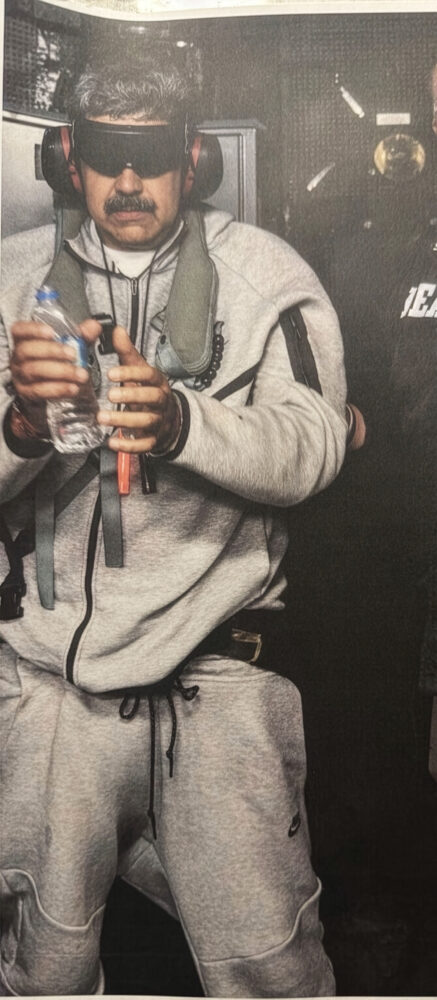 Seized: A blind-folded Nicolás
Maduro on board the USS
Iwo Jima. Photo: United States
Department of Defense
Seized: A blind-folded Nicolás
Maduro on board the USS
Iwo Jima. Photo: United States
Department of Defense
Meanwhile, protests in Caracas and abroad – from Latin America to Seoul – highlight the backlash against US intervention, complicating Washington’s claim to moral authority.
The human and geopolitical fallout of this “perp walk” diplomacy is already manifesting in real-time. President Trump’s dismissal of opposition figures like María Corina Machado – who has been sidelined despite her 2025 Nobel Peace Prize – suggests that Washington isn’t seeking a democratic revival but a corporate receivership.
This is evidenced by the immediate directives for US oil majors to “spend billions” to fix the infrastructure they intend to control. Such blatant resource extraction, performed while the elected leader is held in a New York jail, harks back to the darkest days of the 19th-century “Banana Republics.”
It fundamentally undermines the concept of the nation-state, suggesting that a country’s assets are forfeit the moment its leadership falls out of favour with the North.
This is not just an attack on Venezuela; it is a signal to the entire Global South that their developmental paths are only permitted as long as they do not conflict with American geoeconomic appetites.
While the administration speaks of restoring democracy, the President’s own words tell a different story. Trump’s candid admission that US oil companies will soon run Venezuela’s vast reserves – the largest in the world – reveals the operation’s true motive.
This is geoeconomics by other means. The goal is twofold: first, to dismantle the oil-for-debt partnership between Caracas and Beijing that has anchored Chinese influence in Latin America for over a decade; and second, to reintegrate Venezuelan crude into a US-controlled supply chain.
This is not diplomacy; it is an eviction notice served by Delta Force. But history, from Iraq to Libya, reminds us that seizing a country’s resources is far easier than managing its people. Venezuela is a militarised society; the vacuum created by this raid is where empires typically meet their demise.
Domestic politics is the silent architect of this crisis. With the 2026 midterm elections looming, the White House has opted for a high-stakes military distraction to unify a polarised base.
Yet, this success is a self-inflicted wound. In Miami, celebrations are loud but in Brasilia and Bogota, the reaction is one of profound alarm. President Lula da Silva’s condemnation of the raid as an assault on the region’s “zone of peace” suggests that the US is not saving its neighbours, but alienating them.
As the UN Security Council convened in emergency session this Monday, the United States stood in a position of “splendid isolation,” facing a world deeply fractured by this Absolute Resolve.
It has shown it can deliver a forceful blow but it has yet to prove it can foster a stable peace. In the transactional era of 2026, might may make right in the short term but the thunder over Caracas will reverberate as a warning to every nation that in the eyes of the new hegemony, no border is sacred.
Dr Imran Khalid is a freelance columnist on international affairs based in Karachi, Pakistan. He qualified as a physician from Dow Medical University in 1991 and has a master’s degree in international relations from Karachi University.