Our lives change constantly and with them our medical needs.
This makes it essential to check regularly — or at least once a year — that the schemes we are on still meet our needs.
Anyone starting a family, for example, or someone who has been diagnosed with a chronic condition will certainly need to review their options.
Choosing a scheme
The starting point is whether you are with the right scheme. When deciding on a medical scheme there are three key points you need to consider:
- Size matters: We have seen several medical schemes go under in the past few years. Imagine paying your premiums diligently only to discover that you do not have cover when you need it most. In this tough economic environment only strong schemes will survive so it is better to opt for large schemes with well-known brands that cannot afford to go under.
Choosing your option
Once you have selected a medical scheme, or have one chosen for you by your company, selecting the right plan for your needs is just as important.
- How much cover do you need? Andrew Edwards, principal officer at Liberty Health, says many people are over-insured. People tend to take out comprehensive cover in fear of what they will need rather than what is necessary. Analyse your medical expenses over the past year and compare that to your claims record to see if you are under-or over-insured. Edwards says at the end of every year you are able to change the level of your cover, so rather go for extensive chronic cover only when you need it.
They have put agreements in place with many GPs and specialists to pay them directly. This means that their members will never be faced with unexpected medical bills.
Although Discovery Health has signed up about 80% of doctors, if the doctor of your choice is not on the list, you will probably have to pay in.
Finance website www.thinkmoney.co.za has a good comparison calculator for medical schemes.
Schemes in trouble
Based on the Council for Medical Schemes (CMS) latest annual report, 21 out of 119 medical schemes had a solvency below the statutory level of 25%.
This does not necessarily mean that the scheme is in financial difficulty, because a fast-growing membership can affect solvency rates. But it is an indication of financial health.
Schemes that have run into financial difficulty and been forced to close include:
Bonitas, one of South Africa’s largest schemes with 650 000 lives covered, is under investigation as it appears the principal officer did not follow good corporate governance practices. It is not clear yet if this will affect members. The CMS says the investigation into this scheme continues and that it would therefore prefer not to comment at this stage.
Why it is important to review your options
Just looking at my medical scheme’s price and product list for next year indicates how important it is to review medical cover each year.
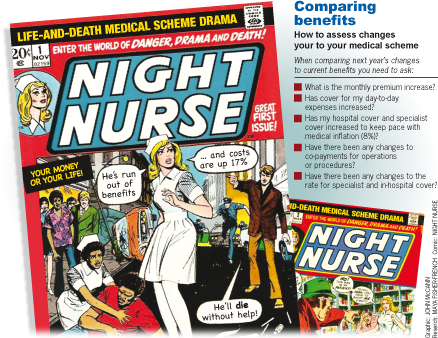
There were significant changes to the scheme that have effectively lowered my cover but increased my premiums by 17%.
Despite paying more, the chronic cover, which my family requires, has not increased and neither has the day-to-day savings allocation, yet medical inflation runs at around 8%.
Taking inflation and the premium increase into account, the value proposition has fallen by 25%.
Co-payments on operations have increased in some cases from R1 500 to R2 500 and most critically, hospital benefits have been reduced from 300% of the National Health Reference Price List (NHRPL) to 200%. In other words, I am paying more for a lot less.
What tends to happen is that medical schemes aiming for market share will offer aggressive pricing and higher cover to increase membership.
This opens them up to antiselection — in other words sicker people who need the higher cover
migrate to the scheme. For example, this particular medical scheme offers in-hospital benefits at 300% of the NHRPL.
As a result, specialists and surgeons recommended it to patients who had to undergo procedures, and the scheme experienced a 25% increase in hospitalisation.
A scheme’s primary objective is to stay solvent. So if it experiences particularly high claims, this will be felt in higher premiums and lower cover the following year.
But it is not always ideal to change medical schemes every year because of waiting periods for new members. Over time you will reap the benefits of a well-managed scheme and a large increase in one year may be followed by a lower premium increase the following year.
If the scheme is well out of line with prices from other schemes, it may be worth making the change because the profile of the membership may result in continually high premium increases or drastic cover reduction.
In an ideal world, your medical scheme will have had premium increases of between 8% and 9%, but the cover will have increased by a similar amount to adjust for inflation.
Be aware that some schemes may announce lower premium increases but could be cutting some of the benefits, so you need to understand the underlying benefits. Also don’t just accept the covering letter stating the average premium increase.
What matters to you is the premium increase on your cover.