


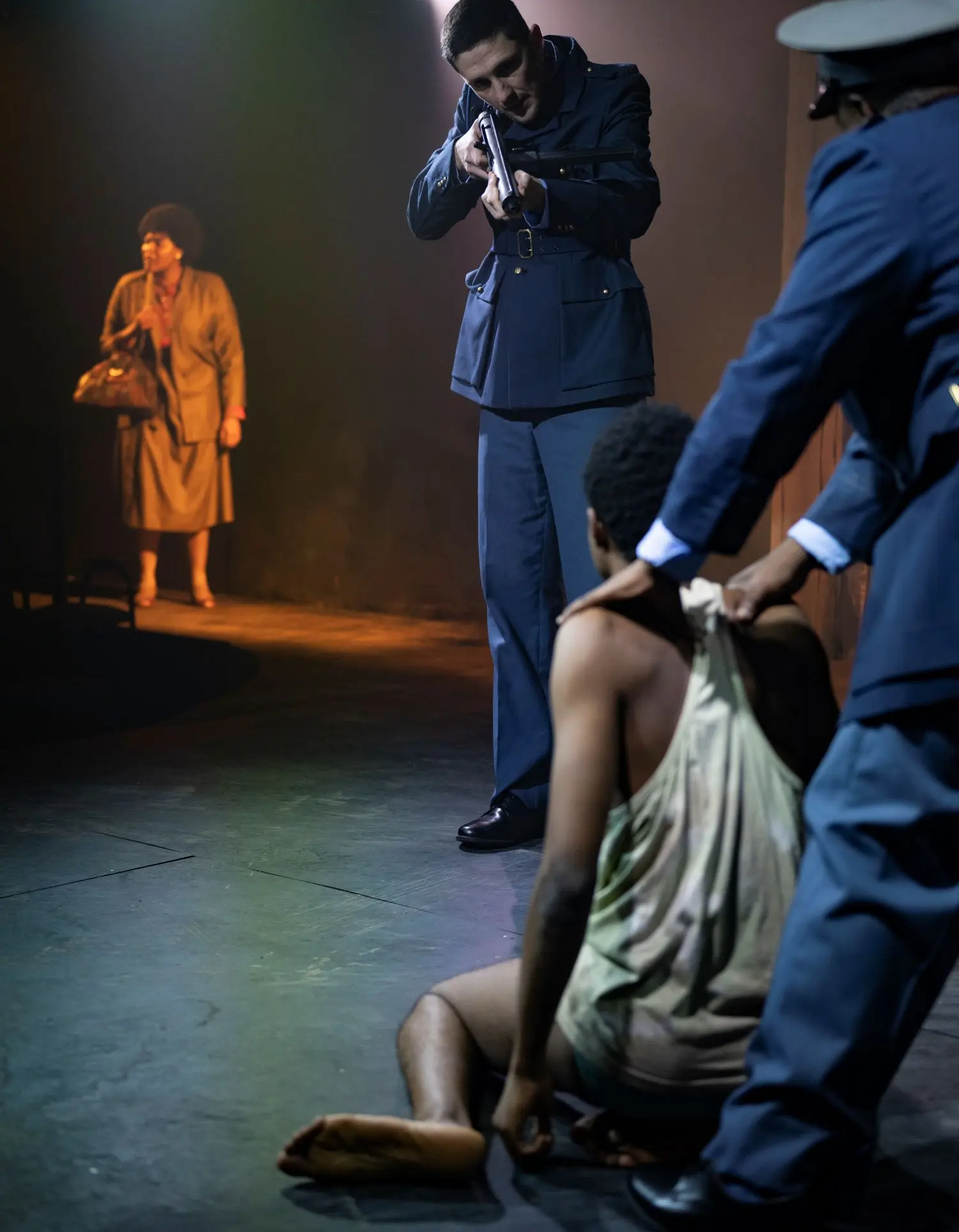
‘Memory is a romantic thing.” These words are repeated at various points of Rise ‘76: The Story of June 16th, now running at the Market Theatre’s Mannie Manim space and they carry a different weight each time.
Playwright and director Tiisetso Mashifane wa Noni lifted the phrase from a written testimony by the late Sibongile Khumalo, who had prefaced her own account of June 16th 1976 by warning her interviewer: “Memory is a romantic thing. So please stop me if I start romanticising anything.”
It was just one of many details that Mashifane wa Noni collected during two and a half months of research — university archives, TRC testimony videos, autopsy records, first-hand interviews with survivors — and tucked away in what she calls her “little bank,” unsure at the time of exactly how it would be used but certain that it meant something.
That instinct for the telling detail is everywhere in this production. “I have picked up what I think are only a couple of crumbs,” she told me when I sat down with her after seeing the play on Sunday, its opening day at the Market Theatre.
“But the crumbs do give us an idea of the various flavours of that terrible day.”
Mashifane wa Noni’s great instinct as a dramatist is to resist the gravitational pull of the monumental. She was writing about an event that most South Africans encountered first through a photograph, Hector Pieterson’s body carried through the street and that has since been processed and repackaged, annually, into something called Youth Day.
Her response was to go smaller and more specific, to find the boy inside the icon. It was in a TRC video, she told me, that she first noticed something small and arresting: a woman walking out of her home to give testimony about her dead son had beautiful pink flowers growing outside her front door. That image, grief existing in the same frame as ordinary beauty, found its way into the play.
So did Khumalo’s memory of how she became best friends with someone at school simply by sharing her lunch. “Children just become friends,” Mashifane wa Noni said, recounting it. “You shared my lunch and then we became friends. There was nothing more to it.” That becomes, in the play, the origin story of Bafana Buthelezi (played by Alex Sono) and Kedibone Moloi’s (Zilungile Mbombo) friendship — unremarkable, human and devastating in retrospect.
The play is structured in two halves that operate almost as different genres. The first is kinetic and alive, full of the adolescent energy of Molefe Secondary School, with students arguing and dreaming and performing the ordinary drama of teenagers on the eve of an exam. There is real laughter in the theatre.

When Bafana gives directions to his house using the pink flowers as a landmark, almost immediately undermining his own instructions, the room exhales in the kind of shared amusement that only theatre can produce. Mashifane wa Noni told me this was entirely deliberate:
“The first half must be action-packed and fun so that the emotional impact really hits when the second half comes in.” She described the tonal shift to me the way her sister had put it after watching the play for the first time: “You tricked us at the beginning and then in the second half, you reminded us why we were actually here.”
And hit it does. The second half is slower, quieter and structured around testimony. The staging shifts. A group of children’s clothes laid out on the floor stand in for the 176 young people killed that day. Later, the black police officer, Sergeant Joseph “Razor” Tladi appears at Bafana’s funeral and leaves behind a set of the boy’s school notebooks. It is one of the production’s most haunting images and it raises questions the play is too honest to resolve.
“I just let the characters tell the story themselves,” Mashifane wa Noni said. “However long they want to take it, however long they want to tell it.”
That honesty extended to the casting choices. Rather than playing the police as a monolithic force of pure menace, Mashifane wa Noni gave them inner lives and, in one structural flourish, a kind of dark comedy. She uses the theatrical device of chorus — characters speaking in unison — to underline how individual policemen dissolved into collective purpose.
“They’re a group thinking together,” she said, “almost like the minions.” The observation is bleak and exact. The most physically unimposing actor in the cast plays the officer responsible for the most violence, a deliberate inversion of what we expect brutality to look like. “A lot of the most dangerous people in apartheid were normal-looking people,” she explained. “The most meek-looking people in the world. You look like a teddy bear but you’re a killing machine.”
She also uses chorus to honour the uprising’s most recognisable student leader. Rather than assign Tsietsi Mashinini to a single actor, three young black men embody him simultaneously. “I’m not going to put pressure on one actor to act as Tsietsi Mashinini,” she told me. “We give reverence to him by making three young black men be Tsietsi Mashinini.”

The character of Razor deserves particular attention. He is not based on a single historical figure but assembled from countless passing references in other people’s testimonies — the neighbourhood policeman people mentioned by way of explaining something else, the black officer spotted at the moment a child was shot, the colleague who said nothing.
“What is the weight of living your life like that?” Mashifane wa Noni asked, articulating the question that drove her to create him. “At the end of the day, you’re a black policeman working with the white police but you have to go home to Soweto and Langa. You have to live amongst the other black South Africans. What is that like?”
She discovered, in one account, that a black policeman near Pretoria took his own life after 1994, unable to live with what he’d done and that his community refused him burial in their ground. That real story shadows Razor’s fictional one, giving him a weight that mere villainy could never produce.
The production takes on an additional resonance from the fact that it is playing at the Market Theatre at all. The Market opened its doors just three days after June 16th 1976, in a building that had itself been rescued from another kind of destruction — turned from a produce market into a space of defiant, non-racial art-making.
Fifty years later, the theatre is marking that anniversary and this production sits at the centre of those commemorations. Mashifane wa Noni was conscious of the inheritance. She studied how the Market’s productions had changed in style over five decades, from the urgency of protest theatre in the 1970s to the more complex, layered work of the present.
Her conclusion was that she should not attempt to replicate the aesthetic of that earlier era. “Do I go back and try to create a play in the style of protest theatre of that time,” she asked herself, “or do I take the story of that time period and add what I call 2026 theatre-making elements to it?” She chose the latter — her own voice, her own formal devices, her generation’s way of seeing.
That generational perspective also sharpened her unease with how this history has been packaged. The play emerged, in part, from her encounter with a testimony given at a parents’ meeting held just days after the uprising — a father who stood up and told the assembled grief-stricken adults that it was embarrassing for the older generation to be sitting there planning children’s funerals. He felt they should have been the ones facing the police. Interviewed two decades later, he had not changed his mind.
“This thing of making these children heroes, it’s not it, guys,” Mashifane wa Noni said, channelling his argument. “These children should have been children living their lives.” She wrote Bafana accordingly — full of whimsy, full of dreams, irreducibly a teenager. And she has little patience for the annual softening of what that day actually was. “These kids were massacred,” she said to me plainly.
“There should be a weight to it. Youth Day is just not enough.”
Fifty long years, she reflected, do strange things to an event. “It’s like leaving a newspaper in the sun for too long,” she said. “It sort of faded a little bit and now you’re trying to read it again. It’s all there, but we sort of forget about it, or we can’t quite read it clearly.”
Details are lost. People die. Certain stories get overshadowed by others.
She told me about a woman she came across in the archive — interviewed while working as a cashier, living with the entirety of June 16th folded into her memory, unrecognisable to the customers she served each day. “You’re passing this cashier at Checkers or Pick n Pay,” she said, “and she literally has history sitting in her bones and we wouldn’t even know it.”
It is that woman and the generations of survivors now in their 60s who have had to watch the country that emerged from their struggle become whatever this is, whom the play ultimately speaks to. “I see you,” Mashifane wa Noni said emphatically. “I recognise you. I still care about what you have to say.”
Rise ‘76 runs at the Market Theatre’s Mannie Manim Theatre until 28 June 2026, with special commemorative performances on Youth Day and as part of the Market Theatre’s 50th birthday weekend, 19–21 June.