


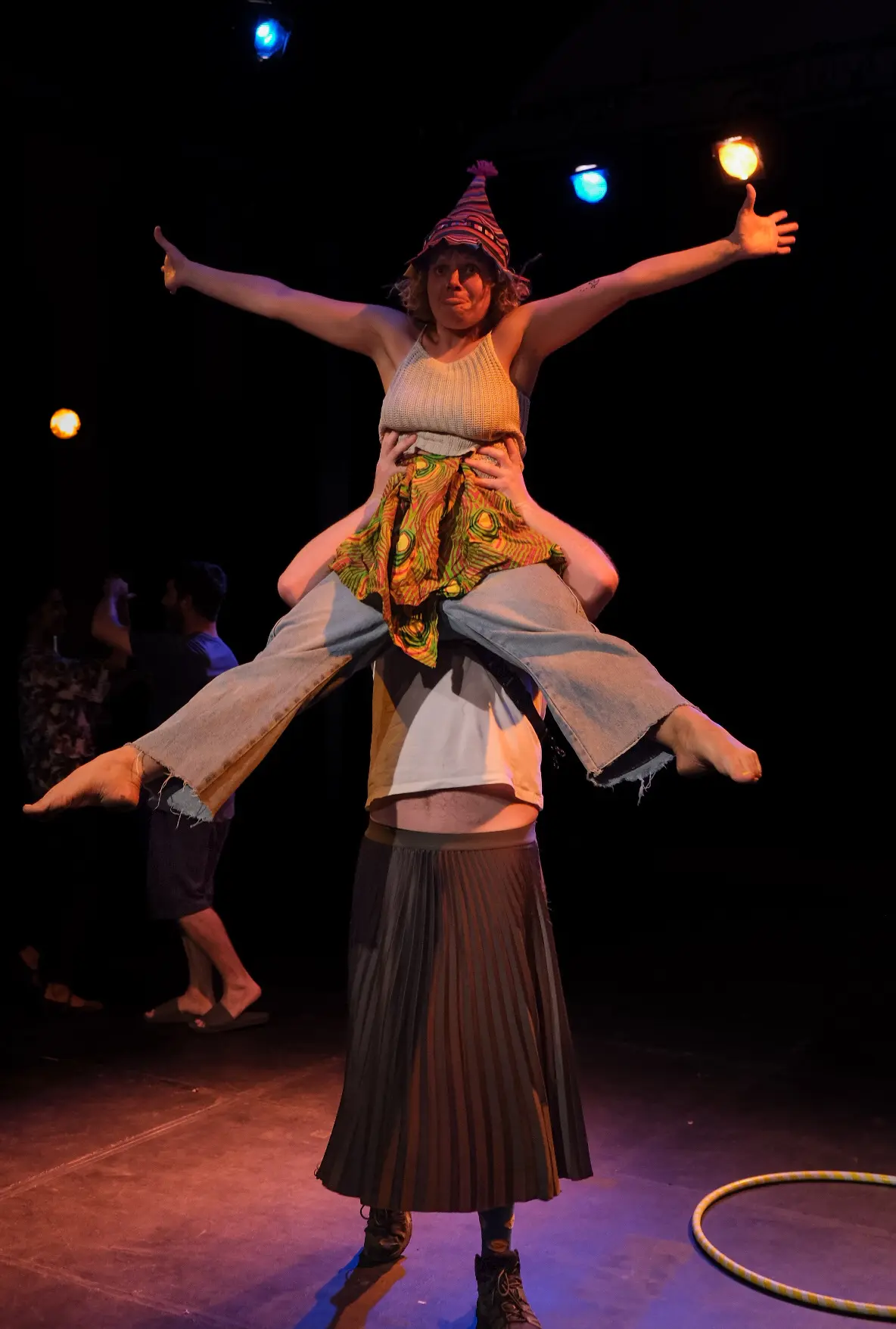
Sophie Joans and Mxolisi Masilela are both theatre-makers that have spent their careers building spaces the industry wasn’t building for them.
They have that stubbornness in abundance. Both recipients of the Mail & Guardian’s Top 200 Young South Africans recognition, the two are now bringing that founding energy to the National Arts Festival in Makhanda with Joans helming the Spark Hub and Masilela the TX Theatre Hub.
Their paths couldn’t look more different on paper. Masilela, 35, grew up in Thembisa’s Madelakufa informal settlement, where drums and street rehearsals formed his first theatre school.
Without formal qualifications, he spent two decades building TX Theatre from a community gathering point into a globally recognised institution, training at Australia’s NIDA, performing at the Market, State and Windybrow theatres and earning an International Society for the Performing Arts Global Fellowship that will see him in New York annually for the next three years.
Joans, 28, came up through UCT and Wits, launched Spark in the Dark Theatre in the wreckage of the pandemic as “an act of creative defiance” and within four years had brought 14 original works to the National Arts Festival, won a Gold Standard Bank Ovation Award for her solo show ÎLE and earned a nomination at the Edinburgh Fringe competing among more than 3 800 shows.
But ask either of them what they recognise in the other’s story and they don’t lead with the accolades. They lead with the refusal.
“We are not waiting for a platform to be given to us to tell a story,” says Masilela.
“We just take a platform and tell a story. It doesn’t matter if we tell our story on a small screen in WhatsApp groups or behind a school hall or in a soccer field. We’re on the same journey, doing the same thing, wanting to achieve the same thing: to tell authentic stories for young people without being given permission.”
Joans nods at this immediately. “To wait is to stagnate and nothing will happen.”
She recalls performing her first stand-up comedy gig at TX Theatre in Thembisa as a young woman and recognising the same energy she’d been trying to build herself.
“Neither funding nor permission are coming and if they do, it’s a nice addition. But you can’t wait.”
What makes both their stories remarkable is that in building spaces for themselves, they inadvertently built spaces for dozens of others. Masilela’s TX Theatre has mentored and platformed young artists from Thembisa and beyond for two decades.
Joans’s Spark in the Dark has employed more than 40 performers through National Arts Council and Presidential Employment Stimulus Programme funding and currently has three interns learning to produce.

“Next year,” she says, “we’ll have 10 young people who can produce shows. You can create a network where artists aren’t entirely dependent on doing everything themselves.”
Both are acutely aware of the industry vacuum their work is filling. The independent theatres that once served as career launchpads — the scrappy, willing-to-take-a-chance-on-you venues between drama school graduation and a Baxter or Market Theatre run — have largely closed, many in the aftermath of Covid. “You can’t go straight there,” Joans says.
“You’ve got to build steps. Those theatres closed. And if we don’t launch the careers of young people now, then we lose a chunk of a generation who become theatre makers and artists.”
She’s seen it happen to contemporaries. “They want to make plays, they take a part-time job, it becomes a full-time job and it’s 10 years later and they haven’t done anything. It’s hard to be in the industry if you’re not fully there.”
The hubs at Makhanda are, in part, an answer to that. For Masilela, the TX Theatre Hub is about giving grassroots South African work from underserved communities the proximity to global eyes it rarely gets.
The programme includes a hip hop theatre piece about a 19-year-old girl shot 12 times at a California gas station in 1998, whose killers were never arrested and a work exploring how society raises men.
“South Africa has way beyond amazing young talent that the world hasn’t seen,” he says. “What we’re trying to build with these hubs is to give great young talented professionals eyes from all over the world.”
For Joans, Spark Hub is about proving that theatre at its most powerful needs no grand infrastructure. “Live theatre is AI-proof,” she says — a line that’s earned her pushback, which she accepts with some nuance but stands behind in its essential truth.
“I think it’s going to be a long time and possibly never, that you can replace a human being on a stage, in front of a bunch of human beings in an audience.”
She has a sideline argument she’s equally passionate about: theatre is one of the last remaining places where it’s socially unacceptable to check your phone.
“For me, that’s something really special, especially as a normal human being who’s definitely addicted to her phone. Every hour spent off your phone is a tiny revolution.”
There’s a broader cultural argument beneath both hubs, too, about what South African theatre is and isn’t saying. Masilela is unambiguous about it: “We haven’t begun to tell the truth about our country. We haven’t begun to tell the stories that are current — crime, unemployment, education, race conflict now. We’re still locked in producing what has worked for the past 50 years and discounting that theatre will take us to the next 50 years. It won’t.”
Joans agrees and adds urgency. “We’ve got to catch young voices before the world dumbs them down,” she says.
“The naive, clueless, brave, unfiltered voices. If we only support theatre makers who have proved themselves and are guaranteed to sell tickets, we’re not letting through enough of those rougher, raw, maybe messy plays that can only be said by people who are too young to have learned to play it safe.”
Ask what they hope someone walks away with after spending an hour in either hub and their answers arrive almost simultaneously.
“That they want to come back for another hour,” says Joans. Masilela: “It will be the greatest mistake of their life because they will never spend any other hours at the festival.”
For two people who built their tables from scratch, in communities and conditions that were never meant to produce them, that confidence is entirely earned.
The National Arts Festival runs from 25 June to 5 July 2026 in Makhanda. TX Theatre Hub and Spark Hub are among the festival’s featured programming destinations.