


South Africa’s history is delicately woven with stories of struggle that led to sovereignty and the heroes that steered us there, not without sacrifice. These names are etched into the history books and lexicon of South Africa.
Think: black consciousness leader, Steve Biko, the schoolchildren who were in the firing line in Soweto 50 years ago and the women who stood at the foot of the Union Buildings in 1956, chanting “you strike a woman, you strike a rock”, to protest against apartheid pass laws.
These words were slightly altered to “you strike a queer, you strike a rock. You strike a drag queen, you strike a rock” in the opening scenes of the boldly executed theatre production Nkoli: a fierce and fabulous life, which tells the life and story of South African anti-apartheid, gay rights and Aids activist Simon Nkoli.
He was a lesser-known figure in the struggle for freedom but no less important than the Mandelas, Hanis and Sisulus we are more familiar with today. He fought a dual struggle: first against homophobia and then against the injustices faced by black South Africans.
He was also romantically involved with a white man, when inter-racial relationships were illegal, adding an extra layer of drama to his controversial life.
Nkoli was charged with treason alongside 21 other activists for their involvement in protests in the Vaal. Nkoli spent four years in prison where he had to once again defend his identity and capabilities as a gay man, even to his inmates.
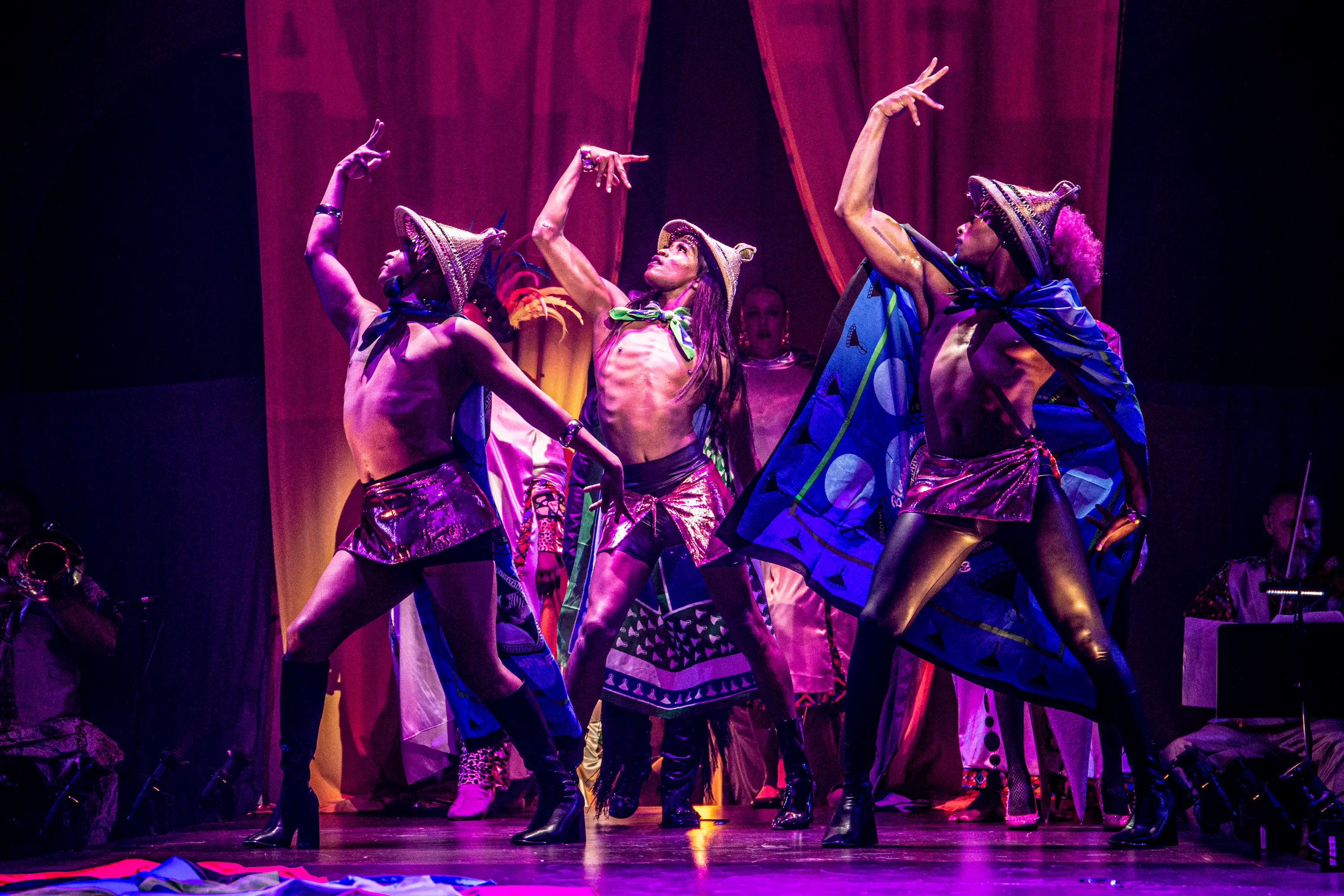
Nkoli is a vogue-opera that blends opera singing with a live orchestra, rapping, lip-syncing and voguing — a dance form rooted in the underground black and Latino LGBTQ+ ballroom scene that emerged in Harlem, New York, during the 1960s and 1970s.
While Nkoli deals with heavy themes of incarceration, racism and homophobia, director Phillip Miller, alongside assistant director and co-writer S’bo Gyre, managed to colour and create a production that is bold, provocative, unapologetic and unabashedly sassy.
“This story really should be right up there in the lexicon of like amazing South African stories of leadership,” said Gyre.
“When I think about it, to be queer and fight apartheid … Like, honey, pick a struggle! He was like: ‘No, I’m fighting all of you, I want you one by one.’ So, it’s cool because it’s a learning process as well.”
Gyre started working on the script in 2021. The production premiered at Johannesburg’s Market Theatre in 2023 and had a sold-out season at the Baxter Theatre Centre in Cape Town in 2024.
It gave Johannesburg four shows in June before it heads off to the Theatre der Welt in Chemnitz, Germany, for its international debut next month, for two shows only.
Gyre said it was important for the production to be home-grown first and accessible to communities to understand the nuances of intersectionality.
“We’re getting closer locally to touching communities a bit more because you also want to have that story there.
“For me, it will be beautiful when we can have a proper theatre run in South Africa particularly to touch, to put it quite bluntly, the young black community so they can see themselves. I think that will go a long way.
“The parallels are just uncanny for most of us who are queer in this cast because we’re still dealing with some of the same issues but they experienced it back then in different ways … Intersectionality, which is something that he even struggled with. We speak about it because gay misogyny is a real thing and we didn’t shy away from engaging with that.”
Simbone Qonya, a performer who hails from the Eastern Cape, successfully portrays Nkoli as a delicate and soft man who is victimised by his family and community for being gay but also as a firm freedom-fighter who is unapologetic about who he is and what he stands for.
It becomes evident in the changes of his stature from slightly restrained with a low voice to someone who occupies the stage as a presence to be reckoned with. His struggle begins to be felt.
As their chant goes: “We’re here, we’re queer, we’re everywhere!”
Ann Masina plays Simon’s mother while Nokuthula Magubane plays the role of Dr Beverly Ditsie, a lesbian, LGBTQ+ rights activist and an ally to the Gay and Lesbian Organisation of the Witwatersrand, co-founded by Nkoli. Luthando Madikizela plays the role of Gcina Malinda, who was an anti-apartheid activist and close friend of Nkoli.
The platform has two levels: the ensemble cast of Nkoli seduce the audience with sultry singing, sexy movements and skin-tight shorts that give a sneaky booty shot here and there. It brought the glam of the gay scene to stage in all its flamboyance and sensuality.
When male vogue dancers took centre stage in their tiny shorts, high heels and full-beat face, the audience couldn’t help but cheer. Police officers also entered the scene shirtless and in cheeky little shorts to tease the crowd.
The novelty of the production was that images, words and videos, both live and archived, were projected across the platform on the stage. It acted as another layer of live storytelling which helped progress the storyline.
The biographical element of the production was recreated by using the original sound bites from archives as dialogues which the actors would lip-sync to as live visuals were projected on the screen. It was scarily accurate and could easily be mistaken for the real footage of the real characters.
The entire story is tied together by Gyre, who takes on the role as an extravagant, glamorous and vivacious MC who bridges the gaps between Nkoli’s life and scenes in loud, proud and gay belting — sometimes in heels and dresses, other times in a tiny sparkly skirt that shows enough leg to make any conservative shriek.
The production was an expression of a culture and community deeply underrepresented and a figure who was little known and very personal for Gyre as well.
“It comes from a very deeply personal place, where I see this character in this production but it’s not a real character; it’s a person’s life that was lived fully and how do you honour that? I think the best way to honour that is to honour your own story and then the rest will come to it and speak and most importantly, I think to educate as well.”
Nkoli died from Aids-related illness in 1998 but in his life, he forged a way that made it easier for gay people to be who they are. He organised the first gay pride march in South Africa in 1990.
In 1998 same-sex sexual activity was decriminalised and in 2006 same-sex marriage became legal in South Africa.
Nkoli lived a life of duality: gay and black/fierce and fabulous/colourful and complicated but as the production teaches: “Where there is life, you must use it.”