


The Italian modernist artist and furniture designer Enzo Mari once said: "Museums are the lungs of the city – they make it breathe."
It was a fitting quote for Governor of the South African Reserve Bank (SARB) Lesetja Kganyago to invoke at the opening of the South African Reserve Bank Head Office Campus and Museum in Pretoria.
For a city often characterised by bureaucracy and government administration, Pretoria has in recent years quietly begun expanding its cultural footprint. Alongside Johannesburg's growing network of galleries, museums and independent art spaces, the capital city is increasingly making room for places that encourage reflection, conversation and historical reckoning.
Museums matter because they offer precisely that. They hold a mirror to society, preserving memory while creating space for ordinary people to encounter history, question inherited narratives and imagine different futures.
The newly opened SARB Museum feels somewhat like grass pushing through concrete. Housed within one of the country's most intimidating institutions, the museum manages to soften the imposing image of the Reserve Bank, finding its place and making an unexpected mark.
"Central banks can seem distant, even mysterious. People often do not fully understand what we do or why it matters. That is why we decided that the SARB Museum should be about more than money. It should help us explain our work, so that the people we serve can better understand our role and hold us accountable for the mandate we carry," Kganyago said during the opening.
Walking through the architecturally striking new headquarters, it becomes evident that this ambition has been carefully considered. The sleek contemporary building sits comfortably among the older heritage structures that surround it, creating a dialogue between past and present rather than erasing what came before.
Inside, visitors are taken through a number of exhibition areas that trace the history of exchange, trade and economic systems, culminating in the formation of Africa's oldest central bank.
The museum asks deceptively simple questions: What is money? Who prints it? How have methods of exchange evolved? Who regulates the systems through which we pay for goods and services? More importantly, how have political systems, particularly apartheid, shaped South Africa's economy?
These questions unfold through a series of interactive displays and historical artefacts.
One of the more compelling sections explores the history of Mapungubwe and its participation in regional and global trade networks centuries before colonial intervention. Artefacts dating back as far as 75,000 years reveal that sophisticated systems of exchange have long existed on the African continent, challenging simplistic narratives that often begin African economic history with colonialism.
Another section documents the period preceding the establishment of the Reserve Bank in 1921, providing visitors with a sense of the economic conditions and political circumstances that necessitated the creation of the institution.
But beyond statistics, timelines and historical documentation, it is often the human encounters within museums that linger.

As I walked out of one of the exhibition spaces, I was stopped by Bongani Mthombeni, a security guard at the new SARB headquarters. Standing proudly in front of a photograph of the historic Netherdutch Reformed Church situated on the campus, he began narrating its history.
He spoke about how the Reserve Bank had acquired and preserved the building as a protected heritage site. There was an unmistakable pride in his voice, not only in the institution itself but in being part of a place that safeguards history.
Mthombeni proceeded to give me an impromptu tour of that section of the museum.
His enthusiasm revealed something profound about museums: they do not simply preserve objects. They create custodians. They foster ownership. They make people feel connected to histories that might otherwise remain distant.
The museum also houses memorabilia documenting the legacies of various Reserve Bank governors through different political and economic eras. From Chris Stals, who steered the institution during South Africa's democratic transition, to Tito Mboweni and Gill Marcus, visitors are offered insights into the philosophies and priorities that shaped monetary policy during critical moments in the country's history.
Yet it is the museum's art programme that perhaps most successfully bridges economics and everyday life.
The ZA@Work exhibition pays tribute to South African labourers whose contributions sustain the country's economy. Through artworks by several contemporary artists, labour is repositioned not merely as an economic input but as a deeply human endeavour.
Among the works featured is The Economist by Nkhensani Rihlampfu, created using shredded banknotes. The work invites reflection on value, labour and the symbolic power of currency itself.
The exhibition Her Currency: Heritage, Identity, Power and Memory extends these conversations further. Featuring works by Esther Mahlangu, Mmakgabo Helen Sebidi and Mary Sibande, the exhibition foregrounds women's experiences and contributions within broader narratives of nationhood and economic life.
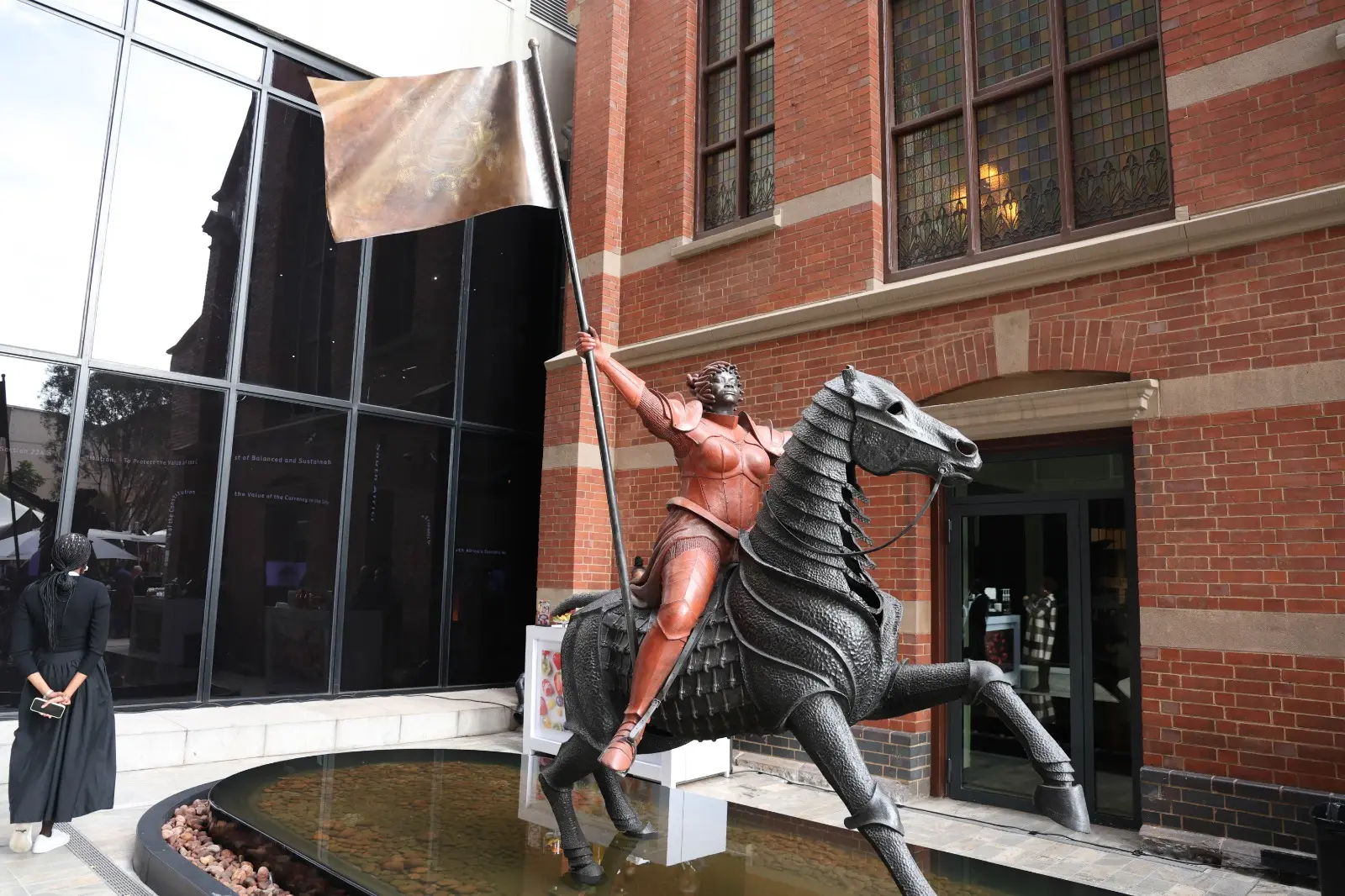
Installed in the museum gardens is Sibande's monumental sculpture, Monument to an Absence.
The work immediately commands attention.
For several years, Sibande has interrogated monuments and the histories they uphold. At the SARB Museum, she continues that inquiry through a striking image of a Black woman mounted on what appears to be the skeletal remains of a horse.
"I've been interested in monuments and what they represent," Sibande explained during the opening.
"Monuments are reminders of conquest. They remind us of leaders and conquerors. I decided to place a Black woman on a horse, but I removed the horse so that you only see its skeleton. In that way I was speaking about absent figures."
The sculpture addresses a glaring omission within South Africa's monumental landscape.
"We don't have enough of our people on public monuments being celebrated," she said. "The work speaks about that absence — not enough of our heroes and voices are represented."
Crucially, Sibande chose not to elevate the monument on a traditional pedestal.
Instead, the sculpture exists at ground level.
"She's not high up there where she is unreachable," Sibande explained. "She's down here amongst us."
The decision fundamentally alters the relationship between monument and viewer. Rather than gazing upward at a distant heroic figure, audiences encounter the work at eye level, creating a sense of intimacy and shared humanity.
Sibande hopes visitors will project their own heroes into the work.
"I wanted viewers to place their own forebears, their freedom fighters, the people who built South Africa, into the monument," she said.
For the acclaimed artist, museums play a critical role in shaping society.
"Museums are essential in society because they preserve culture and memory," she said. "In South Africa, we don't have enough museums. They serve as educational spaces and offer alternative forms of thinking that you may not necessarily encounter in schools."
"They are important because generations will learn through these spaces. That is how, as a society, we create alternative ways of building our future," she said.
Her sentiments echo the broader ambition of the SARB Museum.
In opening its doors to the public, the Reserve Bank is not merely showcasing the history of money. It is inviting South Africans into conversations about power, labour, memory and belonging.
Institutions such as central banks may continue to appear distant and complex. But museums have the capacity to humanise even the most intimidating spaces.
If museums truly are the lungs of the city, as Mari suggested, then Pretoria has just taken a deep and necessary breath.