


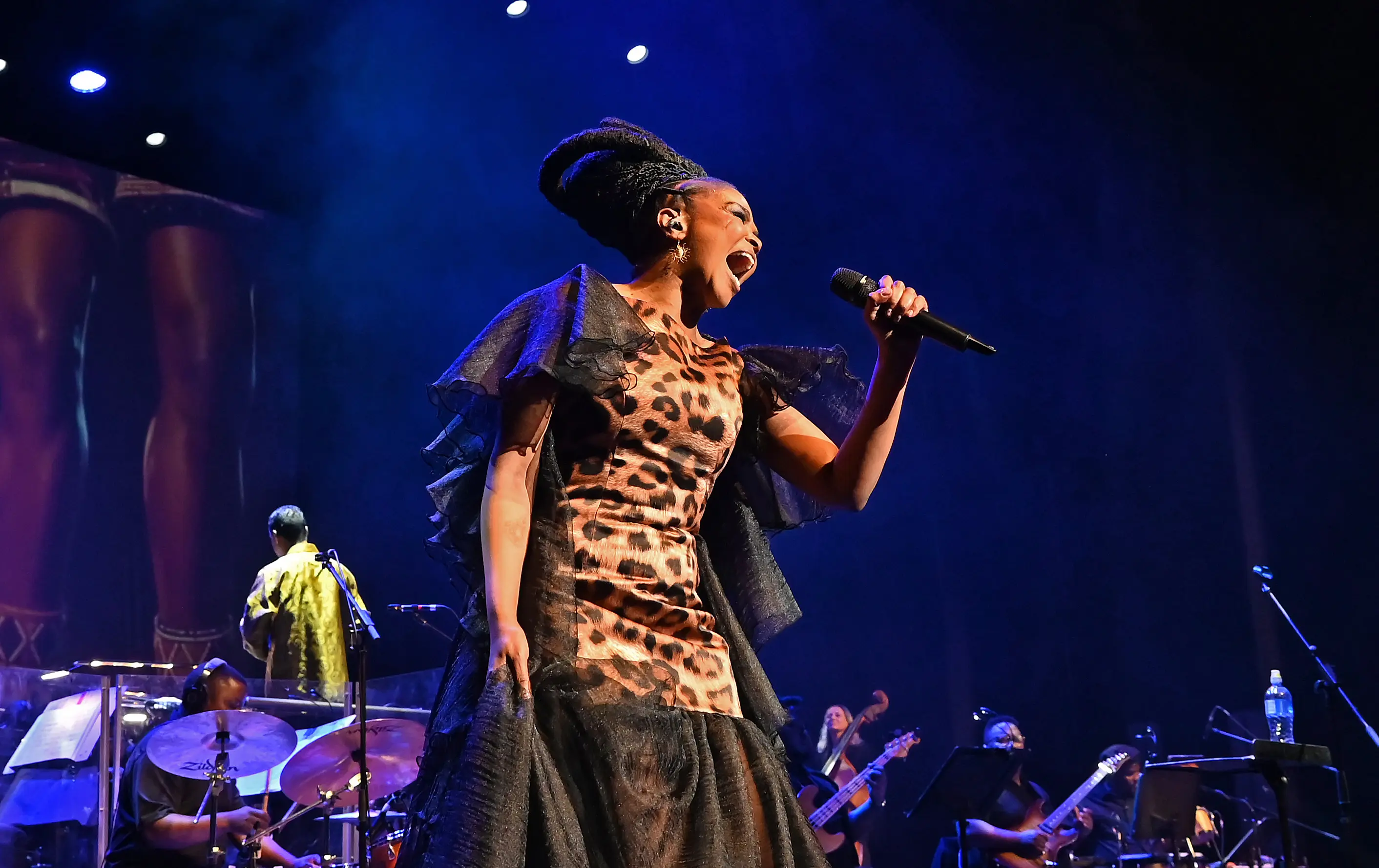
Simphiwe Dana. 29 July. Artscape Theatre. Sold out.
Jimmy Nevis. 30 July. Homecoming Centre. Sold out.
Manana. 1 August. Baxter Theatre. Sold out.
Three nights. Three different audiences. Three different experiences. One unequivocal conclusion: live music is back.
Earlier this year, Global Brands Magazine observed that “audiences are trading everyday small treats for a handful of unforgettable nights. A concert is a memory, a photo dump, a story you tell for years”. It is difficult to argue with that after this past week/end.
My first stop was Simphiwe Dana’s The Symphonic Experience with the Cape Town Philharmonic Orchestra.
There is a growing trend, locally and internationally, with DJs even, to assume that adding an orchestra elevates the experience. For me it does the opposite. It subtracts personality. The optics might look great on stage. But, no.
To be clear, I am not faulting the Cape Town Philharmonic Orchestra. They are exceptional. I did feel they created a solid double-barrier line alongside a performer who has never been known for standing still and merely delivering notes. Dana herself quipped an “I won’t even be able to make mistakes!” line on stage.
And nyani ke, there were moments when the orchestra’s precision seemed to force Dana into negotiating with her instincts rather than surrendering to them.
Here’s the thing: Simphiwe Dana has never been merely an arranger’s singer. Hugh Masekela and Sibongile Khumalo both told her as much. She is an unschool-able talent; one whose gift should remain undomesticated because academia would polish away what makes it extraordinary.
Bringing formalities like orchestras is a gamble. Dana alone suffices. She is an interpreter, a conjurer and an artist capable of moving people with her voice. Alone.
The evening timeously opened with Inkwenkwezi, advanced to Sizophum’ Elokishini, to my favourite, Mayine, to Ndiredi and more. Her Malaika duet with Eastern Cape choreographer and performer Xolisile Bongwana (named 2016 Mail & Guardian’s 200 Young South Africans) was beautiful.
The audience, something Dana noted, was a diverse representation of Cape Town. People sang together, swayed together, embodied the spirit of !ke e: /xarra //ke (unity in diversity) and some even did the traditional ceremony dash to drop off a R100 or R200 note on stage, which Dana would then tuck into her pre-colonial African hairstyle. Cheers and ululation thereafter.
“One of the great things about our nation is its diversity. When different cultures come together, it becomes beautiful,” Dana reflected on stage.
Next up, Jimmy Nevis’s Roses & Thorns, on Thursday. The Home-coming Centre was to capacity.
The thing about Jimmy Nevis is that he has one hell of a voice. He has been at it since 2012. You can hear the fingerprints of '90s R&B throughout his phrasing and delivery but there is also a stubborn refusal to abandon Cape Town. The international influence is there, yet so is an insistence on sounding unmistakably Cape Town.

“I actually work with international producers quite a lot. But the goal isn’t for them to make me sound like London or Los Angeles. It’s the opposite. I want them to step into my world and help elevate a sound that’s rooted in Cape Town. For a long time we looked overseas for validation. I’m much more interested in asking: ‘What does Cape Town sound like?’ And then inviting world-class collaborators to work on that. I don’t want to export someone else’s identity,” replied Nevis when I once broached this subject. Fair enough.
I really need to work on my global-recognition-equals-success expectations. The audience proved this throughout the night; they knew the Jimmy Nevis story and more importantly, they saw themselves in this story as they sang along to hits like PREY, 7764 and F.B.A wherein he asks the Cape-common: Is jy jas? (Are you mad?)
Wat het almal in verleentheid laat lag? (What made everyone laugh in the past?) That made everyone cringe and laugh at the same time.
The defining moment of the evening came with the debut of AK87, a tribute to Ashley Kriel. An anti-apartheid activist. Killed at 20. In Bonteheuwel. 1987.
Actor Dean Smith, who’d infused theatrical monologues in between Nevis songs throughout the evening, also enacted a moving tribute just after AK87.
This is how history survives. Not in textbooks alone but in songs, stages and collective memory. Given the social challenges confronting Cape Town, particularly the Cape Flats side, these are the stories younger generations deserve to inherit.
Among those in attendance was Dr Reuben Richards, the author of Bastaards or Humans: The Unspoken Heritage of Coloured People, whose work has long explored identity, family and historical trauma in coloured communities. As was Western Cape Minister for Cultural Affairs and Sport Ricardo Mackenzie and Artscape Theatre CEO (who was also present at Dana’s show) Marlene Le Roux. And most notably, Ashley Kriel’s elder sister, Michel Assure.
As much as this was a music-and-theatre production, something deeper was unfolding at the Homecoming Centre. Remembrance, reckoning and connection.
Thank you, Jimmy.
After the emotional evening, I took Friday off before resuming my musicking on Saturday with 2026 Standard Bank Young Artist for Music, Ndumiso Manana. The show, Mending Broken Hearts, had been sold out since 16 July. Don’t ask how I got a ticket. But I was there.
The audience could not have been more different from Dana’s wonderfully diverse Gen Y audience or Nevis’s largely Gen X following. Manana’s crowd was Gen Z and overwhelmingly female.
From the first note, it became crystal clear why this eSwatini-born, Drakensberg Boys Choir School-trained, UCT South African College of Music alumnus is one of the country’s most compelling voices.
I struggle to find the words to capture Manana. His first name, Ndumiso, says it all for those who understand Nguni languages.
Perhaps today’s edition of the Mail & Guardian should have arrived with a Manana CD tucked inside. Thereafter, all I would’ve written was: Listen to the CD. The end.
I have not heard vocals delivered that effortlessly in years. I sat back and surrendered to it all.
The Gen Z audience knew every lyric. Every. Single. Word.
At some point, my Gen Y ears picked up hints of Uncle Sam, particularly on Little Things which sounded like the ’90s I Don’t Ever Want to See You Again. One love-struck, one fed-up. Yet similar.

Now, I am not suggesting imitation; every musician carries echoes of those who came before them.
It also made me wonder what makes an artist compelling. Simphiwe Dana overwhelms through sheer vocal force. Jimmy Nevis wins you over as a crooner. Yet somehow it was the quietest performer of the three, Manana, who carried the greatest emotional weight.
How that works, I don’t know.
When he sat behind the piano to sing I Can’t Believe I Get to Call You Mine, it was tear-inducing. Then came Distance (I’m Yours). Shu!
Manana is going far. Very far.
If the three nights proved anything, it is that live music is back. Not because of these alone but because sold-out venues have become an increasingly familiar sight, both in South Africa and across the world.
The experiences do not come cheap; the shows I attended averaged at least R350 a ticket. Yet audiences continue to show up in their numbers, willingly sacrificing everyday luxuries for moments that cannot be replicated. Because, ultimately, they are not simply buying a ticket. They are buying a feeling.
And all three artists delivered exactly that: unforgettable experiences that reminded us of the power of live music.