

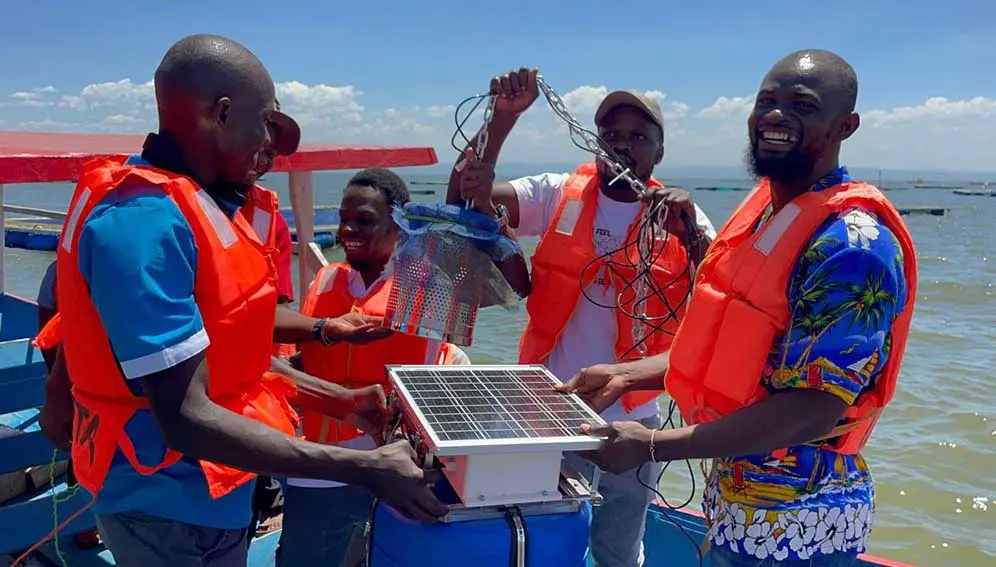
For years, fish farmers at Dunga Beach, along Kenya’s stretch of Lake Victoria, lived with a dread that never really left them. They could end one day looking out at cages packed with healthy tilapia and begin the next staring at a surface strewn with dead fish.
Their entire catch would be lost overnight, with little warning and even less explanation.
For many years, fish farmers along Kenya’s shores of Lake Victoria lived with constant uncertainty. Farmers operating cage aquaculture systems frequently experienced sudden mass fish deaths that wiped out entire harvests overnight. Healthy tilapia stocks could disappear within hours, leaving farmers with major financial losses and no clear explanation of what had gone wrong.
A turning point came in February 2026 when fish farmers at Dunga Beach in Kisumu received urgent text-message alerts on their phones. The alerts were generated by a new AI-powered underwater monitoring system that had detected dangerously low dissolved oxygen levels in the lake. Instead of waiting until fish began dying, farmers were warned early enough to act. More than 300 farmers coordinated efforts to move more than 450 fish cages into safer waters, successfully preventing what could have been another devastating fish kill.
The impact on farmers was immediate and dramatic. Didi Victor, a fish farmer at Dunga Beach, described the event as transformative, saying: “This is a miracle. This is one of its kind on Lake Victoria. We used to have fish kills and we never knew what was happening.”
The AI system was developed through a partnership between the Kenya Marine and Fisheries Research Institute (KMFRI) and Nairobi-based ShoShin Innovation Hub. Underwater sensors continuously measure water-quality indicators and send data to cloud servers, where AI algorithms analyse trends and predict dangerous conditions. Farmers then receive simple SMS messages advising actions such as slowing feeding or moving cages before fish deaths occur.
The need for such a solution has grown increasingly urgent. ShoShin Innovation Hub CEO Naftal Obwoni said fish kills between 2024 and 2025 wiped out nearly $1 million (around R16m) worth of fish stock at Dunga Beach alone.
Cage farming had promised economic growth and food security but recurring fish mortality events threatened farmer incomes and investor confidence.
Researchers sought to understand why fish were dying. KMFRI scientists found that oxygen depletion was often the main culprit. One major driver is excessive nutrient runoff from agriculture. The nutrients stimulate rapid growth of plankton and algae. During the day, plankton generate oxygen through photosynthesis. At night, however, they consume oxygen. When plankton populations become excessive, oxygen levels can collapse rapidly, particularly in crowded cage-farming areas.
Chrispine Nyamweya, a senior scientist at KMFRI, explained: “When we have an excess of these plants, at night they consume a lot of oxygen, depleting oxygen from the water column and hence suffocating fish.”
Other factors worsen the situation. Heavy rains wash organic matter into the lake, while leftover fish feed, fish waste and decaying vegetation consume oxygen during decomposition. Together, the factors can create conditions where fish effectively suffocate in the water.
Pollution also remains a significant concern. Community leaders point to waste flowing into Lake Victoria through rivers such as Nyando and Kibos.
Maurice Ouko, the vice-chairperson of the Dunga Beach Management Unit, explained how pollution events often coincided with AI-generated warnings: “Immediately the rivers discharge the waste to the lake, the early warning is telling us that the oxygen is low.”
Ouko acknowledged that fishing communities contributed to pollution but argued that industries bore a larger responsibility: “The main perpetrators are factories — the big factories which are in Kisumu.”
Scientific evidence supports concerns about declining environmental conditions. In 2025, the Lake Victoria Basin Commission conducted a major survey across the lake, measuring oxygen levels, nutrient concentrations, pollution indicators and heavy metals. The survey confirmed widespread environmental pressures and highlighted the growing threat posed by algal blooms, pollution and habitat degradation.
Addressing the challenges has required more than data collection. Researchers wanted a system capable of translating environmental science into practical advice for farmers. By combining historical KMFRI research with real-time sensor readings, ShoShin trained AI models to recognise patterns associated with fish kills and issue warnings before conditions reached critical levels.
The system has demonstrated strong results. Since the first alert was issued in February 2026, there have been no reported mass fish deaths at Dunga Beach. Farmers who relied on observation or rumours now receive scientifically generated assessments on their phones.
The success of the pilot has attracted attention from across Lake Victoria. KMFRI has identified 15 high-risk locations for possible expansion and plans to deploy the technology at additional sites. The expansion is important because aquaculture in Kenya is growing rapidly. Production increased from just 24 metric tonnes in 2014 to more than 30 500 metric tonnes by 2024, with the number of cage operators rising from 39 to 2 737 over the same period.
Researchers have also developed spatial planning tools to help guide aquaculture development. Mapping systems identify areas best suited for fish farming and highlight zones where environmental risks are highest.
“What we have seen is that the fish that die, die in places that we characterise as unsuitable for aquaculture. Anyone who is in the green zone has not suffered these fish kills,” Nyamweya said.
For ShoShin, the project represents more than a technological achievement. It also demonstrates how locally developed innovation can solve problems facing African communities. Much of the system’s hardware and software, including sensor components, was designed locally. This reduces costs and makes the technology more accessible and adaptable.
Obwoni believes improved environmental monitoring could also shift debates about accountability. For years, disputes over pollution sources have continued without sufficient evidence. Reliable environmental data could strengthen enforcement efforts and support better policymaking.
He emphasised the wider implications: “The ripple effect on this is bigger. It’s beyond just the death of fish.”
The benefits may extend into finance as well. Farmers have often struggled to obtain affordable insurance because insurers lacked reliable information on the causes and likelihood of losses.
Paul Ochieng, who lost approximately one million Kenyan shillings (R126 000) worth of fish during a previous fish-kill event, explained the challenges: “The insurance companies always come but they are too expensive. They insist on insuring per cage.”

With improved monitoring and documented environmental data, insurers may be better able to assess risk, potentially reducing costs and increasing access to insurance products.
The lessons learnt at Lake Victoria are also influencing aquaculture projects along Kenya’s coast. WorldFish scientists, working in partnership with ShoShin, are using digital monitoring systems in marine aquaculture projects that raise tilapia, sea cucumbers, oysters, seaweed and other species. The systems track temperature, salinity, oxygen and other water-quality indicators to help farmers respond to climate-related stresses before losses occur.
Esther Wairimu of WorldFish emphasised the value of the Dunga Beach experience: “What ShoShin and KMFRI are demonstrating at Dunga Beach is the value of continuous sensing, rapid analysis and timely alerts in a high-risk aquaculture environment.”
Climate change is increasing the urgency of such innovations. Wairimu reported that some coastal pilot sites recently recorded water temperatures as high as 47ºC to 48°C, creating severe stress for aquatic organisms that normally thrive between 25°C and 30°C. Digital tools can help identify such risks early and support corrective action.
Despite its promise, researchers stress that AI is not a complete solution. AI cannot eliminate pollution, stop agricultural runoff or prevent climate change. What it can do is provide timely information that allows farmers to respond before environmental stress becomes catastrophic.
As aquaculture innovator Dave Okech noted: “This AI early warning system is a welcome development, so long as the AI models give timely, accurate and farmer-friendly alerts.”
Ultimately, the experience at Dunga Beach demonstrates that AI can play a major role in reducing fish deaths on Lake Victoria. By combining scientific research, locally developed technology, real-time environmental monitoring and practical farmer communication, the system is helping transform fish kills from unpredictable disasters into manageable risks. While AI alone cannot solve the lake’s underlying environmental challenges, it is proving to be a powerful tool for protecting livelihoods, strengthening food security and building resilience in a changing climate.
The story was supported by the Pulitzer Centre.