



You’ve heard about the new six-monthly HIV jab, lenacapavir (LEN). You’ve found a clinic that has it. Now what?
First: an HIV test. Then, if LEN is right for you, two pills and two jabs in the tummy or buttocks. The next day, two more pills.
About a month later, there’s a check-up. And six months after your first shots, you’re back for two more, if you feel you need protection.
Sounds like a lot to remember? We’ve got you.
Find a clinic that stocks LEN here.
South Africa started giving LEN jabs on 5 June. And word has travelled fast.
At Phumlani Clinic in Philippi, Cape Town, people are walking in and asking for lenacapavir by name.
That has surprised Cleo Lucas, one of the clinic’s doctors. Some patients don’t know the names of their blood pressure pills, she says. But they know LEN — and that you only need to take it twice a year.
Short videos, social-media posts and news stories have helped. “It’s brought feet in the door,” Lucas says.
But what happens when your feet are through the door? Do you need an appointment? Why do you need an HIV test? And what are the four tablets for?
Bhekisisa went to Phumlani Clinic and asked Lucas and senior nurse Sister Nolufefe Tose, who gives LEN injections there, to talk us through it.
The health department says the process should be much the same at the 360 clinics where LEN is available at the moment, although waiting times and booking systems may differ (the Western Cape uses a different booking and prescription system from the rest of the country).
Think of this as your LEN clinic cheat sheet.
1. Book — or simply walk in
At Phumlani, you can book online through the City of Cape Town system, or simply walk in.

Booking will probably save you time. But if you arrive without an appointment, staff will check if Sister Tose has a gap. If she does, you can get LEN that day. If not, you’ll get the nearest available appointment. (The national health department says no clinic in the country is allowed to turn you away if you do a walk-in; most clinics outside of the Western Cape work without a booking system and walk-ins only).
2. At reception, say the magic word: LEN
Tell the clerk you’re there to ask about LEN.
If you already use the clinic, staff will find your folder. New? They’ll open one for you.
At City of Cape Town clinics, Lucas says an ID or passport is useful but you won’t be turned away if you don’t have one. You can give staff your name, date of birth and address instead. (At clinics outside of the Western Cape, you can use your ID, passport, asylum seeker number. If you do not have any of these, the clinic can create a special number called the HPRN. This is a number created especially for you.)
At Phumlani, the aim is to get you in and out in about 90 minutes to two hours. (At many other clinics, especially in other provinces, this could take longer).
3. Before the jab(s), there’s a chat
Nobody should simply stick a needle into your tummy or buttocks.
First, a nurse will explain your HIV prevention choices.
LEN is one. Or you could use condoms and pills that prevent HIV.
The nurse isn’t there to choose for you. The idea is to find something that works for your life.
For many people, Lucas says, LEN’s big attraction is simple: only two clinic visits a year.
But there’s an important catch. LEN protects you against HIV. It doesn’t prevent pregnancy or protect you from other infections passed on during sex.
Tose says some people get so excited about LEN that they ask why they need condoms. That’s why she explains that condoms still have a job: they can help prevent pregnancy and other sexually transmitted infections.
4. Next up: An HIV test
No HIV test, no LEN.
That’s because LEN, in this case, is used to prevent HIV, so you need to test HIV negative before getting it.
If you test positive, you won’t get LEN. Instead, clinic staff will talk to you about HIV treatment and help you start it almost immediately.
The nurse may also ask when last you had sex without a condom or whether you’ve recently felt ill. That’s because someone can have contracted HIV so recently that an HIV test doesn’t pick it up yet, so you’ll need extra checks.
Tell the nurse about medicines you use too. Some TB and epilepsy (fits) medicines can interfere with LEN, so the clinic staff needs to know about them so they can decide if LEN is right for you.
5. LEN time: Two tablets + two jabs
Ready?
On Day 1, you swallow two LEN tablets. Then come two injections.
Yes, two.
Together, those two jabs make up one LEN injection dose.
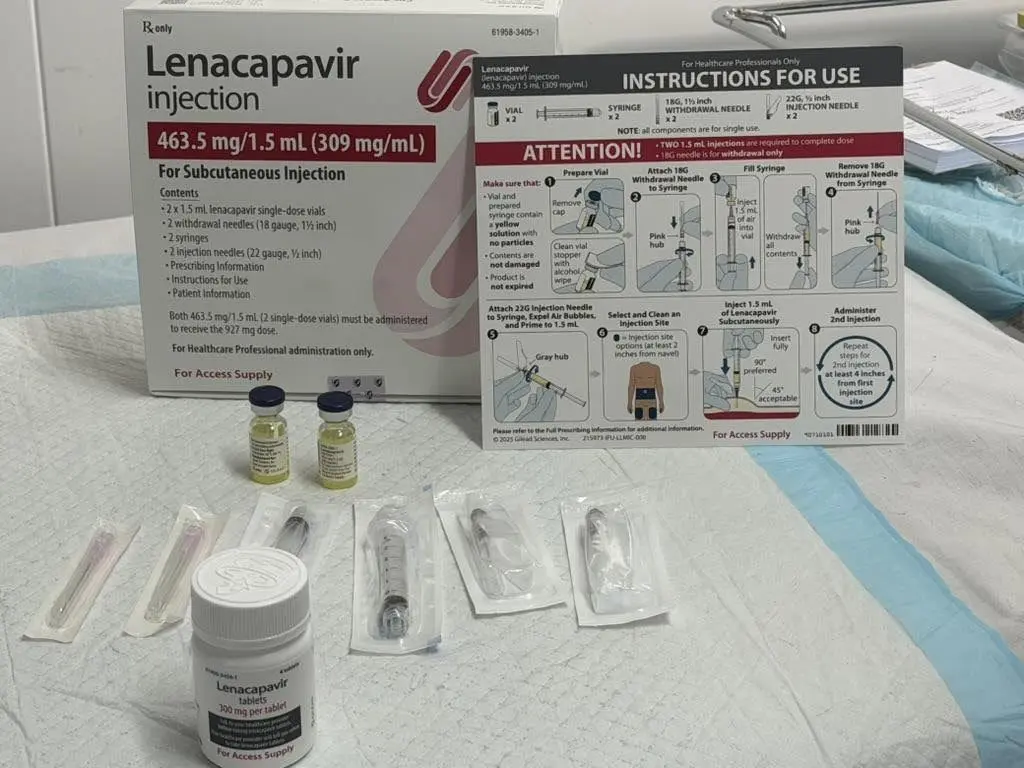
Tose first shows people where she will inject them, because many have never had an injection in their tummy or buttocks. LEN is injected into the fatty layer just under the skin.
6. Jabs done. But don’t run out the door
You’ll usually be asked to hang around for another 10 to 15 minutes so the nurse can check that you’re feeling okay.
Afterwards, the injection spots can hurt or swell, and you may notice two small bumps — one at each injection spot — under your skin. This is normal and the bumps usually go away on their own, sometimes in a few weeks, sometimes after a few months.
Why the bumps? They’re little depots. The bumps are where the LEN, which is released into your body over a period of six months, is stored.

If something worries you, such as fluid leaking out from the injection spot, go back to the clinic.
7. Day 2: Don’t forget the other two pills
The jabs are done, but your first LEN dose isn’t quite finished.
The next day, take the other two tablets the nurse gave you, at about the same time you swallowed the first pair.
Tose’s trick? Set an alarm on your phone.
Forgot? Take them as soon as you remember. Lost them? Go back to the clinic.
The four tablets help to get enough LEN into your body quickly while the injections start doing their job. Once you’ve taken the second pair of pills, your starting dose is complete.
By Day 3, there should be enough LEN in your body to protect you against HIV, and the injections keep that protection going for about six months.
Until then, use a condom or another HIV prevention method.
8. One month later: Quick check-in
First LEN dose? The clinic will ask you to return about four weeks later.
Staff will check how you’re doing, look at any pain or bumps from the injections and do another HIV test.
But don’t wait for your appointment if something doesn’t feel right. If you get a rash, unusual pain or if there is any blistering or changes in the colour of your skin in the area of the injection spot, go back sooner.
9. Six months later: Jab time again
This is the date you really don’t want to forget.
Your next LEN injections are due about six months after the first ones.
At Phumlani, the clinic sends you an SMS reminder. But put the date in your phone too — or somewhere else where you can easily see it.
When you return, you’ll have another HIV test. If you are HIV negative and still want LEN, you’ll get another two jabs. You’ll then be covered for another six months.
There’s some wiggle room: you can get the injections up to two weeks early or up to two weeks late. That is why you can go for your next shots between 24 and 28 weeks after your first injections.
Travelling? Working away from home? Moving? Tell the clinic as soon as you can. (In the Western Cape, you will be able to collect your next jabs from another clinic which stocks LEN, because the province uses an electronic patient record system, which makes it possible for all clinics in the province to access your patient data. In the rest of the country, clinics use a system that does more or less the same thing, but only for LEN data).
If you’re more than two weeks late for your follow-up injections, things can change: you’ll need the tablets again along with the injections. Come back within the recommended window and it’s simpler — just the two jabs, with no tablets.
Then six months later, you do it again.

And that’s really the LEN routine: test, tablets, jabs, tablets, check-in, repeat (and no tablets if you return in time for your next shots).
Six months of HIV protection involves a little more than simply walking into a clinic and getting your jabs — especially the first time.
But once you know the drill, the next round is much simpler.
This story was produced by the Bhekisisa Centre for Health Journalism. Sign up for the newsletter.