


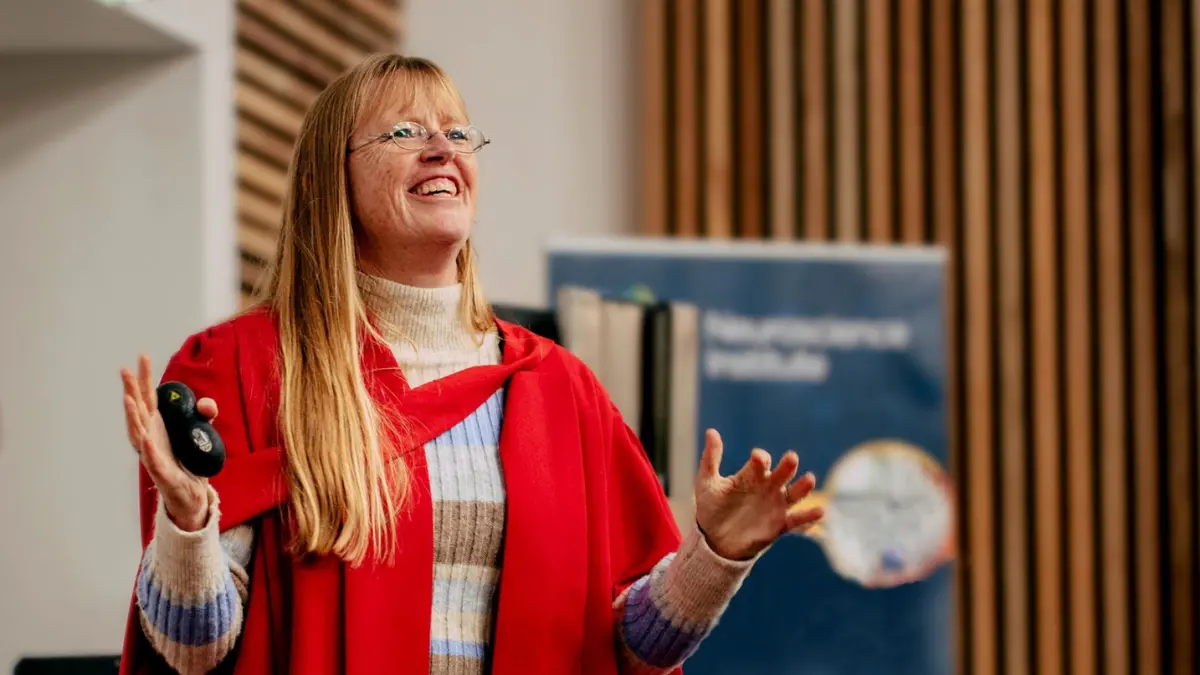
Professor Romy Parker lives in a house on stilts, perched on a mountainside at the southern end of the Cape Peninsula, with a view across to Elsie’s Peak and the shining waters of False Bay. It seems a good refuge for a physiotherapist who has spent decades treating others’ pain, while pushing as hard as anyone to realise a healthcare system that understands, and can help with, pain.
“As it happens, October is Pain Awareness Month,” says Parker, who pauses, before adding, “or is it September?”
It is in September. Parker, who is on sabbatical (and not the working kind), is more keenly aware that tomorrow is the 20th anniversary of her marriage to whale expert Ken Findlay, who is at work in an office on the lower level of their mountain eyrie.
“I’m exhausted. We may go around in circles,” she warns, looking relaxed and comfortable in a strelitzia-print T-shirt, her freckled arms testifying to a life spent as much outdoors as in.
Parker’s need to rest will not surprise those who know her. For years, above her responsibilities at the University of Cape Town (UCT), where she is the director of the pain management unit in the department of anaesthesia and perioperative medicine and works at the Groote Schuur Hospital Chronic Pain Management Clinic, she has been connected with (if not central to) much of the work that has been undertaken to improve South Africa’s pain response.
“In pain circles she’s known as the matriarch,” Parker’s long-time colleague (and director of UCT’s African pain research initiative) Tory Madden told me, in advance of my visit.
Parker has served two-consecutive terms as president of PainSA, which strives to improve all aspects of pain management in Southern Africa, and she sits on the council of PainSA’s mother body, the International Association for the Study of Pain.
With others, Parker has been working on an advocacy document called the national pain strategy, which she describes as “a map of all the things that contribute to pain not being managed properly, with recommendations on how to address those issues”.
Pain is everywhere in the healthcare system. The most common reason why people seek out medical care is pain. Pain is a problem after having a baby, an accident, an operation and when we're dying. People living with chronic conditions like HIV, TB, cancer, diabetes and arthritis frequently experience pain. Lower back pain is the world’s single biggest cause of disability and so it goes.
“Unfortunately,” says Parker, “because it's everywhere and a problem for everyone, it ends up being no one's responsibility.”
What are the issues with pain, exactly? Parker has outlined them thousands of times over the years, but apparently without any dimming of her passion for the subject.

“Pain is divided into two broad types: acute and chronic. Acute pain is short and intense, the type you would experience after surgery. Chronic pain lasts more than three to six months, sometimes longer, after an initial injury has healed. South Africa isn’t doing very well at managing either but we’re particularly bad at chronic pain. There are so many issues and they exist at every level,” says Parker, who lists them from the bottom up.
“It isn’t taught, which means too few healthcare professionals understand it [pain] and that means they’re unable to treat it. Even when they do understand, the resources needed to help — the pain medicines, the rehabilitation platforms — are often not available,” she says, stressing that good pain management “is about so much more than pills”.
“It requires an understanding of the whole human being, starting with their social reality, their psychology, and only then focusing on the biological aspect. Having an interdisciplinary team work to address all the areas that may be influencing a patient’s pain is the best approach. At the minimum this should include the person with pain, their family or support person, a prescriber (commonly an anaesthetist), a nurse, a physiotherapist or occupational therapist, a psychologist and a psychiatrist. For different conditions, other medical specialists can be included,” says Parker.
In the chronic pain clinic at Groote Schuur, Parker and her colleagues listen to people’s stories.
“We hear about the childhood trauma: the father that abused, the uncle that raped, the mother who didn't believe the story. Often the patient is now having to care for these same people while trying to control the son who smokes tik and steals his brother’s laptop in the middle of the night. And they hear the gunshots in the street and the bullet that came through the wall is still lodged in their leg. I am not making any of this up. And they say: ‘I have pain all over.’ Well, I’m not surprised.”
The person behind the pain
Earlier this year I attended a panel discussion chaired by Parker at UCT, titled “How can I find the right person for persistent pain? Navigating the health care system in South Africa”. One of the panellists was Huyaam Samuels, a doctoral candidate and person living with chronic pain, who has been treated by Parker and other members of the multidisciplinary pain team at Groote Schuur for the past 10 years.
“When I first met Professor Parker she bombarded me with questions. She wants to understand the person behind the pain. Her approach challenges conventional thinking and recognises that effective pain management involves more than symptom relief; it also requires understanding how pain affects a person’s daily life, functioning and independence,” said Samuels, who had been on pain medication for eight years by this time. Parker suggested she come off the drugs and start doing some exercise. Samuels resisted initially but started following this advice three years later.
“She gave me the time to come to terms with it. When I eventually took their advice the result was incredible.”
Parker smiles broadly when I recall these inputs. Today she is an acclaimed teacher (in 2019 she received UCT’s distinguished teacher award), academic researcher, and author but for most of her career she has been a hands-on healer.
A life on the move

We’ve vaulted over her life story. After a pause for coffee (“I hope you’re okay with instant”) Parker obligingly goes back in time.
“I’m Brazilian — a Carioca [native of Rio de Janeiro],” she starts.
“My mother was South African of English descent and my father was Zimbabwean, also of English descent. They met and married in Rhodesia. When the government made its Unilateral Declaration of Independence in 1965, they were like: ‘This is not gonna go well.’ So my father was offered a transfer and that’s how I spent the first 10 years of my life as a Brazilian beach kid.”
After some thought she adds: “My father finished matric and went to work in a factory. My mother did her O-levels and went to secretarial school, but there was never any question of their children not being able to do what they wanted. Dad worked for British American Tobacco. He made cigarettes but it wasn’t all bad. All that tobacco money led to my sister being a vet. My brother's a psychiatrist and I work in physio and pain management.”
Parker’s parents moved back to southern Africa in 1978 to be nearer to the family, initially settling in Johannesburg.
“I hated it. I attended an all-girls school [Brescia House] and it wasn’t a good fit for me. I also didn't fit in with conservative white South Africa. Not everyone in our world was pro-apartheid — there was lots of hand-wringing over PW Botha’s Rubicon speech and that sort of thing — but nobody was sticking their necks out to do anything. I found growing up as a privileged white girl in apartheid South Africa very distressing. It made me into an outsider.”
Parker says she was conscientised by her mother’s voluntary social work and trips she made with her brother — then studying medicine at Wits — to Alexandra.
“When I was 15 I tagged along whenever he went to vaccinate kids. Often he’d spend more time patching up people who’d had the s*** kicked out of them by the cops and were too scared to go to hospital,” recalls Parker, who at this point knew exactly what she wanted to do with her life.
“One: get the hell out of Jo’burg. Two: become a physio. I was always really sporty. Gymnastics, swimming, diving, hockey, squash, tennis, riding horses — we did everything in those days. Sport was how we played as a family. And camping!” says Parker, recalling how the family used to camp on the beaches of Rio’s Cabo Frio before it became a surfing mecca.
“I was six weeks old the first time we went, and there was nothing there. Mum’s joke was that she just needed enough fresh water to wash her boobs and my bum.”
Journey to pain
Parker studied physiotherapy at UCT, at the Sports Science Institute. After graduating she “shared a house with mates in London and locumed”.
During a stint of work on a cruise ship, on a Saturday morning docked somewhere in the Caribbean, Parker walked past a newspaper stand and read that Chris Hani had been assassinated.
The memory brings instant tears to her eyes.
“Sjoh,” she says, taking a moment.
“I remember sitting on the pavement on the side of the road, just thinking: ‘Is this it?’ I think that was the first time I recognised that I am African. Up until that point I was like: ‘I could live anywhere,’ but it suddenly felt so weird to be so far away, hanging out with a bunch of people who had no fucking idea why I was upset, joking that I was a communist and that sort of thing. So I came back to Cape Town in 1993, back into boring old private practice.”
Parker’s memories of the Cape were good. She’d been a serious rower at university and took it up again. Her clients were mostly sports people and included the U21 provincial rugby team, which gave rise to the most humiliating moment in her life.
“The U21s were playing the curtain raiser for Springbok versus Scotland at Newlands. One of my guys went down the other side of the field, so I ran across. I don't remember what the injury was but I must have opened my bag and forgotten to close it, because as I was sprinting back the whole stadium erupted in laughter, and of course I'd left a trail of bandages and scissors as I ran. The whole thing was on the big screen,” says Parker, who went out with the teams that night, carried from bar to bar by Scottish lock Doddie Weir, “who said you’ve done enough running today!”
Parker started her own practice but was mainly interested in rowing.
“My practice was in Grassy Park, and I rented a little house on the shoreline of Zeekoevlei, owned by the yacht club. All my working life was built around my training. I had dreams of getting to the Sydney Olympics, in the lightweight sculls,” she says, joking that she was “starving all the time, trying to make the weight — not a genius move”.

When she realised she wouldn’t qualify, Parker “packed it all in” and travelled to the United States (US), working in Arkansas and Michigan when Medicaid, the government-sponsored health insurance, was fully reimbursing healthcare providers for services rendered.
“When the [Medicaid] bubble popped I couldn't get work anymore but I still had the visa, so I did a season in Vail, Colorado, as an optician's technician,” says Parker, who took away from her American sojourn “a firm belief that there are two things that should never be privatised: education and health”.
“That was the first time I heard people speaking about the business of healthcare and it made me feel nauseous. Like, how can you talk about the business of people suffering?” says Parker, who understood perfectly well how the US later came to be grappling with an opioid crisis.
News of her father’s death (“he smoked himself off the planet”) led Parker to return to South Africa. Finding no opportunities outside of private practice she took a job in Hereford on the border of Wales and England, “doing something that I never pictured myself doing, which was rheumatology”.
It was here that Parker began her journey in pain.
Lessons from tough Welsh farmers
“When people have rheumatoid disease attacking their own bodies — rheumatoid arthritis is the classic — the joints get hot and red and swollen and you end up with joint deformities. I was working there before the modern drugs came in, so people had fingers that drifted off in weird directions and elbows that bent in ways they shouldn't. It's a nasty, nasty disease but a lot of my patients were Welsh farmers and they were just getting on with their lives. They’d call and say: ‘I’ve had a bit of a flare up,’ and that usually meant their knee was swollen like a football. We’d treat them and they would carry on with their lives,” says Parker, who had other patients come in with much milder disease, “and they were in agony, wracked with pain, their lives falling apart”.
Wanting to understand this apparent contradiction better, Parker enrolled for a master’s in pain (“Sounds like it involves whips and chains, doesn’t it?” she quips) at Queen Margaret University in Edinburgh, returning to South Africa in 2004 with the aim of getting an academic job, teaching pain management.
“It just appealed to all my base motivations of why I went into health in the first place: the belief that human beings are valuable and deserve to be cared for and respected in every aspect of who they are, no matter what their background is or what they've done. There's just an inherent value in life,” she says, though conceding her mission to get hired by a university proved so difficult she “almost became a horse physio”.
In 2005 Parker found work as a lecturer in physiotherapy at UCT, where she set about secretly subverting the curriculum, “integrating pain into absolutely everything that I taught”.

“At the time, pain simply wasn’t taught in South Africa, we were seriously behind,” she says.
After discovering there was a chronic pain clinic at Groote Schuur Hospital, run by the department of anaesthetics, Parker stepped in, “and pretty quickly started doing things that directly led to where I am now”.
In Hereford she had run a six-week self-management programme for people with rheumatoid arthritis and adjusted it for people living with chronic pain, “including exercise, education, mindfulness — all of the known evidence-based self-management strategies for people with chronic pain that we know make a difference”.
She used to run the course with the fourth-year physiotherapy students, so that they would learn how to do it themselves and was able to show that the approach was effective.
Parker’s doctoral thesis, which focused on pain in people living with HIV, was described by the university as a world first.
“A bit like my rheumatoid arthritis patients, people living with HIV are at increased risk of developing chronic pain but it's not related to viral load, to opportunistic infections or to their treatments. So, what is it and what should we do about it?” explains Parker, who developed and tested a peer-led exercise and education intervention (“Because who the hell am I to tell someone living in pain in Khayelitsha as an HIV-positive person that they should do some exercise and some deep breathing?”) and was able to show that it made a difference.
Parker was supervised by the late professor of psychiatry Dan Stein and ended up with a degree “not in pain and HIV but in pain and behaviour change strategies”, looking at self-management strategies for people with pain and how those change our physiology — how the body’s organs and cells function.
“One of the nuggets that I teach to students and health professionals is that the morphine our brain manufactures is 30 times stronger than oral morphine. So go for a run. Go for a walk. Have a laugh. Do some breathing. Get a hug. All of these things give you your own morphine. They aren’t just nice things to do, they’re medicine,” says Parker, making an example out of something we all know: the broken bone that traditionally ends up clad in plaster of Paris.
“Say it’s your dominant arm that is immobilised for six weeks, what happens is that the map of that hand in your brain shrinks and the map of your non-dominant hand enlarges. When you take the cast off and start to move it again, that map should once again become bigger but for some people it doesn't. Then they end up with complex regional pain syndrome, which is appalling, agonising pain,” says Parker, adding that a healthcare professional who doesn't understand the complex ways pain shows up in the body might dismiss a patient's complaints.
“Understanding the physiology is important and not just for the clinician. The person living with that pain needs that information, too, so that they understand why we're trying to treat them the way we are and that it’s not about fixing their arm or spine, it’s about their central nervous system — the very core of who they are as human beings — and what we need to do to rewire that.”
‘A gobby little s***’
Parker joined PainSA in 2010, “when it was still pretty small and very doctor-led, and still quite focused on medicines and drugs”.
At that year’s congress in the Drakensberg, she “met her people” and was soon asked to stand for council, “because I’m a gobby little s***”.
The awareness of pain in South Africa was expanding. PainSA played a key role in this, conducting outreach and education activities.
In the same year, Parker met Beverly Bolton, a physiotherapist in Gqeberha, who had done her masters in pain through Sydney University.
“We realised we were on the same frequency and soon afterwards put together and ran a two-day course we called ‘Principles of Pain’, which we're still teaching. We offered it to working physiotherapists initially but within a few years realised that everybody needed this.”
Parker and Bolton formed the Train Pain Academy, which today runs a range of two-day courses on pain management for practitioners, via Zoom.
“It’s probably why I'm tired at the moment. I have my day job, then I do Train Pain Academy, then I do PainSA then, then it’s International Association for the Study of Pain and I still go out trail running. This is me,” she says, shrugging her shoulders.
This story was produced by the Bhekisisa Centre for Health Journalism. Sign up for the newsletter.
