


Malawian Mussa Peters, 29, who has been watching over his wife and two-year-old child on the grassy grounds of the Sherwood Hall, stepped forward from the crowd and poured out his heart. He is worried about his wife and child. Food is scarce and resources are minimal. But he is torn between waiting here for transport home and returning to the room they rented in Mayville.
He is one of around 10 000 displaced Malawian nationals stranded in the Sherwood Community Hall transit camp, where the infrastructure has buckled and a heavy stench of urine hangs thick in the winter air.
Over the past week, the desperate conditions at the camp have seen new life and acute trauma: at least one woman gave birth on the site and another six were taken to the hospital by ambulance.
For Peters, the immediate survival of his family depends on getting out of South Africa but his budget is scarce and he is trapped in a logistical gridlock.
“Out in Malawi, there is no money,” Peters said. “Our sisters here, they come here pregnant. There’s no specialists, there’s no hospital here, there’s no place we can stay.
“Why don’t they just take the car (the heavily secured immigration deportation vehicles that rolled into the camp on Tuesday), put a full tank and take us from here straight to Malawi? Why do they want to use that petrol to take us here and go put us in Lindela (Repatriation Centre in Krugersdorp)? Why don’t just go straight to Malawi with that petrol?”
The Peters family represents just one of many who are facing a swelling humanitarian crisis that has seen between 7 000 and 10 000 undocumented and displaced foreign nationals descend on Durban site.
Their trickle to the site, which began on last Sunday with about 70 arrivals, follows a wave of national xenophobia which has been marked by outbursts of violence – two Mozambican nationals were killed during protests in Mossel Bay – and incidents of people being chased from their communities and businesses. Several foreign-owned businesses were looted in Cornubia, near uMhlanga, north of Durban on Monday night, leaving business owners distraught after their stock was stolen and destroyed.
Ward Councillor Warren Burne said the headcount of people at the Sherwood site “has long been abandoned”. “It’s an absolute guess. What I can say is that by Thursday evening there was a name list of just under 4 000 and it was touching on 7 000 by Friday. It got bigger since yesterday,” he said.
It is also understood that the group of around 200 Congolese migrants had started arriving on the site on Tuesday after being displaced from Moore Road in Glenwood. Crowds of people were spilling over onto the grass verges and across nearby roads surrounding the grounds by the afternoon.
As the situation on the ground remains fluid, the crisis has reached a critical turning
point because the South African government has abandoned the lengthy wait for voluntary repatriation, shifting instead to an aggressive, multidepartment legal strategy to enforce mass deportations.
To handle the unprecedented volume without risking violence, the Department of Justice has established an extraordinary virtual priority court linking the camp’s community hall to the Durban Magistrate’s Court.
Department of Justice and Constitutional Development Deputy Minister Andries Nel, speaking to journalists outside the special court on Tuesday, said the state was shifting from voluntary compliance to formal statutory crackdowns.
“It’s operating as a virtual priority court to hear immigration matters mainly emanating from the Sherwood Park area, where there are 7 000 Malawi nationals,” Nel said. “Out of those 7 000, 1 876 have been found to be without documentation and 676 have been voluntarily repatriated with the assistance of the government of Malawi.
“The others are undergoing deportation proceedings. Deportation orders have been issued against them in terms of section 34 1b of the Immigration Act. That requires a hearing by a magistrate and that’s what’s happening at the moment,” he said.
Nel explained that the video link allowed the state to bypass the security risk of ferrying hundreds of people through city streets.
“Instead of hundreds of people being ferried between Sherwood Park and the court, they can remain at Sherwood Park, go to the community hall through a video link, have the matters heard here at the Durban Magistrate’s Court,” Nel said, adding that up to 10 magistrates would be available from Wednesday alongside Legal Aid attorneys to expedite hearings.
The government has mobilised an all-department response through an inter-ministerial committee led by Minister of Justice and Constitutional Development Mmamoloko Kubayi and a provincial steering committee to manage the fallout.
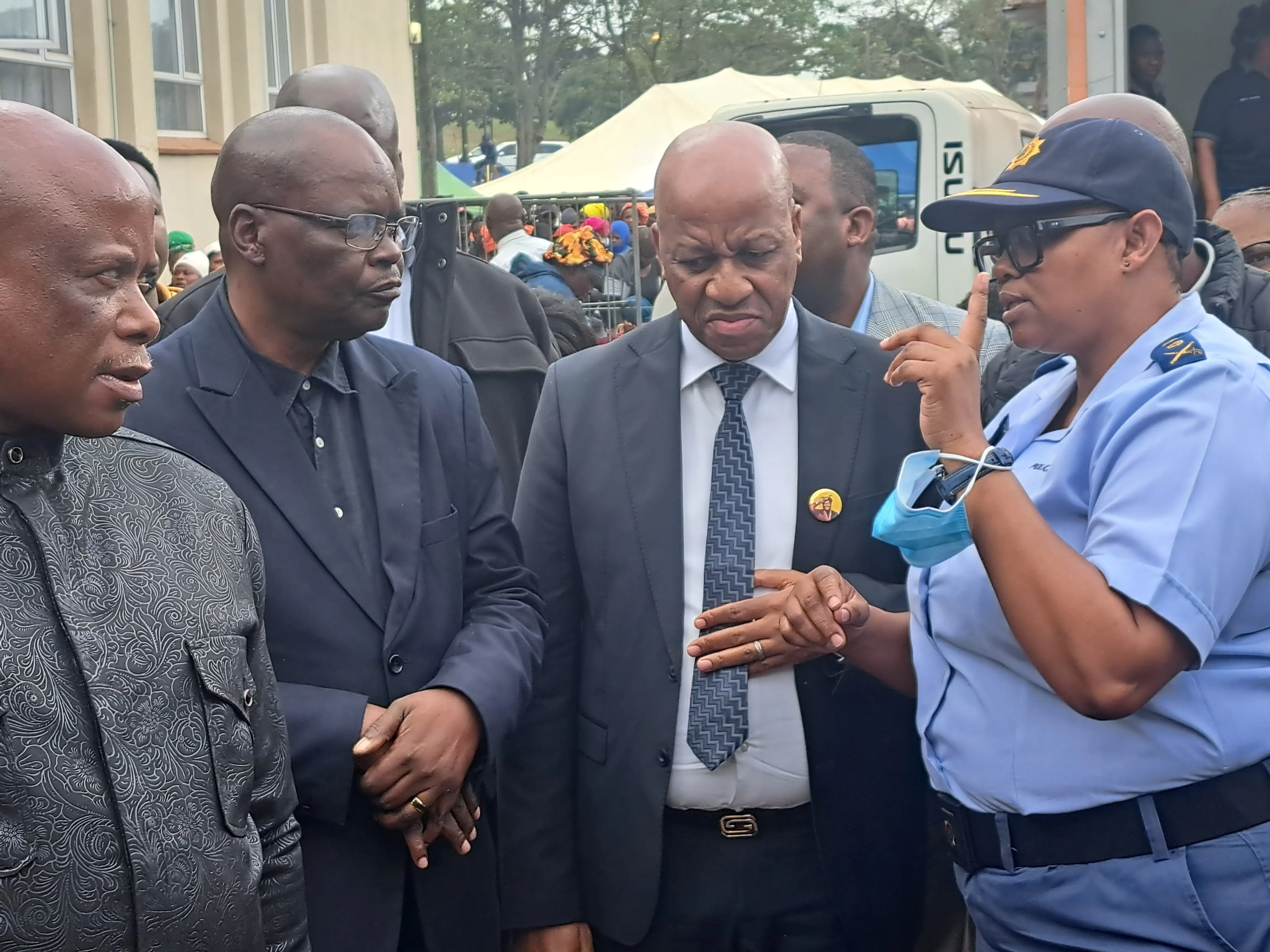
KwaZulu-Natal Premier Thami Ntuli, who visited the site on Tuesday, said the consolidated intervention — involving Social Development, Home Affairs and Community Safety and Liaison — was designed to “ensure that we avoid a disaster” and protect both the displaced individuals and residents. He said there were more than 10 000 people on the site.
Regarding the reports of looting, he said: “Police must arrest criminals. Whether a criminal is a South African or is not a South African, you must be arrested. You cannot loot shops, whether they are owned by foreign nationals or South Africans. Looting is breaking the law.
“Hence, even those who are attacking foreign nationals, when you break the law, you must be arrested. That is why we are making a call to the people of KwaZulu-Natal and South Africans. They must not take the law into their hands,” Ntuli said.
Although the thousands on site have remained peaceful, frustration is rising.
Groups of Malawian men have begun shouting in front of television cameras that they want to go home, actively calling upon Malawi’s dollar billionaires, Thom Mpinganjira and Shepherd Bushiri, to step in with the finances required to bypass the South African state’s slow processing.
“If government, there’s no money that side, please. There’s a Bushiri there,” Peters pleaded. “Mister Mpinganjira … big millionaires in Malawi … person who is in top in Malawi,” he said.
Logistical relief is creeping in slowly. Ten buses arrived on site on Tuesday to transport people to Johannesburg, where they will be transferred to other vehicles bound for the borders.
However, ward councillors said the processing took more than an hour per bus because of the complex cross-border travel documentation required for Zimbabwe and Mozambique.
Faced with a severe shortage of municipal facilities, Muslim humanitarian organisations, such as Gift of the Givers, Gift of the Needy and local representatives of the World Memon Organisation, have stepped in to provide vital infrastructure, supplying large tents, food, water and temporary toilets since the first night.
With the Sherwood site buckling under the strain, it is understood that the steering committee is finalising emergency plans to move the displaced population to Tills Crescent — a 50 000m² sports field four times the size of the current site. Under this plan, it is understood that authorities intend to separate the men and relocate them to the Tills Crescent sports ground about 3km away, keeping Sherwood Park for the processing of women and children.
Disaster Management staff from eThekwini Municipality were seen scoping out the site when the M&G visited Tills Crescent grounds on Tuesday. Local children were playing a football match at the almost-empty grounds.
As Home Affairs immigration officials continue checking documents and processing individuals on site, the state remains firm on its hardline approach.
“This is really just an indication of the seriousness with which government takes a situation” Nel said. “Everyone who’s in our country needs to be here legally and where they are not here legally, the law must take its course.”