


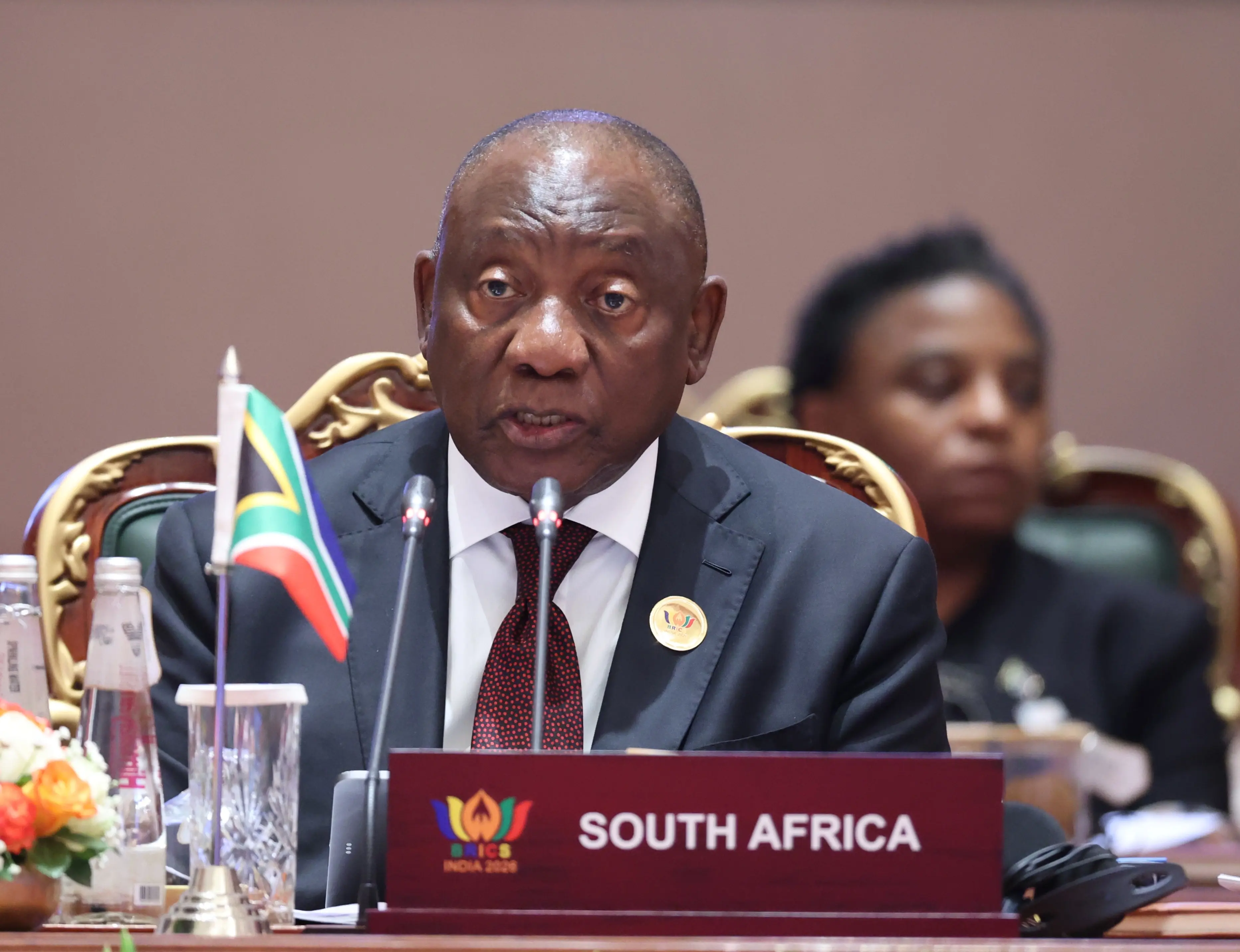
President Cyril Ramaphosa has used the BRICS leaders’ summit in New Delhi to make a forceful case for the equal application of international law, demanding accountability for atrocities in Palestine, Sudan and Iran.
Addressing a session on global governance and multilateralism on Saturday, Ramaphosa warned that the authority of the United Nations and the international rules-based system was being weakened by violations of the UN Charter and the use of war to settle disputes between states.
“To give strength to the law, there must be accountability for atrocities: for the ongoing genocide against the Palestinians, for the crimes committed against the people of Sudan and for the illegal war against Iran,” he said.
“We must exert pressure and expose violations whenever, and by whomever, they are committed.”
Ramaphosa’s intervention placed South Africa’s long-standing demand for consistent adherence to international law at the centre of the summit’s deliberations.
He argued that principles such as sovereignty, territorial integrity, political independence and the peaceful settlement of disputes had to protect all nations, regardless of their size or power.
“International law cannot be applied selectively: the same principles must apply to all states and the same protections must apply to all peoples,” he said.
Ramaphosa linked this position to South Africa’s decision to approach international judicial institutions over Palestine.
South Africa instituted proceedings against Israel at the International Court of Justice in December 2023, accusing it of violating its obligations under the Genocide Convention in Gaza. Israel denies the allegation.
The court has issued provisional measures ordering Israel to prevent acts prohibited under the convention and enable the provision of humanitarian assistance. It has not yet ruled on the merits of South Africa’s case or determined whether genocide has occurred.
The New Delhi Declaration reflected several positions that South Africa has championed.
BRICS leaders noted the provisional measures issued in South Africa’s case and Israel’s legal obligation to ensure the provision of humanitarian assistance in Gaza.
They called for the maintenance of the ceasefire and full, unhindered humanitarian access, while opposing the forced displacement of Palestinians and attempts to change the geography or population of Gaza.
The declaration condemned violations of international humanitarian law, including the use of starvation as a method of warfare, attacks on civilians and civilian infrastructure and the obstruction of humanitarian aid.
It also reaffirmed support for an independent Palestinian state within the internationally recognised 1967 borders, with East Jerusalem as its capital, and backed full Palestinian membership of the UN.
The declaration expressed concern about escalating tensions in the Middle East and called for restraint, dialogue and respect for the sovereignty and territorial integrity of states.
It also raised serious concern about attacks on civilian infrastructure and peaceful nuclear facilities under International Atomic Energy Agency safeguards.
On Sudan, BRICS leaders called for an immediate and permanent ceasefire, unhindered humanitarian assistance and a peaceful settlement based on the principle of African solutions to African problems.
Ramaphosa said the failure to apply international law consistently risked pushing the UN towards irrelevance.
At the same time, he argued that the institution had to be reformed to reflect current global realities and give developing countries a meaningful role in decision-making.
Africa has 54 UN member states and accounts for nearly one-fifth of humanity, but remains without permanent representation on the Security Council.
“This is neither just nor sustainable,” Ramaphosa said.
He repeated South Africa’s call for comprehensive reform to make the council more representative, accountable, transparent and effective.
The New Delhi Declaration recognised Africa’s demand for greater representation and referred to the continent’s common position contained in the Ezulwini Consensus and Sirte Declaration.
That recognition strengthens Africa’s campaign for a greater role in the institution responsible for decisions on international peace and security.
Ramaphosa said BRICS could advance reform by speaking with a united voice, demonstrating that multilateral cooperation produced practical results and helping to build a fairer and more development-focused system of global governance.
He pointed to the New Development Bank and other areas of BRICS cooperation as mechanisms for advancing infrastructure, sustainable growth, food security, health, industrialisation and climate resilience.
Ramaphosa also described BRICS as a bridge across geopolitical divisions at a time of growing global fragmentation.
“In a fragmented world, dialogue matters more than confrontation,” he said.
He said the bloc had to ensure that developing economies were represented in global decision-making, that power remained constrained by law and that no state was allowed to act with impunity.