


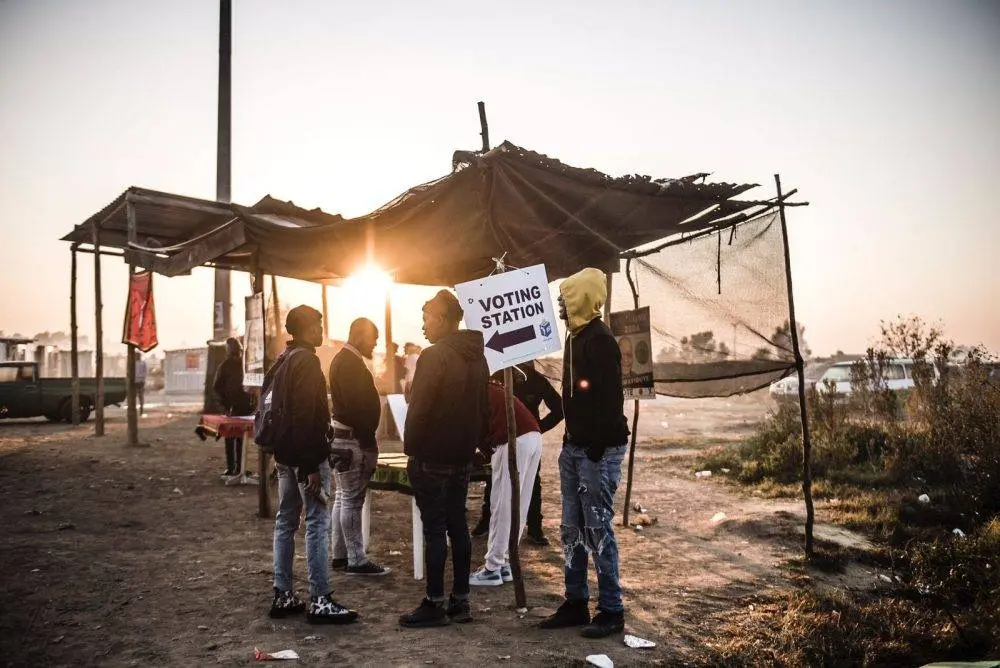
With 546 political parties contesting the local government elections on 4 November, with almost 137 000 candidates vying for just over 10 500 council seats, a political expert has described the number of parties as presenting a logistical nightmare for the Electoral Commission of South Africa (IEC).
Dr Oscar van Heerden, research associate and senior research fellow at the University of Johannesburg’s Centre for African Diplomacy and Leadership, believes there is need for new legislation, curbing the ease with which political parties can participate in elections.
While agreeing that a staggering number of parties were “a nuisance”, independent election analyst Michael Atkins, this week said proactive mitigations were possible “with careful legislative amendments”.
“For example, if ward votes did not count for PR (proportional representation) seat allocations, then ward elections would tend to have only a few candidates and be much more meaningful,” Atkins told the Mail & Guardian.
Anticipating “a technically sound election”, but warning a post-election litigation being “the real risk for the IEC”, Professor Sethulego Matebesi of the University of Free State and head of the Department of Sociology, said IEC readiness was “an interesting aspect of this election”.
“The deadline was defensible and so was the Constitutional Court’s ruling for the ANC.
“There is also a reprinting risk, since 66% of the ballots were already reprinted.
“But overall, we can expect a technically sound election.
“But post-election litigation is the real risk for the IEC, against the background of the outstanding MK Party dashboard outage remaining a concern for the IEC,” cautioned
This, as the IEC has assured of having put systems in place to avert any vote rigging.
The IEC has vowed that there would be no repeat of the 2024 polls, when the leader board at the national results centre went blank for two hours.
With a staggering 29.9 million South Africans having registered to vote on the voters’ roll, the Mail & Guardian has come up with the A – Z Guide to the 2026 local government polls to answer frequently-asked questions.
Averting the 2024 two-hour leader board glitch
The IEC is deploying an additional 14 000 voter management devices and strengthening its election systems, with an additional 40 000 gadgets already procured to improve voting efficiency - particularly at heavily populated stations.
Checking your voter details before heading for your voting station
In confirming your voter registration status to find your voting station – checking your ward details and voters’ roll sequence number – SMS your identity number to 32810. The voting station finder is: https://maps.elections.org.za
Voters unable to cast their vote on voting day due to illness, work or old age
The IEC is also preparing to accommodate voters who cannot cast their ballots on election day, with 2.6 million special votes approved and more than 600 000 home visits scheduled for Monday and Tuesday.
A total of 80% of approved home visits are for voters older than 60, while women account for 74% of approved special votes.
Ensuring information integrity
The IEC has entered a multi-stakeholder partnership with leading civil society organisations and online platforms, having signed a framework of cooperation with online platforms - Meta Inc., Google, TikTok and Microsoft.
The framework will help with concrete mitigation interventions to thwart the dissemination of disinformation during the election period.
Free, fair and peaceful campaigning
Contesting political parties have signed the Electoral Code of Conduct, promoting free, fair and peaceful campaigning - setting standards for responsible participation in the elections.
For the first time, the IEC has promulgated an additional Code of Conduct on measures to counter disinformation - strengthening measures to address false or misleading information and protecting the integrity of the electoral process.
Election observers
The IEC has accredited 109 domestic observer organisations to strengthen transparency, accountability and credibility of the electoral process.
Accredited observer organisations have been briefed to undertake independent and informed observation across all provinces.
Foreign diplomats based in South Africa have also been engaged in a briefing to provide updates on key electoral milestones, election processes and the IEC’s state of readiness to deliver the 2026 local government elections.
The election ballot paper
When you vote to elect your public representative, you will get two ballots - for a person to represent your local geographic ward and the second is a vote for the party which you would like to be in charge of your municipality.
This is called the proportional representation or “PR ballot”.
Your ward vote can be for someone who represents a party or for an independent candidate.
This person will be your political representative - the one you go to when confronted with problems in your area – electricity, lack of municipal service delivery or safety concerns.
Determination of local council seats in your municipality
A quota of votes needed to gain a seat is worked out by adding the total number of votes cast in that election on both the PR and ward ballots and then dividing it by the number of seats available in the municipality.
All votes cast for a party on the PR ballot and for that party’s candidates on ward ballots, are added together.
Each party’s total is then divided by the quota to determine how many seats they are entitled to.
The number of ward seats already won by a party are then subtracted from the total number of seats allocated to the party.
The remainder of seats the party is entitled to, are then allocated to councillors on the party’s PR list to ensure the proportion of votes cast for a party roughly matches its proportion of seats.
Term of the municipal council
Municipal councils serve a five-year term.
The three types of municipal councils operate at metropolitan, local and district levels.
Eligibility to stand as a councillor
In terms of the constitution, any citizen who can vote for a municipal council, can also stand for election to one.
This is unless they:
- Work for that municipality and are paid by it.
- Work for the state elsewhere and are disqualified from municipal council membership under national legislation.
- Can’t vote for the National Assembly.
- Have been declared insolvent and not yet rehabilitated.
- Have been declared of unsound mind by a court.
- Were sentenced to more than 12 months in prison without the option of a fine in South Africa or abroad, and fewer than five years have passed since completing that sentence.
- Are a sitting member of the National Assembly, NCOP or a provincial legislature.
- Already sit on a different municipal council in another category.
What to bring to the voting station?
A copy of their South African identity document: green barcoded ID book or smart ID card.
Voting staff
The IEC has recruited about 188 500 electoral officials.
These include presiding officers, deputy presiding officers, area managers and electoral officers, who have undergone training to ensure efficiency.
Security of voters
The government will deploy a countrywide massive number of police officers and members of the SA National Defence Force to patrol all areas.
Location of IEC offices
The IEC national results operations centre (ROC) is located at Gallagher Convention Centre in Midrand.
Provincial ROC offices are located as follows:
Eastern Cape: East London International Convention Centre
Free State: 24 Ben Jones Street, Hamilton, Bloemfontein
Gauteng: Alberton Civic Centre, Johannesburg
KwaZulu-Natal: Durban International Convention Centre
Limpopo: Protea Hotel Polokwane Ranch Resort
Mpumalanga: ANEW Hotel Sports and Conferencing, White River
Northern Cape: The Light House, 40 Boshoff Road, Ernestville, Kimberley
North West: 50 First Street, Industrial Site, Mahikeng
Western Cape: Century City Convention Centre, Cape Town