


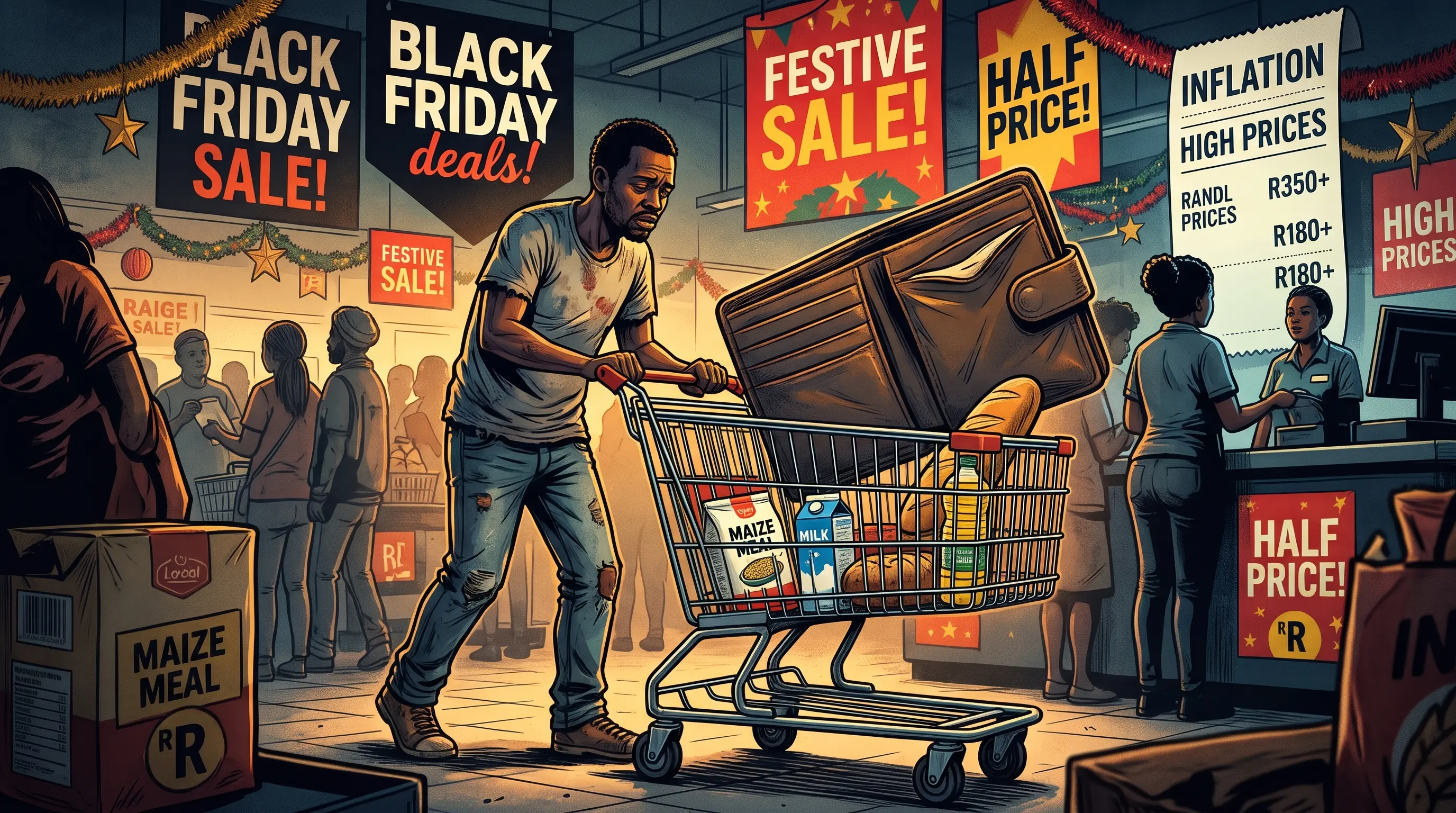
With South Africa’s festive season, marked by a heightened spending spree fast approaching, the Pietermaritzburg Economic Justice and Dignity Group (PEJDG) has warned consumers to be extremely careful in how they spend their money.
This, amid indications that food prices are set continue increasing.
According to PEJDG programme coordinator Mervyn Abrahams, soaring food prices are likely to lead to a deepening affordability crisis for consumers.
“When South African consumers face upcoming Black Friday or end of the year celebrations coming up quite soon, they should be careful in how they spend money.
“We should budget - not just buying whatever we see, but only what we really absolutely require, because prices will continue to increase.
“That is the projection and for that reason, the affordability crisis will only deepen,” warned Abrahams.
“The PEJDG September study found food prices outstripping income, with the food basket tracked standing at R5,488 and six cents, whilst a national minimum wage was R5,078 and 64 cents,” added Abrahams.
The PEJDG food price caution comes as the latest Festive Trading Gap research published on Monday by the Brand Journal – part of the world marking of the Global Entrepreneurship Week (GEW) – has reported a surge in retail sales.
Observed from 18 to 22 November, under the theme “Entrepreneurs Thrive Here”, the focus of this year’s GEW is on “building locally and scaling globally”.
The event is celebrated across over 180 countries, with thousands of live, virtual and hybrid events - connecting founders, investors and policymakers.
In terms of its key outcomes, the Festive Trading Gap research found that, after removing price changes, retail sales in November 2025 were about 23% above an average month - from January to October, with December figures standing above 45%.
“Together, the two months made up 21.1% of the whole year's retail sales.
“The festive season is already underway and it is the hardest stretch of the year for many households,” said the study.
In a national survey of more than 5 400 people, respondents singled out December and January as the hardest months for their budgets.
A monitored household food basket cost R5,512.53 in October 2026, with communities together starting saving early.
About a third of township residents surveyed, belonged to a stokvel or group savings scheme.
One national wholesaler served more than three times its usual number of stokvel customers in December - many of them on orders placed in November.
“Spending is growing close to home.
“In one payment company's data, festive spending through card machines in Soweto rose 35.2% - the largest single contribution to its festive growth,” said the report.
Phones, it said, were “part of shopping and data costs shape it”.
In the 2026 survey, 41% of township residents said they had ordered from a business in their area by phone and 37% said data costs sometimes or often stopped them engaging with brands online.
The report also sets out the full festive calendar to 7 January 2027 and the rights that shoppers hold through the season under South Africa's Consumer Protection Act.
This included the right to choose a refund when an item bought in advance runs out and the rule that a "was" price on a Black Friday or Christmas sale label should be a price the shop really charged.
Lindsay McDonald of Brand Journal, said the festive season was “often a time when household budgets come under pressure and neighbourhood shops play an important role in local communities”.
“This report brings together the evidence on that period, making it freely available so that households, shop owners, holidaymakers and policymakers can make informed choices," said McDonald.
The report said South Africa's biggest shopping season started in November and it was “often the tightest stretch of the year for household budgets”.
It has brought together latest figures on festive spending, stokvels, household costs and shoppers' rights in South Africa - from Black Friday to the January school run.
The report can be sourced from: https://brandjournal.co.za/reports/festive-trading-gap/