


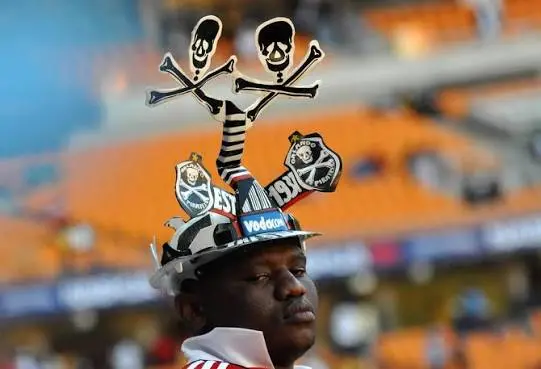
The Soweto Derby between arch-rivals Kaizer Chiefs and Orlando Pirates is more than a Premier Soccer League fixture. It is the purest expression of South African football’s heritage, its resilience through difficult times and its enduring ability to command attention far beyond the country’s borders.
Every time the black-and-white of the Buccaneers and the gold-and-black of the Amakhosi fill the stands at FNB Stadium, the world is reminded that the game’s deepest roots in this country produce its most compelling theatre.
The rivalry began on 24 January 1970, just 17 days after Kaizer Motaung formed Kaizer Chiefs after his departure from Orlando Pirates.
What started as a third-place play-off in the Rogue Beer Cup ended 6-4 to Pirates and lit a fuse that has burnt for more than half a century. Chiefs, built by a Pirates legend who had returned from the North American Soccer League, embodied ambition and a new professional energy.
The split created an intensity that has never faded. Matches quickly became social events that drew supporters from across South Africa and neighbouring countries. In the apartheid years, when formal political expression was heavily restricted, the derby offered a rare public space for collective emotion, identity and pride. Football became a language of resistance and belonging — and the Soweto Derby its most eloquent dialect.

That cultural weight remains intact. Modern derbies attract crowds that routinely push past 80 000. Fans travel from every province and from Lesotho, Eswatini, Botswana, Namibia and Zambia. The stands explode with colour, song and choreography that few other African fixtures can match. Supporters sit in mixed sections more often than not, a living demonstration that fierce rivalry need not equal permanent division.
The fixture has evolved from periods of volatile violence in earlier decades into a safer, more celebratory spectacle, yet it has never lost its edge. It continues to dominate local television ratings, regularly outdrawing even major rugby Tests in pure viewership numbers inside South Africa.
The numbers on the pitch tell their own story of competitive balance. Across more than 180 meetings in all competitions since 1970, Kaizer Chiefs hold a narrow overall lead with about 75 victories to Orlando Pirates’ 49, with around 54 draws. Goal tallies have historically favoured Chiefs by a similar margin. Individual records add colour: Pule “Ace” Ntsoelengoe remains the all-time leading scorer with 19 derby goals for Chiefs, while Happy Jele holds the appearance record for Pirates. The biggest winning margins stand at four goals. Chiefs’ 7-3 in 1972 and 5-1 in 1975, matched by Pirates’ 5-1 in 1990. Recent seasons have swung towards the Buccaneers in league meetings, underlining that history never grants permanent advantage. Every derby feels like an open contest.
Both sides entered this week’s build-up with Carling Knockout Cup victories that provided contrasting messages from their coaches. Kaizer Chiefs coach Fernando da Cruz saw his side defeat TS Galaxy 3-0 at FNB Stadium, a result he described as important for confidence but far from perfect.

“Yes it’s the game that we wanted to win for confidence but if you analyse well, it’s not our best game. We have played better games before,” Da Cruz said.
He pointed to improved efficiency in front of goal as the key difference and expressed hope that the win would serve as a springboard.
“Today we made a good game but sometimes we made a better game, and we didn’t win and I hope that now it’s the starter for us to keep confidence and we continue on this way … We’re having confidence in our model game but not in the efficiency and I hope we get ready… we will prepare the game for this Saturday.”
Orlando Pirates coach Abdeslam Ouaddou was far less satisfied after his team’s 3-0 win over Milford FC.
“The positive point, I think, is the win. I think I will only retain this victory because I was not happy about how we played,” he said. “We didn’t have the control, we had a lot of precipitation, we were selfish. A lot of players were selfish. Instead of giving the ball to the teammate to score and they are not in a bad position they shoot. There was a lot of wrong decision-making.
“The positive point is these three goals and the clean sheet but to be honest, if we want to dream bigger, when I say dream bigger, it is to win the Betway, win the Champions League… I think if we continue like that, we’re going to win nothing… So, I was not happy about the game.”
What elevates the fixture beyond domestic importance is its consistent international broadcast footprint. SuperSport’s coverage of the Betway Premiership ensures the match is available across sub-Saharan Africa via DStv and GOtv platforms.
Beyond the continent, the derby has been beamed for years to audiences in the United States (through ESPN platforms reaching tens of millions of households), the United Kingdom and Ireland, Australia, New Zealand, the Caribbean, Latin America (including Brazil), the Middle East, North Africa and Southeast Asia (Singapore, Vietnam, Thailand, Hong Kong, Indonesia and others).
Delayed and highlights packages have further extended reach into parts of the Indian subcontinent and additional Asian markets. While exact rights packages shift season by season, the pattern is clear: when the two Soweto giants meet, cameras and satellite trucks treat the occasion as a global product.
This international visibility matters. South African football has long punched above its weight in producing talent and passionate support, yet it has sometimes struggled for sustained global recognition compared with North African or West African leagues. The Soweto Derby acts as a regular reminder of the quality, drama and cultural depth that exist here. It showcases the technical skill of players who often progress to Europe, the tactical evolution of coaches who import and adapt ideas and above all the unmatched atmosphere generated by supporters who treat the match as a festival. In an era when African football is gaining greater commercial and media attention, the derby remains one of the continent’s most reliable ambassadors.
As another Soweto Derby approaches on 31 October at FNB Stadium, the familiar ritual repeats. Tickets are sold out. Studio analysis intensifies. Diaspora communities gather around screens from London to Atlanta to Perth. On the pitch, 22 players will contest three points. Off it, millions will watch a spectacle that has never stopped representing something larger than the scoreline.
In showcasing the passion that first took root in the townships more than half a century ago, the Soweto Derby continues to place South African football firmly on the global stage, loud, colourful, competitive and unmistakably its own.