


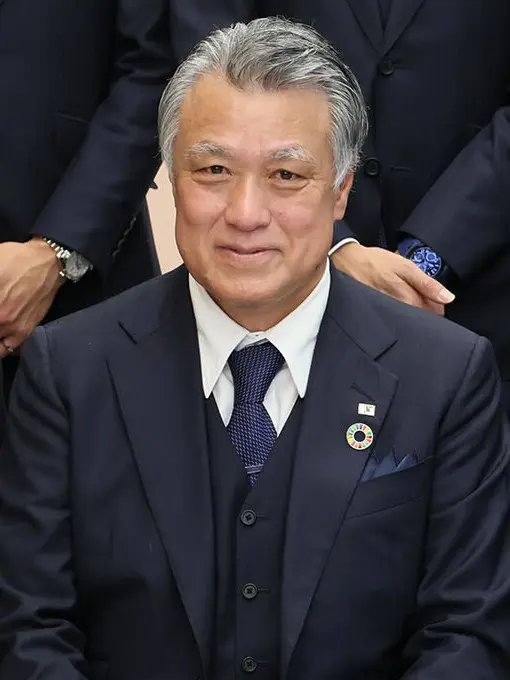
Japan Football Association’s (JFP) honorary president Kozo Tashima formally entered the race for the FIFA presidency on 17 November 2026, becoming the first Japanese candidate to challenge Gianni Infantino. He has since subsequently taken a big step to strengthen his ambition. On the 17th the JFA submitted his nomination letter to FIFA, confirming he has secured the backing of five national federations which is the minimum required to stand. Tashima, who has not yet named the supporting associations, told reporters he will reveal them later. The election is scheduled for 18 March 2027 at the FIFA Congress in Rabat, Morocco.
The 68-year-old former Japan international (seven caps) and long-time FIFA Council member since 2015 frames his campaign around a clear philosophy. Governance and transparency come first. “First and foremost, I believe it is essential to establish proper governance and ensure that transparency is firmly maintained. We must get that right first. Then, on top of that, various policies can be put forward,” he has said. His broader platform rests on the values of sincerity, soundness, fair play and integrity. These are principles he associates with Japanese football’s development. He has repeatedly spoken of making FIFA “a healthier and more trusted organisation” that prioritises the game itself over commercial excess.
Tashima rates his own chances realistically low, at around 20 to 30 percent at the outset, while expressing determination to raise that figure through the campaign. He is self-funding the effort and positions himself as a low-profile, consensus-oriented alternative to the high-visibility style of the incumbent.
Tashima has described his approach as guided by “samurai spirit” and selflessness. He wants to safeguard football so that it remains loved and accessible to everyone, reviewing FIFA’s systems to rebuild good governance and put “football first.” He has been openly critical of Infantino’s abandoned plan to sell stakes in major competitions, including World Cup commercial rights, to private investors, calling the proposal flawed in both process and substance. In his view, the sport’s integrity must not be subordinated to business interests. “It’s not about winning or losing but about conveying to the world the honest, sound and upright attitude that Japanese football has built,” he stated when declaring his candidacy. “What FIFA needs now are these values.”
In a significant development, Tashima has opened discussions with French Football Federation president Philippe Diallo, who has emerged as UEFA’s candidate and is also challenging Infantino. Diallo has publicly called for the opposition to unite forces, stating that those who share the same vision of football should come together. He has confirmed that contact had already been made with Tashima.
Tashima has responded positively, saying he is prepared to hold talks and would listen with an open mind if the question of a joint candidacy or closer cooperation arises. He has noted that they are aligned on key points, though he has also stressed the need to consider the most effective tactical approach to defeating the incumbent.

The arithmetic of FIFA elections makes any challenge difficult, and Africa’s role is decisive. The Confederation of African Football’s (CAF) 54 member associations represent more than a quarter of FIFA’s 211 voting members. It’s the largest single continental bloc. Africa has consistently backed Infantino throughout his tenure, as it did when Sepp Blatter was at the helm of FIFA. In October 2026, CAF president Patrice Motsepe announced that all 54 associations had given Infantino their “unconditional support,” citing the substantial increase in FIFA funding and development projects delivered to the continent under his leadership. Africa holds the key. Infantino has channelled significant resources into African football through programmes such as FIFA Forward and many associations credit him with tangible improvements in infrastructure and opportunities.
This solid African backing has long been a cornerstone of Infantino’s political strength. Because each member association holds one vote regardless of size or footballing pedigree, Africa’s 54 votes form a powerful foundation. When combined with support from other regions, they make it extremely hard for a challenger to reach the simple majority required. For Tashima, Diallo and any other candidates, the implication is stark: without fracturing or significantly eroding Africa’s loyalty to Infantino, the path to victory remains narrow. Africa’s numerical weight means the continent is effectively a kingmaker. As long as that bloc remains united behind the incumbent, the status quo is heavily favoured.
Tashima’s candidacy, as well as the emerging dialogue with Diallo, still matters. It forces a public debate about governance, transparency and the balance between commercial growth and the sporting values of the game. Whether or not a united challenge ultimately materialises, his emphasis on integrity and institutional health has placed those issues firmly on the agenda ahead of the March 2027 Congress.
Let the campaigns begin.