

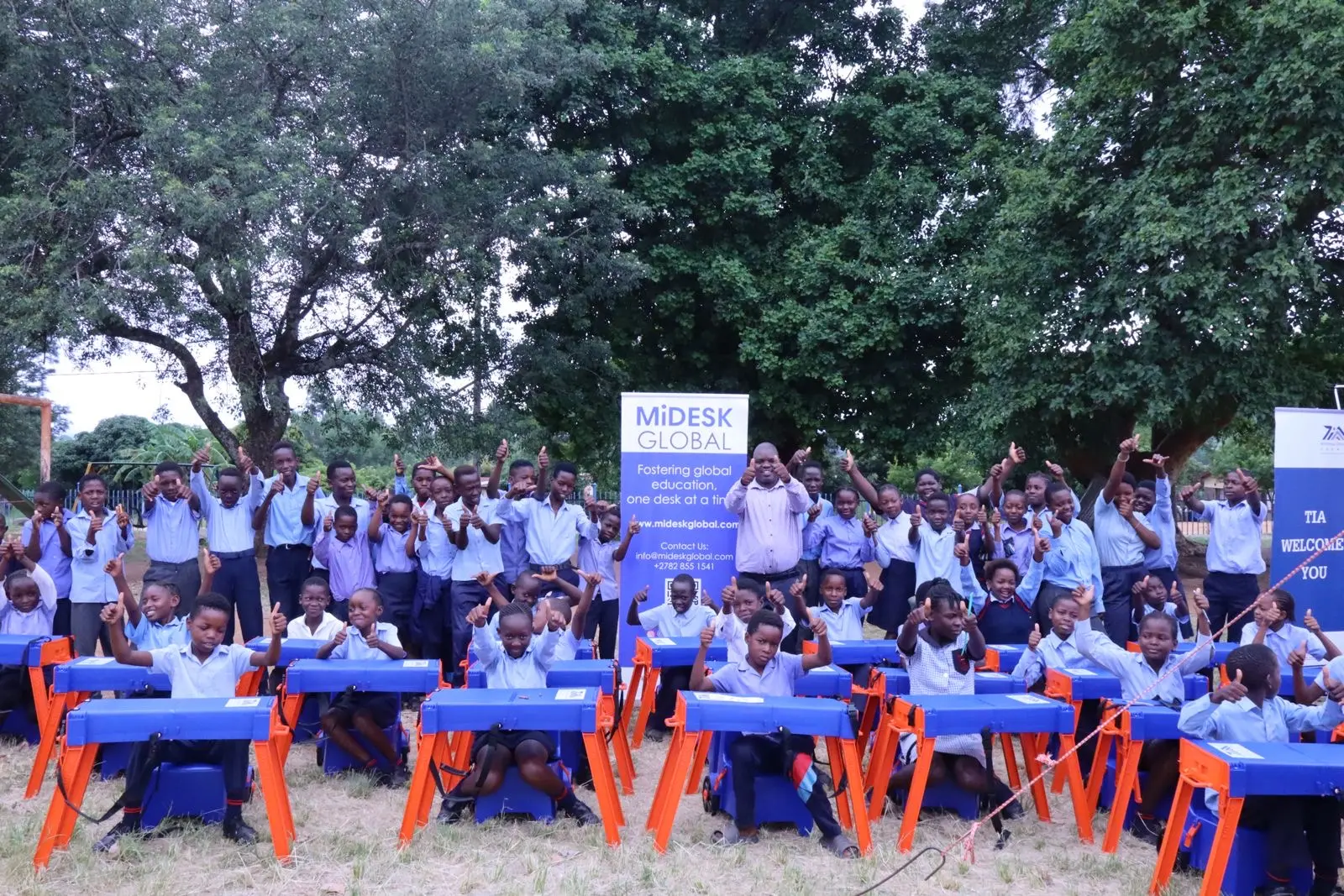
As countries around the world recognise World Youth Skills Day under the theme "Skills for a shared future," South African social enterprise, MiDesk Global, is calling for greater attention to one of the most overlooked barriers to skills development in the country: millions of children learn to read and write while sitting on the floor, with no access to a desk.
Observed globally on 15 July, World Youth Skills Day focuses on equipping young people with skills for employment, decent work and entrepreneurship, but MiDesk Global says that conversation can't begin without addressing a more basic barrier first.

Talita Boodhram, co-founder and Chief Impact Officer at MiDesk Global confirms an estimated 2.4 million South African learners still don’t have access to a school desk. Across Africa, over 95 million children do not have proper desks or chairs. “A desk is a basic learning tool that not only underpins literacy, concentration, critical thinking and the skills needed for future employment but also provides an important sense of dignity to learners.”
“Literacy is often a hard-won achievement when school children don’t have the basic tools they need to learn,” says Boodhram. “Imagine having to sit on a cold, hard or muddy floor while you’re balancing a book on your lap and trying to write on an uneven surface? No child should have to learn like that.”
As developed countries strategise how to help their youth take advantage of rapidly advancing technology to develop their skills for job market eligibility, for the Global South just getting the basics of literacy right remains a core challenge, says Boodhram.
With UNESCO advocating for “a balanced set of competencies that combines technical, digital, AI, green, social-emotional and civic skills with the human qualities that technology cannot replace”, Boodhram says South Africa cannot build a future-ready workforce while millions of learners lack a basic place to learn.
An investment in South Africa's future workforce
MiDesk Global, endorsed by UNESCO, isn't arguing against the goal. It's arguing about where the starting line is. “We have to accept that a successful career starts in the classroom, where children learn to read, write, solve problems and think critically,” says Boodhram.
She points to statistics highlighting that only 30% of Grade 1 to 3 learners are reading at grade level in their home language, meaning seven out of every ten children are falling behind during the most critical years of learning.
“This early learning gap is not only an education concern, but an economic warning sign. The foundations of employability are laid long before matric, a learnership or a first interview. They are set in the early grades, when children form the confidence, habits and abilities on which every later skill depends,” says Boodhram.

Desks create conditions for learning and thinking
While South African youth unemployment among those aged 15 to 24 at 60.9% is often described as a jobs crisis, MiDesk Global says it is also a pipeline crisis.
“A desk is one of the earliest investments we can make in a child’s future employability,” says Boodhram. “You cannot build a digital economy if children have nowhere to learn to read and write. Desks create the conditions needed for acquiring literacy, confidence, concentration and critical thinking, which are the foundational skills every employer depends on.”
Boodhram wants South Africa’s skills development conversation to start with the fundamentals. “Basic skills development does not start with coding classes or technical training. It starts with literacy and numeracy, and those skills are developed in classrooms equipped for learning, where every child has a desk.”
She explains that there is a positive association between education and GDP per capita, “The estimated impacts vary between studies, but the median value is that one additional year of schooling is linked to an 18% increase in GDP per capita.” MiDesk Global argues that a desk, one of the cheapest possible interventions in a child's education, sits directly at the start of that return.

MiDesk’s portable, solar-powered desk-and-chair solution is a practical intervention in the space between need and delivery. And for learners who study in crowded homes, walk long distances, or live where electricity is unreliable, the desk becomes part of a broader learning ecosystem. It follows the child from school to home - extending the classroom into the evening through solar light, helping turn intention into routine, and routine into progress.
“Every desk, chair and learning space contributes to the human capital our economy depends on. If South Africa is serious about building a future-ready workforce, improving productivity and driving inclusive growth, we must widen the lens on what skills readiness actually requires and invest in the foundations that get our youth to the starting line. Otherwise, today’s empty desks will become tomorrow’s empty CVs,” concludes Boodhram.
A desk is more than classroom furniture. It is where futures are built.
Help us fill the blank spaces.