

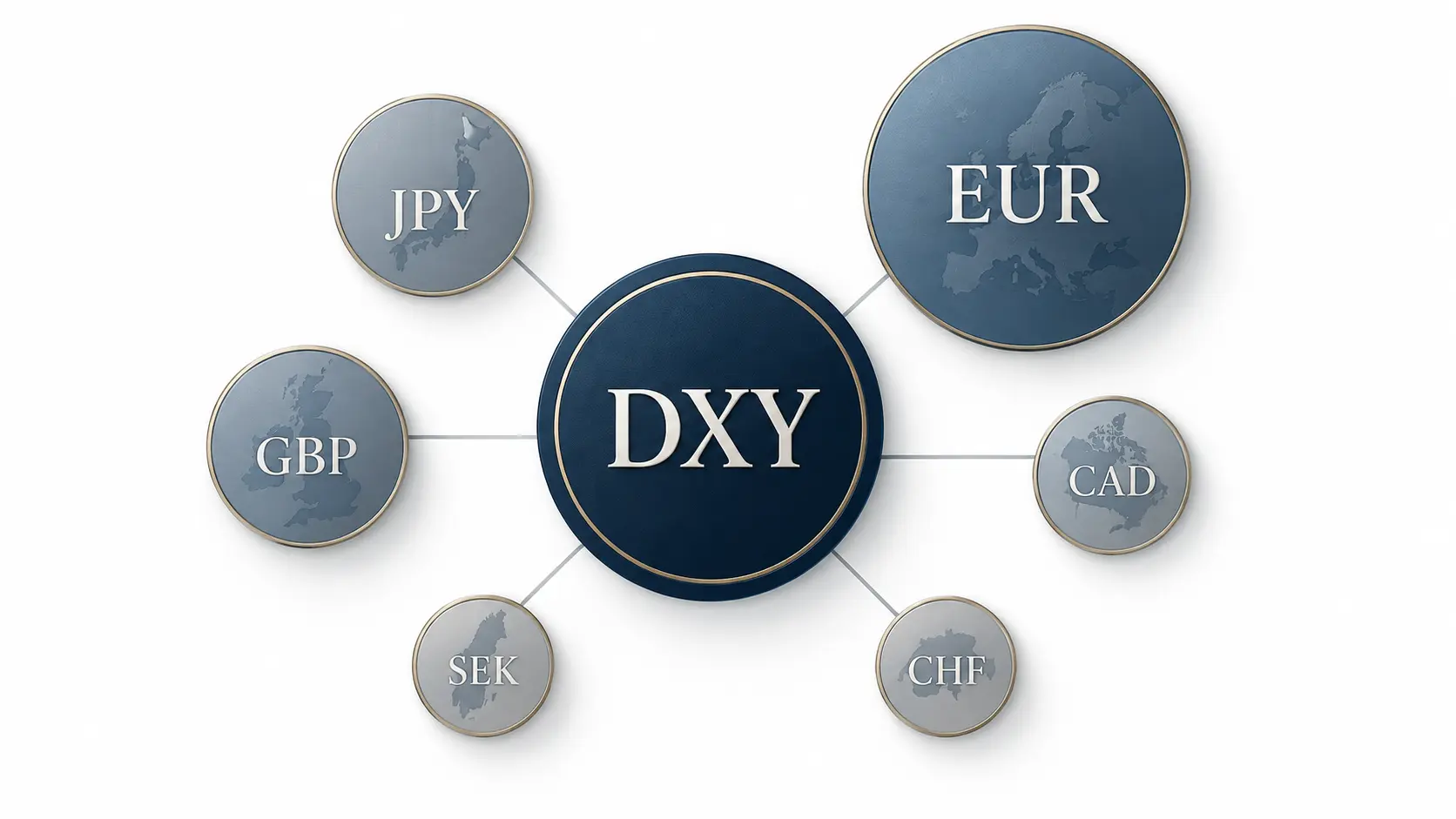
The US Dollar Index, usually called DXY, is one of the market’s most widely followed indicators of dollar strength. But it is not a measure of the dollar against every major currency — and it does not include the South African rand.
DXY tracks the dollar against a fixed basket of six currencies. The euro makes up more than half of that basket, which is why EUR/USD often has the biggest influence on moves in the index.
The six currencies inside DXY
ICE, the administrator of the US Dollar Index, uses the following fixed weights:

The euro’s 57.6% weighting is larger than the combined weight of the other five currencies. In practical terms, a significant move in EUR/USD can move DXY even if the other currencies in the basket are relatively stable.
Why EUR/USD and DXY often move in opposite directions
EUR/USD shows how many US dollars are needed to buy one euro. If EUR/USD rises, the euro is strengthening against the dollar; that usually puts downward pressure on DXY. If EUR/USD falls, it often supports DXY.
This is not a perfect inverse relationship. The other five currencies still matter, particularly around central-bank decisions, major economic data or risk-off moves.

The ICE methodology reflects these quote conventions: EUR/USD and GBP/USD enter the formula inversely, while USD/JPY, USD/CAD, USD/SEK and USD/CHF move in the same direction as the dollar.
What DXY does not measure
DXY is not a complete measure of global dollar strength. It does not include the rand, Chinese yuan, Indian rupee, Mexican peso, Brazilian real or Australian dollar.
That matters for South African readers. A rising DXY does not automatically mean USD/ZAR will rise by the same amount — or even move in the same direction. The rand can be influenced by commodity prices, local inflation, fiscal policy, electricity-supply developments and shifts in appetite for emerging-market assets.
For a broader trade-weighted measure, the US Federal Reserve maintains a broad dollar index covering currencies from 26 economies. DXY remains popular in market commentary because it has a long history and is widely traded, but its basket is narrower.
A fixed basket with a long history
DXY was introduced in 1973. Its composition has changed significantly only once: in 1999, when the euro replaced several legacy European currencies, including the Deutsche mark and French franc.
The fixed structure gives the index consistency across decades. It also means DXY does not automatically adjust as global trade patterns or emerging-market currencies become more important. ICE’s USDX materials explain the benchmark’s fixed-composition design.
How traders access DXY and which costs matter
DXY can be followed as a benchmark, traded through exchange-listed futures, or accessed through derivatives such as CFDs. The product differs, but traders normally need to review spread, commission where applicable, overnight financing and execution conditions.

For an example of how a retail provider presents the instrument, the Exness DXY page includes a chart, product information and current trading-condition context.
The takeaway
DXY is the dollar against six fixed currencies, not the dollar against the entire world. Its high euro weighting means EUR/USD is central to understanding most moves in the index.
For South Africans, DXY can be a useful signal of broad developed-market dollar sentiment. It should not, however, replace analysis of the specific factors that drive USD/ZAR.
¹ Comparison conducted during the week of 29 March–4 April 2026, using the tightest spread-only account available from each of ten brokers. Past comparisons do not guarantee present or future conditions.
² Spreads, execution and financing costs can change with market conditions and the account or instrument used.
³ This article is for general information only and is not investment advice. Leveraged products, including CFDs, carry a high risk of loss.