

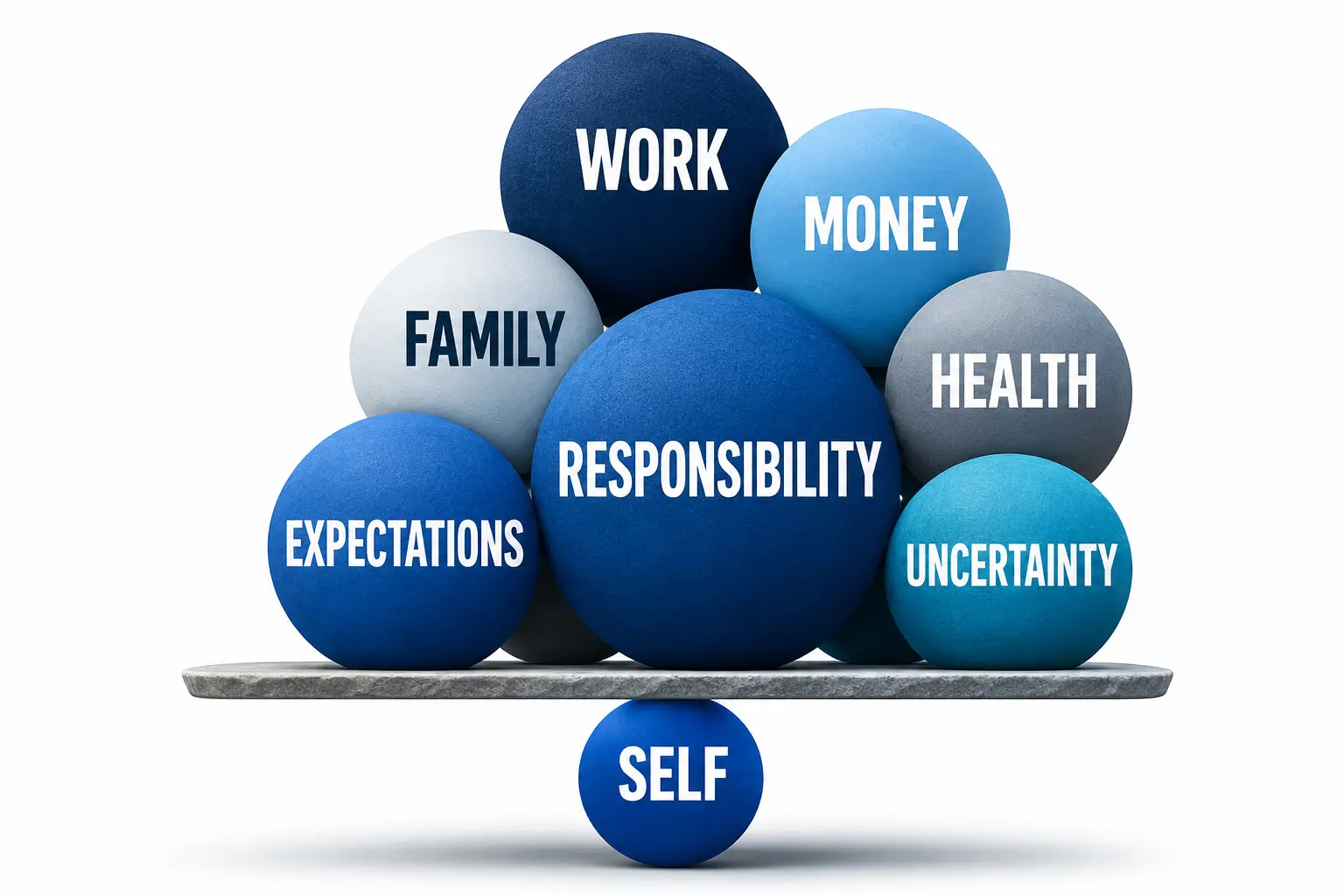
As International Men’s Day approaches on 19 November, MY SECOND50 continues its four-part exploration of men in midlife. This article examines the pressures men navigate, why silence is more complicated than it appears, and what meaningful support requires.
When pressures converge
A parent needs medical care. An adult child cannot find work. Household expenses rise. Retirement savings look inadequate. Employment becomes less secure. None of these challenges is unusual. Together, they can be overwhelming.
Midlife for men can bring simultaneous demands from younger and older generations, alongside changes in health, relationships and earning capacity. The room to recover from setbacks may also be narrowing. Retrenchment at 55 can mean greater financial obligations, fewer re-employment opportunities and less time to rebuild savings than at 25. Experiences vary, but the convergence matters.
Expectations, meanwhile, do not necessarily adjust. The person who has always provided may still be expected to provide. The one who has always solved problems may find it difficult to admit that he now needs help.
The contradiction at the heart of midlife
South African men in midlife encounter a difficult contradiction: expectations of provision and independence persist in an economy that cannot guarantee secure work or adequate income. A man unable to meet family needs may interpret a structural economic problem as personal failure.
Responsibility matters, but it cannot be separated from resources. Financial strain can lead someone to postpone treatment, continue working through exhaustion or conceal difficulties for fear of disappointing others. Economic pressure becomes relational, psychological and physical.
The point is not to deny individual agency. It is to recognise its limits when the conditions needed to exercise it are absent. Encouraging resilience without addressing those conditions can place yet another demand on the person already under strain.
When stress becomes a way of life
Stress can mobilise action. The danger is prolonged pressure without sufficient control, recovery or support. Sleep deteriorates; concentration falters; irritability strains relationships. Reduced connection then leaves fewer resources to manage the original problem. A financial setback can become a cycle of declining wellbeing.
South African Medical Research Council (SAMRC) reporting has highlighted a substantial male–female disparity in suicide mortality. A 2025 publication reported an estimated male suicide rate around 4.4 times the female rate, based on 2020/21 data. Suicide has multiple interacting causes: this statistic cannot establish that silence, masculine expectations or midlife itself caused those deaths. It does, however, underline the need for timely, accessible support.
THE HIDDEN COST
Approximately 4.4 times | The reported male-to-female suicide mortality rate ratio in South Africa, using 2020/21 estimates. This is not a midlife-specific figure. (South African Medical Research Council, 2025).
Why silence is not the whole story
‘Men need to talk’ is an appealing prescription, but it is incomplete. Some fear appearing weak or becoming a burden. Others lack trusted confidants, cannot name what they feel, prefer practical assistance or have previously received dismissive responses. Silence may signal distress, privacy or simply a different way of communicating. It cannot be interpreted uniformly.
Masculine norms may prevent help-seeking, but age, class, culture, relationships and personal history also matter. Nor does disclosure automatically bring relief. If a man speaks about debt and receives only encouragement, or discloses depression and encounters an inaccessible service, the invitation to speak has delivered little.
We cannot reasonably expect men, including men in midlife, to open up without asking what happens when they do.
WHAT MAKES SUPPORT USEFUL?
A trusted person who listens without judgement; practical help appropriate to the problem; affordable, accessible professional care where needed; and follow-through rather than a one-off conversation. These are principles for action, not a claim that one intervention suits every man.
The consequences extend beyond men in midlife
Unmanaged pressure can affect partners, children, colleagues and communities. Withdrawal may weaken relationships; harmful drinking may worsen household strain; conflict may escalate. None of these responses is inevitable or uniquely male. Crucially, distress never excuses intimidation, coercion, abuse or violence.
Redefining strength
Strength need not mean endless endurance. It can mean recognising that an old coping strategy no longer works, seeking healthcare, renegotiating responsibilities, repairing relationships or asking for financial guidance. These are acts of agency, not surrender.
Yet individual behaviour change is insufficient. Employers can offer meaningful transition assistance and psychologically safer workplaces. Health services can reduce barriers to care. Families can share responsibility more fairly. Communities can strengthen connection, mentorship and mutual support. Men in midlife themselves can challenge expectations that make asking for help feel unacceptable.
A QUESTION WORTH ASKING
Is strength measured by how much a man in midlife can endure alone, or by how responsibly he recognises and responds to his need for support.
From endurance to thriving
MY SECOND50 approaches midlife through the challenges people face and the resources that help them thrive. The goal cannot be merely to help men in midlife tolerate worsening circumstances. It must include greater agency, health, connection and opportunities to contribute.
For one man in midlife, that means a credible route back into work. For another, treatment for depression. For another, rebuilding trust at home or finding purpose beyond paid employment. The right response depends on the person and his circumstances.
Perhaps we have asked men in midlife for too long how much they can carry without asking whether the weight is reasonable or the support sufficient. Giving men in midlife a voice matters. What matters equally is whether families, workplaces and institutions are prepared to listen and respond.
Strength should not require silence. Responsibility should not mean isolation. And thriving should mean more than surviving.
MEN IN MIDLIFE MATTER. LET’S START THE CONVERSATION NOW.
CONVERSATIONS THAT MATTER
Let’s talk about men in midlife | WhatsApp 084 983 5918 or Email connect@mysecond50.info to join a series of free, facilitated online conversations for South African men in midlife this November.
ABOUT THE AUTHOR
Pravienna Naidoo is co-founder of MY SECOND50 | Midlife Reimagined, an initiative of Be Unlimited. A social worker by training, leadership facilitator and integrative nutrition health coach, she brings nearly four decades of experience in social and organisational development, workplace wellbeing, learning and personal transformation. Her work focuses on reimagining midlife as a period of human development, contribution and possibility.
For more information or to convene a Men in Midlife Conversation, Email connect@mysecond50.info or Call/WhatsApp 084 983 5918.